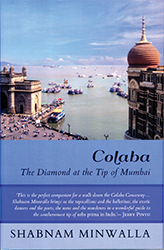
Colaba: The Diamond at the Tip of Mumbai by Shabnam Minwalla. Published in 2020 by Speaking Tiger Books LLP, 4381/4, Ansari Road, Daryaganj, New Delhi 110002; website: speakingtigerbooks.com. Pp: 178. Price: Rs 499.
The book’s dustjacket describes it as a "compelling biography.” Online news magazine scroll.in that printed extracts called it a "personal history.” Colaba is both. Having lived most of her life on the cusp between the bastion of Parsidom that is Cusrow Baug, and the Little Sind of 1st Pasta Lane, journalist and author of children’s books, Shabnam Minwalla has infused Colaba with personal anecdotes, oral histories of residents, extracts from books and records of the area, all written in a breezy style. Not without the backing of research, as the five-page bibliography will attest.

It is evident she loves this precinct, having studied in Fort Convent (wearing "beige sacks”), shopped on the Causeway and in the now tony lanes around the Taj Mahal Hotel. A fourth generation Colabawalla, she knows her bylanes and the once-quaint shops, possibly from anecdotes narrated by her grandparents and her parents (whose romance blossomed on a 6 Limited BEST bus, he a Parsi, she Bohri).
Colaba’s history before the 1600s is non-existent, avers the writer. As any class four student will parrot, Bombay at one time consisted of seven islands, including Old Woman’s Island (OWI) and Colaba. All early colonial action was on the H-shaped island of Bombay to the south of which lay OWI and further south, Colaba. Even after the British acquired the islands in the 1660s, the two southernmost possessions were pretty much left to their own devices. In fact, they do not even figure as separate land masses in the works of some early cartographers. We are told that the British East India Company preserved antelopes and beasts of delight on the islands, and later bred cattle on these parts. What with "Maharatta gallivants” hovering along the coast, the sightings of sharks and packs of jackals, the only practical purpose these islands served was to indicate to incoming vessels that they were nearing the then-growing port of Bombay. "Colaba and OWI (were) mere footnotes in the early history of Bombay,” often confused with each other or treated as a single entity, Minwalla writes.
Before the Causeway connected the island of Bombay to points south in 1838, one took a ferry at high tide to reach OWI. Minwalla points to a well-hidden secret: a stone marker within the Colaba Police Station compound that indicates the landing point of the water transport, now consigned to history books. There is no marker, however, that identifies where OWI ended and Colaba started. Minwalla speculates a narrow creek would have snaked past the current location of Sassoon Dock.
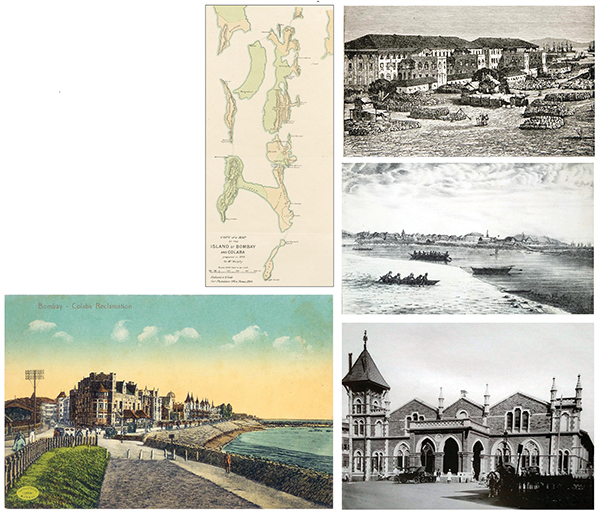
Top: Shabnam Minwalla; clockwise from above: map of Bombay and Colaba Photo: Wikimedia Commons;
the cotton market, engraving from India and its Native Princes Photo: Wikimedia Commons;
construction of the Causeway using timber, lithograph by Jose M. Gonsalves Photo: Wikimedia Commons;
old Colaba Station Photo courtesy: Rajendra Aklekar;
Vintage postcard of Colaba Reclamation Photo: Wikimedia Commons
Above left: Buildings on Merewether Road Photo: Saurab Rao; above right: an archival image of Cusrow Baug
The Causeway brought connectivity but it also created a "Dickensian hellhole” with smoking chimneys, clattering machines and factories. And then came Bombay’s great cotton boom. Minwalla fantasizes about deals in the commodity being made in carriages along the Causeway. The railway line that terminated in Colaba, with an imposing station on the site of the current Badhwar Park, was necessary to bring in cotton to the port for eventual export. Riches brought gentrification to these parts. Mass scale reclamation was necessary, which gave rise to Apollo Reclamation, the Wellington Estate (Wodehouse Road and Cooperage) and Cuffe Parade. The Cotton Green that occupied vast swathes of land along the Causeway was moved to the northern parts of the city. With that, the line between Churchgate and Colaba became redundant, and was ultimately dismantled in 1930. On the erstwhile railway sidings came up Cusrow Baug.
By 1863, the distinction between OWI and Colaba had all but gone. Quoting from city biographer Govind Narayan’s Mumbaiche Varnan (Description of Bombay) Minwalla states that "Colaba has been divided into three imaginary parts – Little Colaba from Arthur Bunder Road to the Gun Carriage (today’s fire station); Middle Colaba reaching up to the Kabul (Afghan) Church and further ahead, Upper Colaba.”
Minwalla brings alive the roaring twenties, the chic 1960s, the 1980s of her growing up years and all the intervening periods with vignettes: eating at Kitchenette, shopping in Rajsi Brothers, dancing at Slip Disc, taking dance lessons at J. J. Rodriguez. This is the part of the book that those who are not Colabawallas (or "Old Womankars”) may not relate to. Ballerina Pheroza Lally, "the tall, imposing” Ms Grant who started Scholar School, Ms Shellim and her play school, the grumpy cashier Rustomjee of Swabal Stores, would only remain names to those who are not to-the-precinct-born. The eccentric aunties of Cusrow Baug who chucked eggs at Minwalla’s brother for daring to cut through the colony may draw some laughs, though. The author brings her readers up to date, with the horrors of 26/11 and its aftermath, and how the area coped and has sprung back.
Is the encompassing peepul tree that spans Badhwar Park and Cusrow Baug and which Minwalla sees from her balcony part of the estate of one Ms Hough who danced with the Duke of Wellington when he was in Bombay? Minwalla believes that could be the case. Did Hough’s descendants sell her property to the Bombay Baroda and Central India (now, Western) Railway to erect the lines and the station? Who knows? The author states that one has heard that Badhwar Park has some traces of the old railway station’s railings or that Hough’s mango tree that fruited twice annually could still stand there. Or that the gate to a fishing wharf has been subsumed into a temple in Colaba Market. She rebukes herself and gives up looking for these fragments of history: Colaba’s past does not live in its undiscovered railings and gates, but in its easy cosmopolitanism, she states.
The one failing of the book is the poor black and white reproductions of public domain images. The Edwardian buildings off the causeway and on the erstwhile Strand Road, the quiet areas of Navy Nagar, even the shabbiness of the fish market would have made for interesting images.
A must read for those who live south of Regal Cinema (the boundary of the precinct that Minwalla draws for herself). How much Colaba will resonate with those who are not familiar with the area remains to be seen.
And finally, a disclosure: Shabnam, I think I may know who shot pellets at your window during your growing up years. It was a neighbor of this writer, who as you state in the book, now has children of his own!
FARROKH JIJINA