Calcutta chronicle
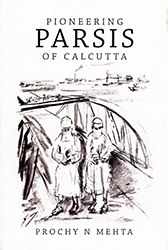
Pioneering Parsis of Calcutta by Prochy N. Mehta. Published in 2020 by Niyogi Books, Block D, Building No. 77, Okla Industrial Area, Phase-I, New Delhi 110020; email: niyogibooks@gmail.com; website: www.niyogibooksindia.com. Pp:180. Price: Rs 495.
First off, a disclosure. Two actually. One, I’m territorial about my hometown, and someone else daring to write a book on its Parsis would doubly raise my hackles. However, author Prochy Mehta (pictured) is a generational family friend, and, as it turned  out, no patronizing was necessary. The painstaking research makes up for the cut-and-dried style, and even the latter is preferable to the ‘gee-gosh’ gush that marks most of the recall of our glorious past.
Discounting author Dalia Ray’s unsatisfying earlier book (The Parsees of Calcutta), Pioneering Parsis of Calcutta, is the first proper record in English, justifying the remark of Noshir Tankariwala in the acknowledgements. The trustee of the city’s only surviving agiary, the Late Ervad D. B. Mehta’s Zoroastrian Anjuman Atash Adaran, encouraged the author with: "This book is an absolute must …not only for the present generation’s enlightenment and knowledge.”
Mehta also declares a personal agenda. But as the early feminists proclaimed, here too, "the personal is political” : the polarizing issue of allowing the children of non-Parsi fathers into the faith, and thereby its exclusive and excluding institutions.
Mehta’s case is more piquant. Her granddaughter, Samara Vyas, was among three such children from the city’s prominent Parsi families who had their navjotes performed. Subsequently, Samara was denied access to the city’s Atash Adaran. This fired Mehta to launch a determined and courageous legal battle because "I wouldn’t allow my daughter’s children to be treated any differently from the children of my son.” This book presents her research into the history of Parsi reform in the hope that it would benefit the entire community, "help it remember that change is inevitable.”
We read of the little-known Calcutta connect in the three historic storms. The 1908 Petit vs Jeejeebhoy case; the 1914 navjote of Bella, child of a non-Parsi father but later adopted by a Parsi and his non-Parsi wife, performed in Rangoon by the head priest of the Deccan and D. B. Mehta agiary; and of course the celebrated navjote of the French Suzanne Briere immediately preceding her marriage to Ratan Dadabhoy Tata.
I’m in Mehta’s camp on this issue, but my heart warmed much more to the illustrious men and women whose names, and sometimes presence, beaconed my Calcutta childhood. However, the book isn’t an incestuous orgasm just for one city and/or community. Its procession of eminences is a universal reminder of the determined, undaunted human spirit. And much more of humaneness. They rose from poverty, and left a philanthropic legacy.
 We see the range of enterprises on which Calcutta’s Parsis left their mark. Trade, of course; not only in the known opium and silks, but also Hormusjee Tangree’s Chinese preserves, colored paper and Czechoslovakian glass bangles; R. K. Modi’s empire built on the exotic Kashmiri root, kooth, which made the visiting Maharajah his house guest. The professions, yes, especially law led by the eminent barrister Padamji Pestonji Ginwalla, Bella’s lawyer in her case vs Saklat. But there’s also Dinshaw Sorabjee’s domination of railway catering ; the geologist D. N. Wadia who merited a one rupee postage stamp; Erach Bhiwandiwala, eighth son of poor parents who "rediscovered the color and oil processes of the Old Masters;” A. C. Ardeshir who cornered trophies both in History and horse racing; J. F. Madan, forced to work as a scene-shifter at age 12 at four rupees a month and became India’s biggest theater builder. And, of course, the fabled Banajis and Mehtas who, inter alia, gave the community its two agiaries. The fickle wheel of family fortunes has reduced the former bequest to a state of defunct decay, profanely encroached upon. This chapter moved me to tears; we shared a wall with the Banaji agiary, its gah-gongs marked our day, its scents of sandalwood infused our lives.
There’s a touching chapter on Seth Edulji Olpadvala who made a fortune with his Byron and Company soft drinks and donated his palatial mansion to the anjuman (the Calcutta Zoroastrian Community’s Religious and Charity Funds) during his lifetime, its trustees not realizing that towards the end he was reduced to selling bits and pieces from his collection of artefacts to pay for his daily bazar expenses. It’s the only chapter written by the late Burjor Modi, a stalwart of the Calcutta Parsee Club, which produced world class sportspersons like Asian record holder Mehta, now its first woman president.
So many of these pillars established the institutions — women’s, sporting, cultural, religious, charitable — which continue to make Calcutta’s Parsis such a cohesive community despite their numbers down to just 400, and ageing.
Ah, the second of the disclosures I mentioned at the start. It’s a confession really. I first checked if my family figured as prominently as it deserved. It did. The Navroz proudly proclaimed on its strap-line that it was "Eastern India’s only Gujarati journal,” so the story of my grandfather Edulji Kanga, who courageously founded it in 1917, and of my parents, Jaloo and Navel who edited it, kicks off the chapter on "Parsis and the Press.”
BACHI KARKARIA
Bachi Karkaria, a veteran journalist and author, is a columnist for The Times of India and MumbaiMirror.