My Life as a Traitor by Zarah Ghahramani with Robert Hilman. Published in 2009 by Bloomsbury Publishing Plc, 36 Soho Square, London WID 3QY; website: www.bloomsbury.com. Pp: 249. Price: £ 7.99.
Zarah Ghahramani and Robert Hilman: chronicling captivity, cruelty
Zarah Ghahramani’s My Life as a Traitor is a compelling account of her traumatic imprisonment in Iran’s Evin Prison. The memoir is co-authored by Robert Hilman, who has written several novels, poetry and short fiction. He won the Australian National Biography Award in 2004 for his memoir The Boy in the Green Suit. Born in 1981 to an upper middle-class family in Tehran, Ghahramani is the daughter of a Muslim father and a Zoroastrian mother. Her father was not an ‘old savaki,’ as the interrogator refers to him; though he was a high ranking officer in the Shah’s army, he was not a fanatic nor a killer. Her mother, like all mothers, wanted her to marry comfortably and live a peaceful life surrounded by several children in a cottage with a rose garden.
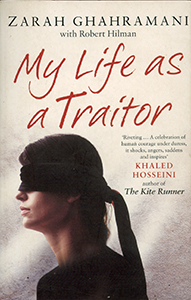
But that was not to be. The reader is plunged directly into Ghahramani’s rough and terrifying interrogation in Tehran’s notorious prison where she has been imprisoned on account of her relatively active role in student politics. She is blindfolded at first and, when this is removed, she is faced with a frightening tall, fat, stinking man. The initial questioning though intimidating is not physical. However, this soon changes and the torture begins. She is given a set of photos and asked to write whatever she can remember about them. These are photos of Ghahramani with her friends and Arash Hazrati, a leader of the protests at the University, a teacher and a friend. When her replies are not to the interrogator’s satisfaction, he hits her with a studded belt, the blow of which sends her flying from her chair with blood flowing from the welt.
On a second occasion, she is given a ludicrous confession to sign. When she refuses to do so she is slapped, her hair is cut and her scalp shaved. She feels humiliated "like an animal in the hands of a man who could shear me or cut my throat with equal unconcern.” She is assaulted, hitting her chin against the edge of the table. As a result, her chin splits open.
At one point, a lady prison warden makes sexual advances. When Ghahramani is terrorized by her behavior and escapes by pushing her aside, she is caught by some male guards who beat her viciously. They kick her repeatedly in her stomach and then lift her up only to jam her against the wall to beat her with their fists.
While the author is in prison, she thinks of happier times and these memories make her present situation even more horrifying and pathetic. Even as a child, she shows signs of being unwilling to fit the norm. Her father bought her a pair of pink shoes with an artificial flower of a darker shade. This expressed, in a way, the world in which she wanted to live. She is not an idealist shouting "Utopia or death;” all she wants is to live her life with freedom, and on her terms. This is also shown in her relationship with Behman, who comes from an affluent family "very close to the régime.” True to his character, he insists that, for a party, she dresses in a conventional manner which is anathema to her. She does comply with this request against her will merely to please him, but this results in the relationship coming to the expected end.
She has long conversations through the ventilation grill with Sohrab, who is a prisoner in a cell above her. His story is extremely heart wrenching as well. He was a surgeon who fell in love with Leila, his patient. He discovered that the administrator at the hospital was helping himself to large amounts of money. To discredit him, the administrator lodged a complaint that he was a drug addict, an accusation which was corroborated by Leila. When he saw his boss flirting with Leila during the trial, his anger knew no bounds and he took his revenge by murdering him. To his great regret, Leila escaped. For this crime, he has been in Evin for such a long time that he now has come to know how exactly the prison works, who the guards on duty are, at what time, and whether they are sympathetic or cruel.
The effects of captivity and the cruelty of the interrogators make a sea change in Ghahramani’s character; she moves from sadness and anger to compelling thoughts of murder. She studied Freud and realizes that these are dreams of impotence; nevertheless, she is obsessed with "fantasies of revenge, fantasies of power” and clearly emphasizes that "this is the sort of corruption that violence breeds in its victims.”
Ghahramani’s ordeal lasts a month after which she is set free and abandoned on the outskirts of Tehran. We understand from the brief biography of the author that she now lives in Australia. Is she a traitor because she opposed the régime or is she one because, under duress, she at one point names her friends in the photographs in front of her? Perhaps eventally it is insignificant; what is evident is that she is a "champion.” It is only at the end of the memoir that Sohrab calls her champion and we are told that he was making a pun on ‘Ghahramani’ which signifies ‘champion.’ That she is a champion, there is no doubt.