While Parsis settled in Rawalpindi only during the British Raj,
Zoroastrianism had a presence in the region from the first century BC
Ammad Ali
Until the mid-19th century there was no Parsi connected with or living in Rawalpindi. That changed with the establishment of a British garrison there. With the colonial military presence came Parsis who put down roots in Rawalpindi, ran their businesses and supplied goods to the British Army.
One such Parsi trader who came to prominence was Dhanjibhai Fakirji Commodore (name also spelt as Dhanji Bhoy or Dhanji Bhouy in some references). A famous trader and a philanthropist, he later earned the title of Khan Bahadur and was conferred the Kaisar-i-Hind first class gold medal in 1895. Commodore established the first public library of Rawalpindi at Massy Gate — the latter being named after the first commissioner of Rawalpindi. The library was funded by the contributions of a Jain trader. This was the Commodore Dhanji Bhouy Jain Public Library.
Commodore started a tonga (horse cart) service between Rawalpindi and Srinagar. He also launched his Tonga Ambulance during World War I and was known for his loyalty to the British during the Afghan Wars, the Boer War and the Boxer Rebellion. The tonga stand was in the Saddar area of the city. Every seven to eight miles, he had provided for a station where the tongas of his service could find a change of horses. In this way he ran a well-equipped tonga-based mail and carrying agency called Dhanji Bhoy & Son.
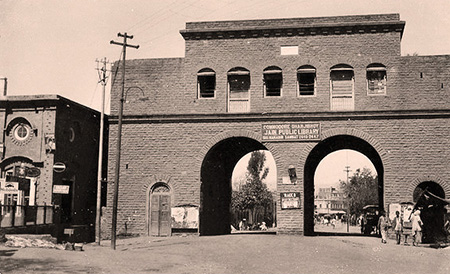
Commodore Dhanji Bhouy Jain Public Library in Rawalpindi
Structure at the Parsi aramgah
This service brought about a drastic change in communication. The journey from Rawalpindi to Srinagar, the capital of Kashmir, involved covering a distance of some 200 miles. Earlier it would take about 14 days but could now be completed in a mere 24 hours. This tonga service and a pony-drawn Tonga Ambulance, also bailed the British out of tight situations during their wars.
The Khan Bahadur had a vivid personality and wore many stylish hats. He was a governor of the Hindu Technical Institute in Lahore and remained a member of the Murree Municipal Committee for nearly 25 years and its vice president for about 12. He was honorary magistrate of the district of Rawalpindi, exercising first class powers for about nine years. In addition to several other positions, he was also appointed a lifetime honorary member of the Calcutta Light Horse regiment. He had also expanded his business interests and bought land and property in Bombay.
An immensely wealthy, popular and successful man, Commodore was bestowed the title Companion of the Most Eminent Order of the Indian Empire. He had a son and three daughters. He breathed his last in 1911.
After the 1947 Partition, many Zoroastrians moved to Bombay, the city with the largest population of Parsis in the Indian subcontinent. The total number of Parsis in Rawalpindi during Partition was around 200.
Rawalpindi had a wine factory run by a Sikh. The famous Murree Brewery was founded by two Britons named Edward Whymper and Edward Dyer in 1860. In the 1880s the Brewery moved to Rawalpindi. Peshotan Bhandara bought the company in 1947. Hailing from a Parsi family of Lahore, Bhandara moved to Rawalpindi. After Partition, he was able to carve for his enterprise a big space in the alcoholic beverages industry of the newly independent state. After his death in 1961, his 23-year-old son Minocher left his education halfway at Oxford University to take charge of the family business. Minocher was a commerce graduate from Punjab University and made a name as the dynamic managing director of Murree Brewery and brought in much innovation. His efforts at promoting art and culture resulted in his opening the Croweaters Gallery in Lahore. He was a member of the National Assembly from 1981 to 1985 and 2002 to 2007 and also a columnist with the newspaper Dawn. He was a firm believer in a democratic Pakistan where all citizens are equal regardless of their beliefs. During his 2008 visit to China he met with an accident and died soon thereafter, at the age of 70.
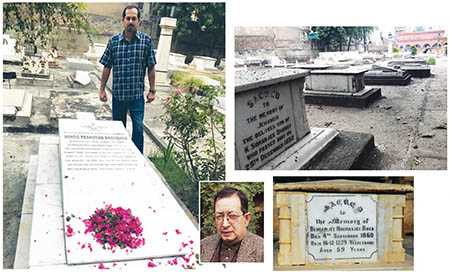
Clockwise from : Isphanyar Bhandara standing next to his father Minoo’s grave;
tombs at the Parsi cemetery; epitaph on the grave of Behramjee Hormasjee Boga; Minoo Bhandara
Talking about the Zoroastrians’ legacy and contributions to Rawalpindi, president of the Parsi Anjuman Rawalpindi and member of the National Assembly of Pakistan (NAP), Isphanyar Bhandara says, "Being a representative of Zoroastrians and Kalash community in the NAP, I always stood and raised my voice for the minorities’ rights. If we look at the history of Rawalpindi we will find a pluralistic society based on the values of coexistence and tolerance. Today there are around one dozen Parsis living in Rawalpindi. In recent years, Parsis from the subcontinent are leaving Pakistan for North America and Europe. This is not because they feel insecure but for better opportunities and living standards. Parsis contributed a lot to the progress of our country, being a wealthy community and active in social work. As the number of Parsis is dwindling, it’s sad that land-grabbers around the Zoroastrian cemetery are trying to erase this heritage site of Rawalpindi. This would be a huge blow to diversity in the city.”
Today the names of Zoroastrians who once lived in Rawalpindi can be seen on the epitaphs of graves in the cemetery adjacent to Murree Road. The engraving on the tombstones is fading. Soon, one day, we might find it erased. But the contributions of Zoroastrians to this city will always be written in words of gold.
Relocating in Rawalpindi
After the annexation of Punjab and its incorporation into British rule, the present cantonment in Rawalpindi was first occupied by troops of the 53rd Shropshire Regiment of Foot in 1849. Later, during his visit to Punjab in 1851, Lord Dalhousie declared Rawalpindi a permanent station for the troops. Rawalpindi, by virtue of its geography, was ideally positioned to provide commanding access to the North West. Soon after the establishment of the cantonment, the town had grown into a city: a new thriving center for traders who came from different parts of India, employees and craftsmen, providing relatively equal and bright opportunities for all. People from very different cultural and linguistic backgrounds made Rawalpindi their home. The life of the city turned over a new leaf: for the first time locals heard English and Gujarati being spoken. They were introduced to Framji, Dhanji and Behramji, Parsi names they had never dealt with earlier. Christians, Jains, Bohras, Buddhists, Jews and Parsis settled in Rawalpindi. The canvas of the city became colorful and a more pluralistic society emerged.
Parsis might have been new to Rawalpindi, but they have a long history associated with the Pothohar region, dating back to antiquity when Gandhara was a province of the great Persian empire. (Rawalpindi is located on the Pothohar Plateau.) The legacy of those times still exists near Rawalpindi: for instance in the Jandial Zoroastrian fire temple, a first century BC structure built in the Scytho-Parthian period. This is believed to be the temple described by Philostratus in his travelog The Life of Apollonius of Tyana. The temple is a specimen of classical Hellenic architecture. It remained active well into the sixth century AD, until the invasion by the White Huns (Hepthalites).
Rawalpindi and Pothohar thus had close connections with ancient Persian civilization, being politically a part of the Achemenid Empire. Greek historian Herodotus mentions Gandhara as the 20th satrapy (province), counted amongst the most populous and developed in the Achemenid empire. During the years 486-465 BC, the capital of Gandhara was the famous city of Takshashila, or Taxila.
Cyrus the Great consolidated the Iranian peoples into a single state that stretched from the north of present-day Turkey to the western banks of the Indus River, which is today located in parts of Khyber-Pakhtunkhwa and Punjab. Both Gandhara and Kamboja soon came to be included in this state which was governed by the Achemenid dynasty during the reign of Cyrus the Great. They were integrated into the seventh satrapy of the upper Indus in the Achemenid Empire. These were the easternmost satrapies.
Later, the Persians lost control over the territory. By about 380 BC, the Persian hold on the region had weakened. Many small kingdoms sprang up in Gandhara. In 327 BC, Alexander of Macedon conquered Gandhara as well as the Indian satrapies of the Persian Empire. Alexander, who came to be known as ‘The Great,’ defeated Darius III and within five years had conquered most of the Persian territories including parts of the Gandhara region. Soon thereafter, local ruler Porus was defeated by Alexander. His forces not only trampled many dynasties and thrones, they also vandalized some religions.
The Seleucids were Hellenic rulers who took over power after the death of Alexander. The Parthian Arsacids overthrew the Seleucids and ruled for a much longer period than the Achemenids, but their rule was less centralized.
Centuries passed and the history of the region saw the rise and fall of many dynasties and rulers. The Gakkhars trace their genealogy from the ancient royal Kayanian dynasty of Persia. Their names starting with "Kai” suggest they were Zoroastrians and converted to Islam in the 13th century. However, today, of course, the Gakkhars are Muslims and claim they came to the region with Mahmud of Ghazni. It was, according to this account, he who bestowed upon them the region of Pothohar. Kai Gohar, alias Gakkhar Shah of Kayan Isphahan, and several other such examples are enough argument that earlier names with "Kai” show their Persian descent and ancestral Zoroastrian faith.
Edited and reprinted from The Friday Times, May 19, 2017.