In the 1984 film Forrest Gump, the titular protagonist gets to meet a series of famous people by pure happenstance and narrates how his life has been touched by greatness — once removed!
Mine has been a Forrest Gump life.
Before I was born, my mother Khorshed (née Wadia), who grew up during India’s freedom struggle, decided to name me Jawahar after Jawaharlal Nehru. Not only was he lndia’s first Prime Minister, but he was also a tall, good looking Kashmiri intellectual, and I suspect my mother, who has always had impeccable taste, admired him for other reasons too. Well, guess what? I was born on Nehru’s birthday, November 14.
Two years later, my brother Gulu was born in Poona. My mother was at the time living with her aunt, Gul-behn Mehta. Gul was married to Dr Dinshah Mehta, Mahatma Gandhi’s naturopath. Long before it became popular, Gandhi was a proponent of what is now rather irritatingly known as "wellness” and what we knew just as health, through natural remedies. Whenever he stayed at my great-uncle’s home, he stayed in a particular room, and after Gandhi’s death in 1948 that room was preserved like a shrine. However, when my mother came home with my brother, she was allowed to stay in that room. My brother, known as Gulu, now a well-known sports journalist, is therefore named Gul-Fraaz (after my great-aunt) Mohan (after Mohandas Gandhi, the apostle of peace).
In the early 1960s, when we were still very young, my father, Joe Ezekiel, who worked with the Indian Government, was posted in London. This was well before the mass migration of Indians to the UK that happened in the ’70s, and we were still viewed with some amount of curiosity. My mother always wore a sari and a big red bindi and would turn heads when she walked down New Bond Street where dad’s office was.
Then two things happened. First Reita Faria won the Miss World title in 1966, and The Beatles discovered India, and everything changed.
Sometime in the summer of 1966, The Beatles walked into dad’s office. They wanted to borrow the services of a gentleman who worked in the office, who was an accomplished tanpura player, and had played with Ravi Shankar and Yehudi Menuhin on what was the first ‘fusion’ album West Meets East. At first they just walked in and asked him to join them in the studios. The poor man explained that he really couldn’t just walk out of office in the middle of the day like that. He would have to speak to his boss, i.e. my dad. To which one of The Beatles said, "We’ll speak to him!”
My dad was Chief Liaison Officer for what was then Hindustan Steel Limited, now the Steel Authority of India Limited. The Big Boss. I was nine years old at the time and loved visiting dad in his office. It was air conditioned and seemed huge, and there was a really cool device on the outside of the door that had a red light and a green light, that indicated whether he was in a meeting and couldn’t be disturbed, or whether it was ok to knock and enter. Well none of this meant a thing to the Fab Four, (only three of them actually were present), who breezed in and proceeded to persuade dad to release the musician for the day.
Dad came home and told mum of the episode. She was a huge fan of The Beatles, and was beside herself with excitement. Typical of my mum, she said, "I wish you had at least invited them home for an Indian meal.” Typical of my Dad, he said, "The arrogant one with the glasses sat on my desk and smoked when he was talking to me!” What was my reaction? Well, it barely made an impression at the time. I’m afraid I discovered The Beatles a few years later. At that time my siblings and I were much bigger fans of another group, one we watched every week on TV — The Monkies! Did I mention I was nine at the time?
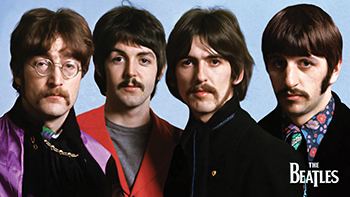
As for my dad’s contribution to the history of pop music, we’re really not sure. We have searched for but never seen a credit on any Beatles album for dad’s musician colleague. But this was the summer of 1966, and The Beatles released Revolver and started work on Sgt Pepper that year. Both albums are heavily influenced by Indian music. So you never know.
Dad completed his tenure in England in 1967 and we returned to India via Beirut and Rome. Before we left England, my mother made contact with an old school friend of her cousin, one Sonali DasGupta. If you are a movie buff, you have already made the connection.
In 1957, Nehru, the Indian Prime Minister at the time, invited the famed Italian director Roberto Rossellini to India to make a documentary on India and put some life into the floundering Indian Films Division. Though married to Ingrid Bergman at the time, he had an affair with DasGupta, a screenwriter, who was helping develop vignettes for the film. Given the climate of the 1950s this led to a huge scandal in India as well as Hollywood. Nehru had to ask Rossellini to leave. DasGupta moved in with Rossellini in 1957 and he adopted her young son Arjun (from her earlier marriage to documentary filmmaker Harisadhan DasGupta) and renamed him Gil Rossellini. Rossellini and Sonali had a daughter together, Raffaella Rossellini (born 1958).
And so on a dark and wet Italian night, a long limousine pulled up in front of our hotel in Rome, and the Ezekiel family filed in and were driven to the Rossellini mansion. The drive seemed to take forever, and though I was still pretty young, I do remember many aspects of the evening. I remember the huge hallway we passed through to get to the even bigger sitting room. I remember the lady of the house apologizing for the fact that "maestro” was away. Forty-five years and one particular Seinfeld episode later, I wonder if that’s how she referred to him in public, or whether that’s what he insisted she call him always! The children came out and befriended us. Like two young girls anywhere, the daughter and my sister Raina bonded immediately. I used to think it was Isabella (Rossellini’s daughter with Bergman), but it was probably Raffaella. Young Gil did not have confidence in his English speaking abilities, so we were ushered into a private theater where he showed us 16 mm Charlie Chaplin movies. Problem solved. No lauguage required!
We then went to the grounds behind the building where Gil showed us his bright red Ferrari racing car built to his size, and his sister showed us her menagerie with wolves and owls and other creatures. Years later, when Gil (who sadly passed away in 2008) came to India for a retrospective on his father’s films, my brother met him, and he confirmed that he did indeed have a racing car gifted to him by Enzo Ferrari himself. Back in 1967, he gifted us a couple of tiny Ferrari toy cars and my brother has kept one to this day.
In the early ’70s when musicians Jimmy Page and Robert Plant visited India, they played what is now a legendary 45-minute gig at The Slipped Disc at the Taj in Bombay and while my four cousins were in attendance, two actually played bass for them, David Ezekiel and Xerxes Gobhai.
My uncle Atmaram Bhende (married to my father’s sister Lily Ezekiel) was the doyen of the Marathi stage and his son Nandu was at the forefront of the Indian rock and roll scene and was Judas in the Jesus Christ Superstar production in Bombay.
And of course my dad’s youngest brother was the famous poet, Nissim Ezekiel. In India when confronted with our surname, most people either went "Whaat?” or "Are you related to Nissim?”
Though these days, that could well be transposed to "Gulu?” an author many times over and an authority on cricket and the Olympics.
So yes, famous by association. My Forrest Gump life.
Reprinted with permission from Khorshed Wadia Ezekiel: A Life Worth Living.