Ignoring community indignation and
threats, the Vajifdar sisters established
themselves as Indian classical dancers
before India gained independence
Parinaz Gandhi
Quite unlike the encores with which her performances were received, when the curtains came down on the 90-year-old Indian classical dancer Roshan Vajifdar Ghose in December 2020 it was a quiet exit. The youngest of the three legendary Vajifdar sisters, she had enjoyed the longest stint on stage, had cherished her stardom when she appeared on cinema screens in a few dance numbers, and became a cynosure of many eyes as the muse of the celebrated Russian artist Svetoslav Nikolaevich Roerich whose paintings adorn many collections.
Roshan’s initiation in classical dance was at the feet of her eldest sister Shirin, nearly 15 years her senior. It was Shirin who had paved the way for Parsis to pursue this art at a time the community considered Indian dancing fit only for the lower castes. In fact, "anything related to dance was considered something to do with the devil and the surest path to moral degradation, associated with courtesans and women of cheap morals,” Shirin recorded her ordeals in her unpublished autobiography, "A Bird Must Fly.”
Hailing from the orthodox Nana Parsi Vad in Valsad, Shirin who died in 2017 at the age of 102 and the middle sister Khurshid who passed away in 2013 at the age of 93 proved to be trailblazers. Selected for Indian delegations on cultural exchange programs to different nations, interacting with premiers and heads of state, the trio were exponents of Kathak, Kathakali, Mohini Attam, Bharata Natyam and Manipuri. For the 1954 film Mayurpankha that won a prize at the Cannes Film Festival Shirin had choreographed a dance sequence performed by Khurshid and Roshan for a duet composed by Shankar and Jaikishan, and sung by Lata Mangeshkar and Asha Bhosle. Almost a surrogate mother to her younger siblings, Shirin demanded the same perfection, perseverance and poise from them as was practiced by her.
.jpg)
Above (from l): Shirin, Khurshid and Roshan Vajifdar;
top: J. R. D. Tata, Khurshid, Queen consort Soraya, Shah Mohammad Reza Pahlavi,
Shirin and sister-in-law Dolly Vajifdar (1st, 3rd, 4th, 5th, 6th, 7th from l, front row)
At a cultural show: Begum Akhtar, Khurshid, Krishna Kutty,
Jawaharlal Nehru, Shirin, (3rd, 4th, 5th, 6th, 8th from l, front row)
"You dare appear on stage”
After training as a classical dancer in Kathak, Kathakali and Manipuri, when Shirin started her dance class Nritya Manjari at the Oceana building on Marine Drive in 1943 with 11 students, five of whom were not charged fees, she received threats to "disfigure” her unless she closed down. "As it is you are an immoral woman. But if you dare allow any other Parsi girl to step into your doorway to learn this shameful nautch you will have to regret very much… We know how to deal with women of your type! You will be made so ugly that you will repent all your life and will never be able to show your disgraceful nautch to the public…” was one of the warnings she received.
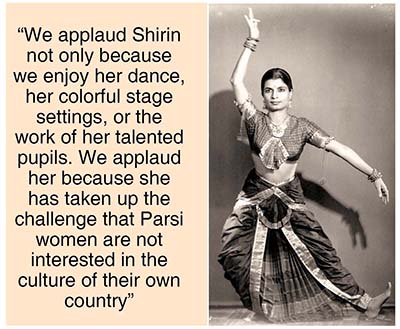
Once more the diehard orthodox created an uproar and summoned a meeting at the Cawasji Jehangir Hall under the auspices of Dharma Raksha Mandali (organization to protect religion) when they learnt that Shirin was to collaborate with film director J. B. H. Wadia. She had been approached to choreograph a group dance for the movie Bhakta Bodhana.
Refusing to be cowed down, Shirin not only continued with her dance class but even started rehearsing for a public recital with her students. By then she had convinced Khurshid, eight years her junior, who was contemplating a teaching career in Poona to join her instead at the dance academy in Bombay. Although they had no godfather to support them, with diligence and discipline the Vajifdar sisters were soon able to win accolades for their talent.
A press announcement nearly 75 years ago of the upcoming show of Shirin’s students at the Royal Opera House incited the conservative members of the community to retaliate: "You dare appear on stage! Or allow any other Parsi girl to be with you! We will burn the theater and all of you alive. Do you remember what happened to…?” As a result, five of her students were withdrawn by their parents just a few days before the recital, disrupting the choreography of the items. Three days prior to the show, the proprietor of the Royal Opera House saw his car damaged and smeared with cow dung and all the tyres punctured. But no untoward incident took place during the recital with the exception of a few sporadic attempts at cat calls and hissings from the gallery seats.
Some of the reviews they received though were very encouraging with Rast Rahbar commenting: "We applaud Shirin not only because we enjoy her dance, her colorful stage settings, or the work of her talented pupils. We applaud her because she has taken up the challenge that Parsi women are not interested in the culture of their own country. We applaud her because she has had more grit than money. We applaud her because she has begun an academy where she aims to teach other Parsi women a part of Indian culture.”
The Free Press Journal commented, "That the curtain should have gone up precisely on time as announced for Shirin Vajifdar’s dance recital at the Royal Opera House last Sunday seems to have astonished a great many people who were not prepared for slick efficiency… The phenomenal success of the show was due to the fact that Shirin dances with her brains as the feet. It is not so much the exquisite grace of her movement as the emotional intensity with which she interprets her dances…”
Emboldened by this initial success and invited as a budding dancer to perform during the 10-day All India Dance Festival in Bombay, Shirin volunteered to repeat the Nritya Manjari show to raise money for those afflicted by the famine in Bengal. She approached her friend Manchi Chichgar, secretary of the International Social Club of Bombay, who had previously organized her performance for the Club’s monthly meeting at the Greens Hotel. Although Shirin would have preferred the Royal Opera House venue, being familiar with the stage, Chichgar insisted on booking the hall of the Taj Mahal Hotel, knowing the Tatas’ reputation for supporting a worthy cause. Their combined efforts resulted in a substantial sum being raised for the Bengal Relief Fund.
Over the years she helped raise funds for The B. D. Petit Parsee General Hospital, the School for the Blind, the Police Maternity Ward, the Milk Supply Fund of a Parsi school… Bharata Natyam exponent Ram Gopal who collaborated with her for some shows cautioned her, "Bombay seems to be a great place for exploiting artistes in the name of charity… Pick and choose and do not allow these society women to have the better of you!”
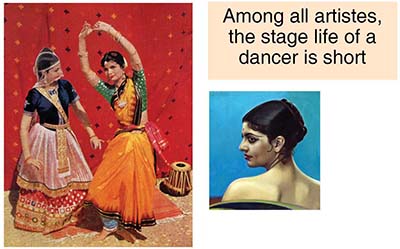
Above: Shirin and Khurshid; (r) painting of Roshan
by Svetoslav Nikolaevich Roerich
Above: In London, at a BBC recital (from l) Khurshid, Shirin and Roshan;
teaching dance to a novice on the banks of River Thames
Shirin greeting the Chinese Premier
When Khurshid started her independent dance class in 1949, two years after her marriage to the famous artist Shiavax Chavda, her students included young girls as also older women, recalled her daughter Jeroo. Khurshid had first met Shiavax at one of their shows when he was interested in understanding the nuances of Manipuri dancing. Shiavax would occasionally design dance costumes for the Vajifdar sisters or draw dance sketches for the articles penned by them. The biennial shows organized under the auspices of Khurshid’s dance academy Nritya Jyoti gave a platform to countless girls who pursued dance as a hobby. Included in her shows were dance ballets for some of which music had been composed by music director Khorshed Minocher-Homji who too in her earlier days had faced the wrath of the community for contributing songs to Hindi films.
New visions and forms
"Dancing alone or with your pupils is not going to be your salvation! Why don’t you form a troupe and produce dance dramas for our people on the contemporary situations and awaken consciousness of new visions and forms?” suggested Shirin’s husband, noted author Mulk Raj Anand. Thus was conceived the Nritya Darpana troupe of dancers and musicians with Shirin and Krishna Kutty as the directors and principal dancers. Among their first dance ballets to be staged in India was Terrible Boon, Birth of Urvashi and Triumph of Life.
Having established herself in India, Shirin had visions of their troupe going overseas. A major hurdle though was funds which they sought to raise by approaching supportive patrons, one of whom, a director of Tatas, A. D. Shroff unabashedly admitted that Indian classical dance bored him but he had enjoyed one of her shows. Besides promising her four advertisements he also encouraged her to apply to the Dorab Tata Trust Fund that sanctioned Rs 2,000 with further personal donations coming from J. R. D. Tata and Shroff, followed by support from other firms and philanthropists, especially Parsis. "It was gratifying to note that we had succeeded in kindling some sort of appreciation for our work. For the first time I realized that I had some place in the hearts of dance lovers,” she appreciated.
With Rs 25,000 in their kitty, a small troupe of seven artistes comprising the three Vajifdar sisters, Krishna Kutty and three musicians set sail for England in March 1952 without any previous arrangements for public recitals. "It was a great risk we had taken under the advice of Mulk,” admitted Shirin. "Only two private recitals were confirmed, one under the auspices of the Institute of Contemporary Arts and the other at the Imperial Institute to invite impresarios, theater managers, critics, journalists and friends to show that we were capable of performing. All remarked that we had better chances if we augmented the number of artistes.” Hiring local artistes, they increased the troupe size to 13.
After a long wait of five weeks one of the impresarios offered to open their season with Nritya Darpana’s performance at the Theatre Royal in Newcastle upon Tyne, to be followed by a week’s season in Brighton and Bristol. They returned to London where they performed for five consecutive weeks at the Comedy Theatre. Their original plan for a three to four-month tour had extended to six, by which time they had built up a fan following that sent them flowers, telegrams, letters that would be pinned near their dressing table. Despite the adulation with repeated encores, curtain calls and queues outside the theater door to take their autographs, they looked forward to unwind on Sundays after a hectic week of shows, morning rehearsals, frequent interviews with the Press and photographers, discussions with students on comparative techniques of dance and other matters to attend to. Too fatigued to extend their tour, Khurshid longed to return to her four-year-old son who was left behind in India while Roshan was concerned that the daily layers of make-up were taking a toll on her skin. Their last engagements in England were television shows and a couple of broadcasts of folk songs and talks on the BBC.
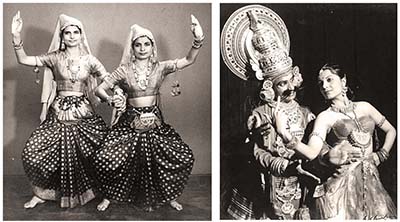
Above from l: Khurshid, Shirin, Krishna Kutty and Roshan
Their return to India confronted them with the realities of a dancer’s struggles. In the years between 1953 and 1958 the government of India sent the Vajifdar sisters on cultural exchange programs to Ceylon, China, Russia, Mongolia and East Germany. Roshan went on a lecture demonstration tour to Europe in 1959. Among all artistes, the stage life of a dancer is short. "After years of hard work involving physical, mental sacrifice, when she matures into a really inspired artiste, she is no more wanted by the public,” pointed out Shirin.
Roused by the rhythm
Mother Gool was forewarned by a caustic neighbor, "Your daughter is going to be a nachnari (derogatory term for dancer)” when her eldest born Shirin tried to pick up steps from street dancers. The mother may never have anticipated that not one, but three of her daughters would emerge as the first Parsis to pursue Indian classical dance as a career.
A mother to six children, the first three being born before she had turned 20, Gool was keen that Shirin be sent to study at the Avabai Petit Parsi Orphanage in Bombay. After Shirin, the second born, Tehmi was sent to the Petit Orphanage (she later succumbed to an illness when studying nursing), followed by Khurshid. The fourth child Ratan died when he was three years old. The next in line was son Koover who later gained fame as a Rent Act lawyer. Koover and the youngest Roshan had their schooling in Gujarati medium in Bulsar.
Since Gool’s husband Cawas worked for Hamabai Framji Petit who had founded an orphanage in memory of her mother Avabai Petit in Bombay, Shirin was admitted as a free ward there. The sensitive child was continuously teased by the elder students who had named her "Kaaliyan” since her complexion was darker than theirs. "The managing committee of the school suffered from a white skin complex. It was no secret that were it not for the founder who paid for my education, I would not have been granted admission,” wrote Shirin in her autobiography. Once the little child’s talent as a singer was spotted and she was selected for the school annual concert and permitted to go on stage after a thick layer of powder mixed with rose water was applied on her face, the teasing stopped. With her flair for music, she was included among the nine orchestra girls and taught the sitar and dilruba at school.
With the students encouraged to present items on special days like the founder’s birthday, Shirin composed her first dance, Anand Nritya, making sure that she did not move her hips. It was well received by the staff and students and she would be called upon to show this dance each time a dignitary visited the school. Their new teacher for English, Sonalini Devi, sister of freedom fighters Sarojini Naidu and Harindranath Chattopadhyaya, taught Shirin a few Kathak steps. When Guru Sunder Prasad came to give Sonalini Devi her private lessons, Shirin would watch through a chink in the door, and with her retentive memory, incorporate the steps in her new dance compositions. A specially choreographed group dance with the girls suitably attired in a sari with their heads covered and carrying incense holders in their hands was meant to appease orthodox Parsi parents who were concerned that their children were taking undue interest in Indian culture. The school management took no objection as long as the studies did not suffer.
Shirin and Khurshid were the first girls from Nana Parsi Vad to have completed their school leaving examination. At her matriculation from St Joseph’s Convent, Bandra, Shirin had secured the highest percentage among her classmates and was therefore sent to Wilson College (at the expense of the Orphanage) from where she graduated. While a boarder at Avabai Petit, Khurshid was sent to the J. B. Petit High School for Girls at Fort to complete her matriculation and hence was required to daily commute by train. For decades, Khurshid continued to teach dance at the J. B. Petit School as also the New Era School.
Shirin’s interest in dance continued unabated. On one of her trips home to Bulsar during her college days, she was fascinated by the dark complexioned village locals who Parsis termed ‘Dubras’ dancing on the street during Dassera. She invited them to perform again in the family courtyard to observe their steps and cadences. The neighborhood thought it to be outrageous. "How could any member of this blue blooded community show even the slightest interest in the barbaric religious festivities of others? Were they not darvans or of a lower birth?” they tried to impress on Shirin who was ordered to go to the fire temple and offer sandalwood while her mother prayed for an extra hour before the fire in the kitchen to atone for the daughter’s sins of omission and commission. The rebel then chose to go to the neighboring villages from where she picked up the Bhil dance, as also the garba and dandiya-raas.
Her parents and neighbors probably never knew that en route to college, Shirin took lessons in Kathak from Guru Sunder Prasad and paid for them by foregoing her monthly allowance of Rs 10. Among her other early dance teachers was Sunder Prasad’s nephew Sohanlal who taught her the popular Rajput folk dance Ghumar that recently gained fame after its inclusion in the film Padmavat, and Guru Nabha Kumar from whom she learnt Manipuri dance. Additionally taking lessons at Prof Deodhar’s School of Indian Music, Shirin was chosen to represent the academy at the All India Radio programs.
Her devotion to dance and music inspired two poets, Bachubhai Shukla and Pinakin Trivedi to compose songs and short dance-dramas for Shirin who by then was on the paid faculty of her alma mater. Their song Sonpari (dream fairy) on which she choreographed a dance had so impressed Maharani Chimnabai of Baroda who was the chief guest at one of the school annual shows that she wanted to present Shirin with a gold necklace. Rather than receive an ornamental gift, Shirin suggested that the money be used to finance the fees for an eight-week summer residential course to learn Bharata Natyam at the Uday Shankar Culture Centre at Almora that she attended with Khurshid.
More intensive was the coaching Shirin received for 21 months at Madam Menaka’s dance center Nrityalayam in Khandala where she started her day with Kathakali from six in the morning, followed by Manipuri and later Kathak. Since food was scarce during those World War II days, students would escape to the nearby valleys in search of wild berries and roots of certain plants to supplement their intake.
To perfect their Bharata Natyam moves, Shirin and Khurshid went to Tanjore, staying at the station waiting rooms for the first few days until they decided to take lessons from a devadasi called Lakshmi Kantham whom they revisited for three consecutive years. Shirin and Roshan became pupils of Kerala Kalamandalam to learn Mohini Atam and to brush up their Kathakali. Roshan, who got the Government of India scholarship to pursue dance, studied Bharata Natyam under Guru Chokkalingam Pillai in Madras and under Kittappa Pillai in Bangalore. She also studied Sanskrit texts and Tamil to better understand dance. Her workshops on dance were a revelation to many and as commented one participant after observing her expressive facial expressions, "Never would I have believed there are nine different ways of moving eyes to say nine different things and seven different ways of moving the eyebrows.”
After her marriage to chiropractor Dr Hiranmoy Ghose in 1960, Roshan’s performances were managed by her enthusiastic husband. Her 90-minute recital based on the songs from the epic Gita Govinda was very well received. A disciple of the Mother, her composition, Pilgrimage of the Soul depicting the devotion of Mirabai, had received the Mother’s blessings in Pondicherry. She continued to give performances in India until the early 1990s and lecture demonstrations till 2000. Once she shifted base to the outskirts of Kodaikanal she taught Indian dance to students at the Presentation Convent in Kodaikanal, the Kodai International School and the Bharatiya Vidya Bhavan.
Lekha Rattanani, managing editor of The Billion Press, who was then a student at the Presentation Convent, remembered the principal standing by when Roshan would lead the congregation in prayer at the Assembly Hall. Sister Magdalen, a very senior nun of the Presentation order, now based in England, knew Roshan to be "a very spiritual woman as she spent time in our chapel after her classes and seemed lost in prayer.” Constantly exploring new avenues, Roshan had even taught the students an innovative dance set to the Lord’s Prayer in English while a nun played the piano, recalled her son Prasanna.
Cheerful and upbeat, all three sisters were known to be broadminded with progressive views. Attired in ethnic Indian clothes and jewelry, they exuded an elegance from a different era. As Shirin repeatedly stressed, "It is only when the artistic temperament and inclination are blended with unflagging discipline and devotion that a true artiste is born.”