With 15% of the delegates registered for the XVII North American Zoroastrian Congress being under 20, a special “Teen Track” program was envisioned
Text: Parinaz M. Gandhi Photos: Jasmine D. Driver
This was the first North American Zoroastrian Congress (NAZC) where "a lot less time was spent on defining who is a Zoroastrian and more on building a community that is cohesive and accommodative,” commented Navroz Gandhi, president of the Zoroastrian Association of Metropolitan Washington Incorporated, when presenting his retrospective of the XVII NAZC at The Hilton Hotel, Los Angeles from December 29-31, 2014.
Khushali nu jashan led by Ervad Zarrir Bhandara

Co-hosted by the Zoroastrian Association of California (ZAC) and the California Zoroastrian Center (CZC), this was the first NAZC where the delegates physically experienced the tremors of an earthquake during the three-day event (California being prone to earthquakes); to see 765 delegates register for the biennial meet (although registration had closed months ahead), with 70% being under 55 years of age; to offer a parallel teen track for 74 delegates (aged between 13-18) and a mini Congress (for 40 children in the five to12 age bracket, with a puppy and ice cream party being the highlight); to provide Reiki sessions plus a relaxation room with facilities for indoor games… When listing the several firsts at this Congress, Gandhi was happy that the community in North America was forming its own identity, away from the Indian fraternity who being "so busy with problems of their own, their overreach has been lower.”
He seemed to be echoing the sentiments of Nadir Godrej, vice president of Godrej Industries, who in his keynote welcome delivered in verse reminded the North American congregation:
"The balm of tolerance gives immunity/Allows enjoyment of faith and unity...
In India we are in a mess./You’ve done better, I must confess...
Our prophet enjoined us to think/Thoughtless faith leads to the brink. Should religion guide our way/Or deal with ritual minutiae?...
Or will we show that we are wise/And find a way again to rise?...
The next few days will be great/ As all of us deliberate...”
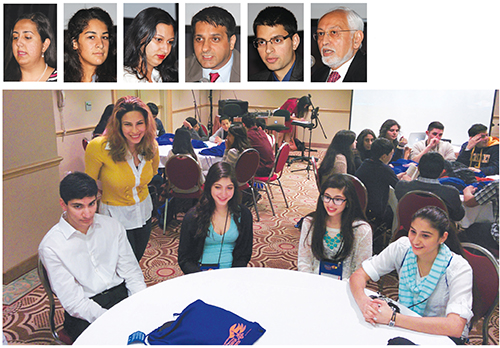
Farzin Avari, Autusa Behroozi, Nazneen Shroff, Jamshed Rivetna, Ervad Poruz Khambatta, Homi Gandhi;
(below): Shirrin Kumaana-Wadia conducting Teen Track (Photo: Arzan Wadia)
Zoroastrian Children’s Choir of Southern California
The credit for "planning, organizing and conducting a monumental and memorable Congress” should go to DhunMai Dalal and her co-chairs Khushroo Lakdawala and Darayus Mistry, the president of ZAC Tehmi Damania and her counterpart, Shida Anoshiravani of CZC, and the Parsi and Iranian members of both the organizations, acknowledged Katayun Kapadia, president of the Federation of Zoroastrian Associations of North America (FEZANA). The theme of the Congress being "Faith and Unity,” she urged the participants to "nurture the Zarathushti faith...and forge unity for a bright future.” Chairman of the FEZANA Congress Committee, Bomi Patel hoped that the delegates will "celebrate our culture and heritage, celebrate old friendships and make new ones” whilst enjoying the inputs of speakers, scholars and luminaries.
In her warm welcome Damania referred to "California nu saubhagya bau léhri (good fortune of California)” to see such a large turnout whilst Anoshiravani alluded to the city "being one of the best vacation spots in USA” and having hosted the Fifth NAZC 29 years earlier after which FEZANA was conceived in 1987. Dalal having served as chair of the Fifth NAZC too, Anoshiravani lauded her "courage, wisdom and energy” in offering to re-host the Congress with the support of her co-chairs.
At the morning khushali nu jashan led by Ervad Zarrir Bhandara, he was joined by 19 mobeds and five paramobeds. Following the jashan at the International Ballroom, the audience joined in humbandagi where holding hands with the registrants beside them they recited Yatha Ahu Vairyo and Ashem Vohu.
The opening ceremony included flag hoisting by the Eagle Scouts after which soprano Tina Siganporia rendered the Star Spangled Banner, followed by soprano Meher Pavri and baritone Ardavan Taraporewala singing O Canada. Hamnavayan Mantrah Group, the CZC choir under the direction of Rostam Keyoumarsi, sang Khaan Ashem Vohu gu Yatha Ahu (a composition by Prof Poure Davoud that is popular in Iran) and Zartoshti-am (I am a Zarthoshti) whilst the ZAC Choir under the direction of Perinne Medora regaled the audience with the popular Chhaiyé Hamé Zarthoshti ensuring that they ended the verse each time with "O Zarthoshti kaum” and not "O Parsi kaum.” When singing "Parsi hamé chhaiyé,” they tweaked one line to "America maa rahiyé (we live in America) instead of the original line which said we are residents of Hindustan. Equally engaging were the colorfully attired tiny tots of the Zoroastrian Children’s Choir of Southern California who under the direction of Shazneen Rabadi Gandhi and Cheherazad Elavia Raetz performed "It’s a small world.”
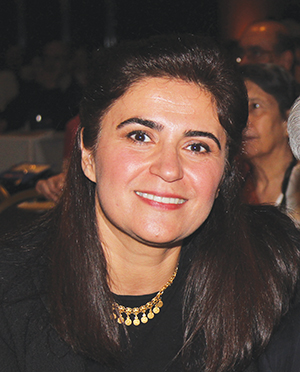
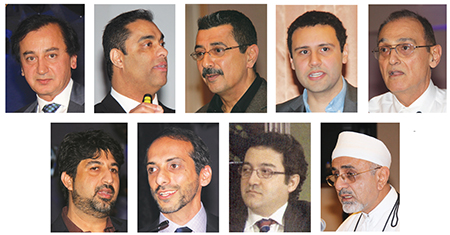
Parisa Khosravi; (from left): Dr Fariborz Maseeh, Zane Dalal, Daraius Bharucha, Dinsha Mistree, Mobed Fariborz Shahzadi;
(2nd row): Arzan Wadia, Navroz Gandhi, Shahin Nezhad, Ervad Parvez Bajan
A section of the audience
Dare to dream
"Although stressful and demanding, working all hours, overnights, I loved the years…the incredible experience.” In her keynote address, Parisa Khosravi, who recently retired as senior vice president of Global Relations for CNN Worldwide after serving the organization for almost three decades, related the highlights of her "long-term dream and passion for international news” from the time she was a sophomore in high school. When studying for a bachelor’s degree in broadcast journalism from Columbia College in Chicago and thereafter Khosravi did seven internships because she believed "it is important to get yourself in those environments.”
In her pursuit of "experience, more than money” she chose to join CNN in the 1980s when it was not well known. "There is no such thing as overnight success. You have to earn each position on merit, not because someone put you there,” she advised the youth. The convenience of Skype and other technological advances have "so changed the way we gather news,” stated Khosravi recalling the time during the first Gulf War when she had to divert a commercial airline to Somalia to pick up equipment and manpower.
Realizing that journalists today are "unfortunately becoming the biggest targets even when we are not part of the conflict,” she mentioned that at CNN they don’t send any reporter to the war zone unless he/she wants to go there. "The safety and security of my people was one of my personal goals,” stated Khosravi whose constant concern and care for her staff members had earned her the nickname ‘Mother Parisa!’ Whether telephonically masterminding the coverage and rescue operations of their business colleagues trapped in the Taj Mahal Hotel during the 2008 terrorist attacks in Bombay, or navigating back-to-back interviews with Pope John Paul II and President Mohammad Khatami in Rome, Khosravi’s lively narration of her exciting career trajectory, kept the audience engrossed in her speech.
In a subsequent meeting with Pope Francis she was introduced as "the CNN secretary of state!” much to her amusement. Recently announcing her premature retirement from CNN after having "walked the walk” she found the reaction of her staff "overwhelming… It was like hearing your obituary whilst you are alive.” She has now opted for "quiet time to think and reflect; to look at life” which she considers "very important.” Equally significant in her marital life of 17 years has been the first Sunday of each month, a day set aside by Parisa and her husband Khodarz for charity and pursuit of social causes, as advised by the priest officiating at their wedding ceremony.
Attributing her career success to her parents, Parisa revealed that she considers her father Ardeshir Khosravi "a true achiever and pioneer” whose "hard work and incredible honesty” made him governor of a region of Iran at the age of 35. He subsequently rose to become deputy governor general and deputy minister when he was in his mid 40s despite belonging to the minority Zoroastrian community.
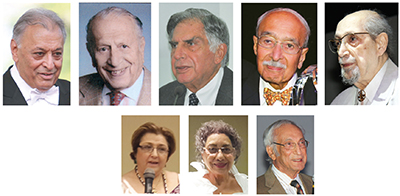
(From left, above): Zubin Mehta, Jamsheed Marker, Ratan Tata, Dr Farhang Mehr,
Prof Kaikhosrov Irani; (alongside) Zarina Mehta, Deenaz Coachbuilder, Dariush Irani
Hail the honorees
Lunch time was not merely to be frittered away in socializing but honoring community achievers. Thus on the first day the awardees announced by the Congress were Jamsheed Marker who, being a respected member of the Pakistani diplomatic corps, has earned the distinction of being the world’s longest serving ambassador and one deputed to most countries. His award was received in absentia by his relative Deenaz Coachbuilder. She conveyed his sentiments: "I feel doubly honored – to be a Zarthoshti and for the privilege to be associated with this significant Zoroastrian Congress, the objectives of which will always remain close to my heart.” Maestro Zubin Mehta’s award was received by his daughter Zarina Mehta who conveyed her father’s pride in speaking Parsi Gujarati for he believed the "language is so vital in keeping the community together.” Due to conduct the Vienna Philharmonic on New Year’s day he hoped to see his fellow community members "at my future concerts.” Chairman emeritus of the Tata Group who was conferred the Honorary Knight Grand Cross of The Order of the British Empire in 2014, Ratan Tata’s award was to be carried to him in Bombay by orchestral conductor Zane Dalal who serves on the management team of the National Centre for the Performing Arts.
Later in the evening a memento was conferred on Dr Farhang Mehr who during his years in Iran rose to become deputy prime minister, although officially denied that title. Mehr noted, "I am proud to be born and brought up as a Zoroastrian…Zoroastrianism is to be practised not only by word; it is by deed.” Mention of the word "Zoroastrian” carries "goodwill.” The award for 92-year-old Dr Kaikhosrov Irani, emeritus professor of philosophy at the City College of New York, was received in his absence by Dariush Irani, president of the Zarathushtrian Assembly.
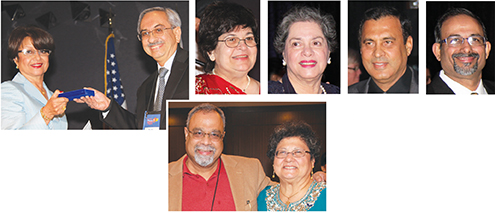
(From left, above): Shida Anoshiravani and Nadir Godrej, Tehmi Damania, DhunMai Dalal, Khushroo Lakdawala,
Darayus Mistry; (alongside) Bomi Patel and Katayun Kapadia
"To kindle our community”
Observing that "many members of the younger generation seem to be fading away from the community because they don’t have a true understanding of the teachings of the faith although they are engaged in following the customs,” moderator Farzin Avari, youth coordinator and Sunday School teacher in Atlanta, invited five members of her panel to suggest ways "to kindle our small community and to make it a strong community.” Participating in the discussion on "Generational Perspectives on Issues of the Day,” Autusa Behroozi, a senior at Flower Mound High School and co-founder of Raise 4 a Cause recommended that we should focus on understanding the essence of the religion and not its religiosity. She was apprehensive that once the older generation passes on, we won’t know the significance of jashan and other ceremonies.
Ervad Poruz Khambatta, a PhD student at Stanford’s Graduate School of Business, recommended funding of religious literature and speakers, and referred to the introduction of online religious classes which sees not only North American students enrolling but even some from China and Australia/New Zealand. By offering leadership roles to the young, being a role model and strengthening connection to the community through social functions, the youngsters would be able to enjoy being in the midst of those who understand the unique aspects of being a Zoroastrian. Youngsters are very underestimated, he felt, for "they are smart enough to change the world and foolish enough to think they actually can.” Nazneen Shroff who had pursued a career in Human Resources specializing in Talent Acquisition, was of the view that a "proactive approach from the youth” would result in marriages within the fold. For those unable to find a Zoroastrian partner at national or international meets despite the best efforts of family and local associations she believed, "No one should be alone if he/she desires a life partner” and the community should "embrace the individual and the partner.”
Pointing out that 60% of marriages recorded in the FEZANA Journal are of interfaith couples, Jamshed Rivetna who married a Christian lady 18 years ago and raised three children as Zoroastrians enquired, "Do we fight the trend or do we accept the situation and adapt?” Being instrumental in the construction of the Dallas Darbe Mehr, he analyzed the Zoroastrian faith’s ability to meet the spiritual needs of its adherents in terms of offering opportunities for "reflection and learning, service and giving, spiritual growth and development, togetherness and belonging.” According to FEZANA vice president Homi Gandhi, parents can facilitate bonding among Zoroastrian children by making religious education classes a priority just as social media, community organizations and volunteering time and money for welfare causes can promote unity if we "respect and concentrate on what we share.”
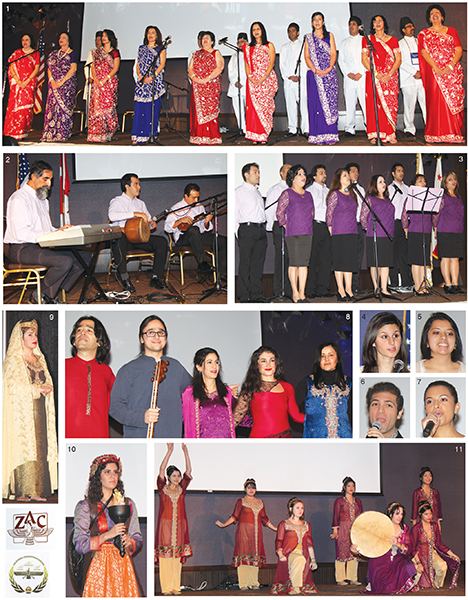
1. Zoroastrian Association of California Choir; 2 & 3. Hamnavayan Mantrah Group;
4. Roya Behmardian; 5. Tina Siganporia; 6. Ardavan Taraporewala; 7. Meher Pavri;
8. Mima Goodarz, Shahrzad Khorsandi (3rd and 4th from left) with musicians;
9, 10, 11. Scenes from Women of Persia
Whilst the panel discussion was in progress, four other sessions concurrently held in other rooms were "Across the Arabian Sea…But for the Faith and Unity” where Ervad Parvez Bajan, panthaky of Bombay’s Mevawala Agiary, referred to the bonds of Zoroastrians in India with their counterparts in Iran. In his presentation on "Shahnameh: Myth or Facts?” Shahin Nezhad, pursuing his PhD at the Spenta University, elaborated on the epic that reflects the Iranian/Zoroastrian world of thoughts, deeds, values, wishes and customs. Daraius Bharucha, co-chair of FEZANA’s Religious Education Committee explained to parents, religion class teachers and those interested how to use the new FEZANA curriculum to design a religion class program, prepare and deliver engaging lessons in his workshop on "Teaching the 21st Century Zarathushti Learner: New Curricula, New Techniques.” The Teen Track kicked off with an introductory session by Shirrin Kumaana-Wadia, an architect-design consultant-photographer, whose session on "Zoroastrian Connection and Creativity” urged the youngsters to interact with other delegates at the Congress using the tools of photography and social media.
Giving and guarding
"An attitude of gratitude creates blessings,” stressed Dr Fariborz Maseeh, founder of The Massiah Foundation, at the commencement of his presentation on "Venture Philanthropy: An Investment Approach for Public Benefit.” Clarifying at the outset that "I am not a Zoroastrian. My ancestors were not courageous enough to withstand persecution,” he told the gathering, "You carry the purest of genes.”
Giving of time, money/resources, or life can be motivated by different reasons, he elaborated. Whilst for some it could be affinity to the people, religion or homeland that we love, others may seek recognition for their deeds. Social and political beliefs may prompt some to donate whilst a few may do so in retaliation, to empower the competitors of one’s enemy. However, puristic giving that transcends human needs is "the ultimate philanthropy” where the anonymous donor does not expect any recognition.
Venture philanthropy is actually "active giving” where one "looks for a right cause which has transformational or abundant impact on society.” It can be "as hard as finding the right business,” explained Maseeh. When you give your hard earned money you expect it will be in the hands of "good stewards” for we want to be "catalytic investors whose money is managed or leveraged several times.”
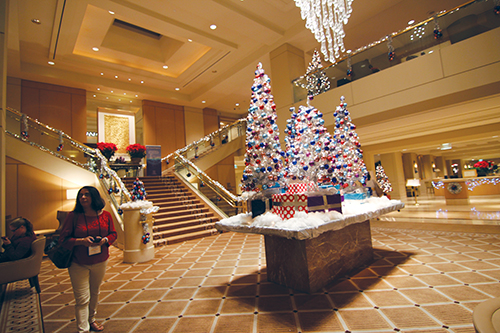
Lobby at The Hilton Hotel, Los Angeles
"I have seen the youth of our community drift away. As a community we have done an abysmal job,” commented Zane Dalal in his presentation on "Zoroastrianism and the Next Generation.” From his experience he knew that "no teenager will listen to ‘you must do this or that’ or worse ‘you must not do this or that.’” Religion, he explained, is derived from the word re=do again and again, ligo (from ligare)=to bind, and thus serves "to rebind oneself to God. This is a personal dynamic; yours to choose and decide…
"Any person believing in good thoughts, words and actions is a de facto Zoroastrian. It is not conversion. It is acceptance… We become co-workers for the truth and destroy evil as a consequence... Our universal faith has been made into a dinner club for 100,000 because we want to keep the money.” Those who want to shut the doors on non-Zoroastrians "are not guardians of the faith. They are guardians of money,” he reiterated.
The Gathas are the core of the religion, all other texts like Yashts, Vendidad, Visperad are commentaries. "A commentary cannot prioritize itself over the Gathas,” he declared. "No man should be compelled to frequent or support any religious worship.” To be able to choose one’s own path "is a great gift, a great unshackled power, a great responsibility, a great legacy…”
One of the concurrent sessions during this period witnessed Dinsha Mistree, a PhD student at Princeton University and co-founder of the website Agiary Connect, focus on the cultural and scholarly programs conducted under the auspices of the UNESCO-Parzor Project. Simultaneously architect and urban designer Arzan Wadia who runs the online portal Parsi Khabar spoke on "The State of the Online Zarathushti” depicting their presence on Zoroastrian websites, social media and more. "Zoroastrianism 101: At least 20 Basic Things We Should Know, But May Not” saw Mobed Fariborz Shahzadi who conducts religious classes, seminars and authors books on the religion, explain the significance of fundamental prayers, rituals and symbols.
Enchanting evening
"An Evening in Persia” that constituted the entertainment on the first night included a poem on Persia recited by Roya Behmardian and a music concert featuring the voice of Mehrbanou (Mima) Goodarz, accompanied by Samandar Dehghani on tombak and daf (percussion instruments), Sina Dehghani and Farin Foroudi on daf, with dances performed by Shahrzad Khorsandi and others. The audience that was eagerly awaiting the Persian repast had to be repeatedly requested to keep silent.
A revelation for many was the play Women of Persia, produced by Adeleh Alba, that saw young ladies, dressed in the costume of that era, walk up to the dais one at a time and briefly introduce the persona they were depicting. The contribution of Persian women who had played an important role in Persian culture and history not being well recognized, the purpose of this play was "to honor all mothers, daughters, empresses, ministers, commanders and warriors who wisely led the country for thousands of years.” The ladies of yore who were remembered were Pouruchista and Homay from the Pishdadian dynasty, Mandana, Atousa, Irdabama, Artemis and Youtab from the Achemenian era, Sora and Artadokht from the Ashkanian age, Pourandokht and Azaddokht from the Sassanian dynasty, Azad Deylami and Banoo Khoramdin who faced the Arab attacks.
A report on Day 2 of the Congress will appear in the February 21 issue of Parsiana.