The engineering expertise of the Shapoorji Pallonji Group was
requisitioned for the construction of the first Hindu temple in the Middle East
Parinaz Gandhi
"A lotus in the desert” is the lyrical description conferred on the first Hindu stone temple in the Middle East by the different teams that contributed to its roots and rarity. Inspired by the lotus motif, the seven spires of the BAPS (Bochasanwasi Akshar Purushottam Swaminarayan Sanstha) Hindu Mandir in Abu Dhabi represent the seven emirates. The water features symbolize the three major Indian rivers — Ganga, Yamuna, Saraswati. The 410 pillars and the carvings have been repeatedly described in detail.
The grand inauguration by the Prime Minister of India Narendra Modi on February 14, 2024 received due media attention in the week preceding and subsequent to the event. Lesser known though is the role the Shapoorji Pallonji (SP) Group played at different stages in the construction of this grand edifice, from the time the foundation was laid to integrating modern LED lighting, air conditioning and security systems within the ornate carvings.
"Our dream of building a Hindu Mandir in Abu Dhabi has now become a reality. SP has played a pivotal role in partnering with us,” acknowledged Pranav Desai, director of BAPS. He expressed his gratitude to SP "for bringing to life our vision of this spiritual oasis for global harmony.” Open to all faiths, it has a special "Wall of Harmony” sponsored by the Dawoodi Bohra community. The Wall is reportedly one of the largest three dimensional printed walls in the United Arab Emirates (UAE) featuring the world’s most magnificent buildings with the word "harmony” engraved in ancient and modern languages.
On behalf of the SP Group, chairman Shapoor Mistry stated, "We are deeply honored to have had the opportunity to work with BAPS and create this incredible monument that brings together art, harmony and faith. Apart from being a celebration of cultural diversity, this is a testament to our engineering expertise.”
Besides Mistry, another Zoroastrian photographed with Modi, the Abu Dhabi rulers and interfaith dignitaries at the inauguration of the Mandir was Dubai based Zubin Karkaria, founder and chief executive officer (CEO) of the VFS Global Group. In his Facebook post he expressed his gratitude to "the visionary leadership of the government of the UAE for continuing to strengthen the bonds between our two great countries (India and the UAE).” He subsequently conveyed to Parsiana, "The Mandir is a beacon of harmony and tolerance in a world which is currently undergoing a lot of strife and conflict. VFS Global’s participation in this iconic initiative is very much in line with our commitment of supporting global social development and diversity, equity and inclusivity and bringing communities closer together. I am humbled to be a part of the collaborative efforts undertaken to build the BAPS Hindu Mandir which showcases the power of unity, diversity and harmony in the pursuit of a shared vision of our Honorable Prime Minister.”
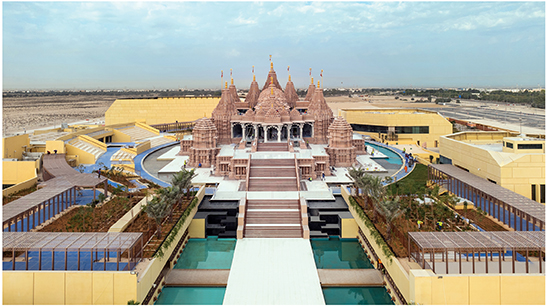
BAPS Hindu Mandir complex in Abu Dhabi
Colossal construction
Standing on 27 acres of desert area on the outskirts of Abu Dhabi, the property was donated by Sheikh Mohammed Bin Zayed Al Nahyan, the then Crown Prince of Abu Dhabi. "The main temple is constructed on a raft foundation using UAE’s largest single pour of unreinforced fly-ash concrete. Instead of iron and steel reinforcements, bamboo sticks and glass fibre were used. The temple façade is built on this foundation, using 40,000 cubic meters of marble from Italy and 1,80,000 cubic meters of pink sandstone from Rajasthan. Thousands of artisans and volunteers intricately carved the stones in Rajasthan, for BAPS. These were then put together in Abu Dhabi like a giant jigsaw puzzle,” noted a press release from Zarin Amrolia, deputy general manager, group communications at Shapoorji Pallonji and Company Pvt Ltd.
"The SP Group dedicated a total of four years to bring the visionary BAPS Mandir to fruition,” mentioned Vidya Sagar Batchu, CEO of Shapoorji Pallonji Mideast LLC when Parsiana sought details on the engineering expertise that went into this project. "The duration of the first phase was 250 days… Fly-ash was used to reduce heat generation and increase overall durability of the foundation. To ensure longevity of the structure and to monitor seismic movements, about 250 detectors were installed in the core foundation for continuous observation.”
Zubin Karkaria, Narendra Modi, Shapoor Mistry (3rd, 7th, 10th from l) with
members of the Abu Dhabi royal family and multi-faith leaders
Subsequently SP’s expertise was harnessed to execute engineering / coordination of technological aspects for the stone Mandir. It was extended to civil, MEP (mechanical, electrical and plumbing) and infrastructure for ancillary buildings on the premises within the project duration of 450 days. These included the arrival lobby and pavilions, security structures, lecture theater, residence of priests, VVIP/Majlis building, kitchen, service and storage blocks, roads and pavements, water tanks and other features. For social and religious events, a multipurpose hall with a capacity to seat 2,000 has been constructed, equipped with the latest technology, audiovisual system and LED display screens for better visibility.
"Our engineering team worked in tandem with traditional artisans and contributed in creating the ecosystem for this marvellous temple,” declared Batchu with pride. "We had to integrate UAE regulations into Indian designs to ensure full compliance with authority requirements. As the Temple is a one of its kind, lot of regulations and guidelines had to be customized in a manner acceptable to different stakeholders. It was very challenging to ensure high level of safety and quality standards during the entire construction period.”
Managing highly skilled workmen in a time bound manner was another challenge. "Due to constraints in sequential activities, harsh weather conditions and hard stop (unextendable) deadline for inauguration, our peak manpower requirement had gone up substantially to about 1,500 per day.”
While adhering to ancient practices of construction, SP was expected to integrate modern green and sustainable technologies. Solar panels cater to the daily needs of resident priests as also the visitor areas. In support of sustainability efforts 6,200 lights and 5.4 km of strip lights used in the Temple premises are of LED and fitted with motion sensors for optimization of power consumption. To minimize wastage, all wooden packing material was repurposed to create an environmentally friendly cafeteria to cater to the anticipated 1,500 daily visitors from March 1, 2024.
Navigating through the hurdles encountered during the project, "from constrained work schedules to procurement complexities, logistics and material handling challenges, our team has done excellent work and shown resilience during the entire construction period.” The SP management considers their involvement in the Mandir "as an honor…to contribute towards strengthening bilateral relations between India and the UAE,” as noted the press release.
Next year will see SP complete 50 years of operations in the Middle East. The first project they had undertaken in this region was the Sultan’s Palace in Muscat in 1975. Among the other landmark projects recently completed by the 159-year-old company in the Middle East and North Africa regions are the Sabic Jubail main building and the Saudi Electricity Company headquarters in Saudi Arabia, the Oman Convention and Exhibition Centre, the Oman Across Ages Museum in Nizwa, the Mahatma Gandhi Convention Center in Niger and the National Assembly in Ghana. In India, their recent marquee projects include Bharat Mandapam and Kartavya Path (former Rajpath) in New Delhi, the Atal Tunnel in Himachal Pradesh and the Port Blair Airport.
An introduction to the company describes it as "a global diversified institution with a leading presence in the sectors of engineering and construction, infrastructure, real estate, water, energy and financial services. With an employee base of over 35,000, SP delivers end-to-end solutions across 40 nations, building megastructures, developing iconic landmarks, and driving innovative technologies in energy and water — with a focus on good governance and sustainable development.”
The Mandir is seen by Batchu as "marking a new milestone in our legacy of excellence… a testament to our expertise, commitment and innovation.”