The Influence of Iran on Other Countries by Dr Jivanji Jamshedji Modi. Pp: 177. Extracts from History of Holy Iranshah by Shapurji Kavasji Hodiwala. Pp: x + 130. The Bombay Dockyard and The Wadia Master Builders by Ruttonjee Ardeshir Wadia. Pp: xix + 435. N. M. Wadia and his Foundation by R. P. Masani. Pp: xvi + 135. Famous Parsis: Biographical and Critical Sketches of Patriots, Philanthropists, Politicians, Reformers, Scholars and Captains of Industry. Pp: vii + 275. Homage Unto Ahura Mazda by M. N. Dhalla. Pp: xiv + 271. Reprinted and published in 2004 by The Bombay Parsi Punchayet Funds and Properties, 209, Dr D. N. Road, Fort, Bombay 400001.
Last year the Bombay Parsi Punchayet (BPP) released a set of six valuable reprints of books on Zoroastrian religion, lore and history, covering a wide range of topics, from the saga of the Wadia family within the evolving context of the Bombay dockyard and shipbuilding industry, to the eclectic devotion of Dastur M. N. Dhalla. The BPP’s initiative — which, as regards the two volumes on the above subject, was co-sponsored by Nusli N. Wadia and S. F. Joshi, in their respective capacities as chairman and managing director of The Bombay Dyeing and Manufacturing Company, and as chairman of N. M. Wadia Charities — has been a meritorious one, for all the books concerned had been out of print for quite a while. All the six paperback reprints have white covers, but the editors wisely chose to use a different type for each of them so that they could not be mistaken even at a cursory glance.
L to R : Banaji, Jejeebhoy and Malabari
The year 2004 marked the 150th anniversary of J. J. Modi’s birth. Therefore, it was also a pious act on BPP’s part to issue The Influence of Ancient Iran on other Countries, a series of talks that the celebrated scholar delivered as Government Fellowship Lectures of the K. R. Cama Oriental Institute which were later published on the occasion of his birth centenary in 1954.
Modi starts out sketching the ancientness of Iran’s civilization and stressing the importance of justice for Persians since Achemenian times. Actually, according to tradition, even under the earlier Peshdadian and Kayanian dynasties (which, as Modi points out, should not be "hastily set aside... as unhistoric only because Classical writers and inscriptions do not speak of them”), the judicial issue was crucial in Iran. This is incidentally linked with the very concept of "spiritual antiquity” as the ideal time for a universal religious and moral dispensation. Both the Poryotkeshan in Zoroastrianism and the Noachides (or Bnei Noach, Sons of Noach) in the Jewish tradition represent this concept, based on righteousness, lawfulness, simplicity and reverence for God’s creation.
A most interesting chapter in Modi’s essay is the one devoted to Persian architecture. When one thinks of classical architecture, it’s the Greco-Roman which most often comes to mind. Modi reveals how the whole Eastern temple building was influenced in different epochs and ways by Persian styles.
Of particular significance to Parsis is the chapter on "Persia and India” which discloses the deep connections existing between the two cultures since Dravidian up to Mauryan times. More material on the subject is offered by the miscellaneous eighth chapter of the book where Modi goes as far as to uphold the hypothesis that the Buddhist goddess Tara — mythically born from the tears of Buddha Avalokiteshvara when he realized he had failed to save all sentient being, and depicted as holding a blue lotus in her hand — was but a late epiphany of the Zoroastrian yazata Ardvisura Anahita.
Modi relies on earlier scholarship, quoting abundantly and cross-culturally; he takes into consideration the Iranian influence on other cultures in a plethora of areas: religion (the Zoroastrian mark on Christianity through both post-exilic Judaism and Mithraism is especially stressed), art, gardening, medicine, singing, etc. It’s a pity that he had to treat some of the topics too concisely, else these researches might have constituted the encyclopaedic footstool of a veritable Zoroastrian universalism.
From left : Wacha, Bengalli and Bhownaggree
From Iran to India, following the Parsis: the next "step” in the BPP’s editorial effort would necessarily be the saga of Holy Iranshah written by Shapurji Kavasji Hodiwala. Only excerpts from the original Gujarati book (first published in 1927) are provided in this reprint of the 1966 edition (translated into English by Dastur Navrooz Minocheher Homji), but the choice must have been well pondered, for the reader gets a round knowledge of the perilous "pilgrimage” of the sacred flame from its inception to its present Udvada location. The first two chapters of the book, dealing with the "Original Iranshah” and its consecration, are actually a serious attempt at recapitulating the riddles of the Parsi advent in India, with catchy glimpses of the lifestyle and spirituality of the "founding fathers.” There follow two chapters on the post-Sanjan vicissitudes and the leadership of Dastur Changashah on the Iranshah party. As regards the date of arrival in Sanjan, Hodiwala stands for the traditional 716 AD, which is notoriously disputed by many scholars. Of paramount interest at the religious level — which, I think, is always more relevant than the historical one when talking about Iranshah — is the paragraph on the secret strategy for preserving the hidden fire from extinction and the appendix, consisting of the 16 Sanskrit shlokas submitted to the rajah of Sanjan, Jaidev (Jadi) Rana, by the first Parsis seeking permission to settle in his land. The shlokas depict the religious values and practices of the Zoroastrians in a most poetic and dignified manner and can be surely treasured in these days when many moral strongholds are being torn down.
In the memorial volume commemorating the 1,251st anniversary of the installation of the Iranshah Atash Behram, published in 1972 by the Bombay Zoroastrian Jashan Committee, the shlokas were analytically examined by Dastur Khurshed S. Dabu, whose thought-provoking comments can help us better comprehend the History of Holy Iranshah (which had been published only a few years before, in 1966). Homi D. Banaji, who prefaced Hodiwala’s book, was also a contributor to the aforesaid memorial volume, where he aptly wrote: "Iranshah! There is a magic in the word. It means and connotes numerous ideas. To a devout Zoroastrian... this word conjures happy and wonderful memories concerning Iran, the ancient Parsi Empire... and above all the immortal teaching of Prophet Zarathushtra.”
From left, 1st row: Lowjee, Nowrojee Jamsetjee, Nowrojee Maneckjee, (2nd row): Framjee Maneckjee, Cursetjee Rustomjee and Jamsetjee Dhunjibhoy: "Driving the silver nail”
To the immaculate, powerful and innocent white flame that forms the loving kernel of the universe and Ahura Mazda’s archetypal creation, Holy Iranshah bears witness, igniting our devotion. Although, most likely, as a Zoroastrian by choice living far from beloved India I will never have a chance of contemplating the revered fire, I must confess I’m almost moved to sweet tears of gratitude and yearning when I think about this token of faithfulness reflecting our celestial home.
So, on the wings of the written word we have moved from the glories of Iran to the hardships of wandering Iranshah borne by staunch Parsi settlers. But a new glory was on their way. They earned respect from the rulers and peoples of India as a reliable, laborious and gentle lot. They set up manifold activities and became pioneers in science, industry, travel. Here we come to the successful experience of the Wadia family as shipbuilders. The files and anecdotes concerning their leading role in Bombay’s marine history were gathered half a century ago (1955) by Ruttonjee Ardeshir Wadia in The Bombay Dockyard and The Wadia Master Builders, a thick, scholarly and detailed work, which nonetheless makes truly intriguing reading, for it keeps the flavor of an adventurous novel.
Long before those Congregational Christians called the Pilgrim Fathers, who in 1620 left Plymouth, England, aboard the Mayflower in search of religious freedom, eventually landing on the eastern shores of North America to establish there the dynamic colony of Massachussetts, the Parsis had their own socio-religious connection with sailing (later to become semi-mythical), which meant fleeing from the Muslim dominion and reaching a new homeland. To this we must add that the growth of the city of Bombay owed a lot to the development of its dockyard, starting in the second half of the 17th century and reaching its zenith in the first half of the 19th. R. A. Wadia’s work chronicles how the Lowjee Wadia lineage gained the British rulers’ trust — despite the protests launched by a handful of alarmed London shipbuilders — through fair dealing and skilfulness coupled with what may be fitly termed as "technical clairvoyance.” The chapter on "The merits of teak” contains rare information on the oak vs. teak dispute, eventually won by the supporters of the latter. Wadia’s vessels turned out to be both nimble and resistant to "worm and water,” so they showed themselves to be strikingly durable and even started setting records: Milford, the premier of Pestonjee Bomanjee Wadia’s fleet, "built in 1786, after constant employment in the trade with China and Europe for 24 years, received her first thorough examination in 1810 when it was not found necessary to shift a single timber.”
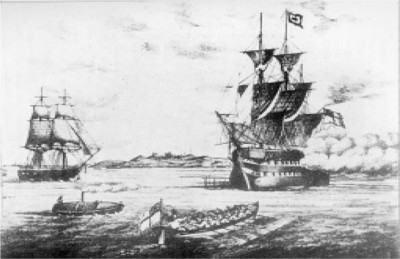
Shipbuilding, like many traditional crafts, was religiously blessed; in fact, a highlight of the book is a report from the Asiatic Journal of January 1820 on the "quite unique” ceremony of "driving the silver nail” in the keel of the East India Company ship Charles Grant, with a Parsi priest holding the said nail "over a pot of frankincense” and reciting a blessing, before it was put in the hole and driven down to the head by a fair lady, after which "The owner... presents the shawls, six in number, to the builders by putting them over their necks. A sprinkling of rose water next is given to all the party... sugar and sweetmeats are distributed to the people of the yard and the party disperses.”
Among the many Parsi characters depicted in the book, that of Ardaseer Cursetjee (1808-1877) stands out for his practical and academic achievements. He was the son of Cursetjee Rustomjee, master builder in the Dockyard from 1844 to 1858, and became a keen mechanical engineer who first applied steam engines to Indian ships, beside creating steam pumps himself and introducing gas lighting in Bombay in 1834. He was actually the first Indian admitted into the Royal Society (1841).
One of the most prominent, yet controversial members of the Wadia family was surely Nowrojee Maneckjee (1837-1909), to whose life and work R. P. Masani’s essay N. M. Wadia and His Foundation is devoted. N. M. was the son of renowned Motlibai, the saintly lady who tried to embody the "spentic” quality, spreading the balm of relief in all directions and at the same time effectively supporting her own Parsi tradition (she paid for all the expenses required for the renovation of the Iranshah Atash Behram in 1893). As a young man, N. M. looked shy and modest, but in 1858 a "sensational episode” seemed to change his public profile. Let’s read from Masani’s book: "On the morning of March 19, 1858, he was proceeding along the Byculla bridge in his carriage when he saw that a horse had fallen on the road and that some Englishmen were standing near, looking at the animal. Being a lover of animals... Nowrojee thought perhaps that the men surrounding the poor animal were aggravating its agony, instead of giving it any relief. He, therefore, approached the Englishmen and requested them to keep away from the animal and leave him in peace. Thereupon one of them, named Richmond, asked him in an offensive tone to mind his business. Nowrojee returned the compliment, perhaps with interest, and proceeded towards his conveyance. This aroused the ire of the saheb. He ran after the meddlesome Parsi’s carriage and, overtaking it, hit Nowrojee with his stick. The sequel to the incident was the appearance of Richmond at the Mazagaon Police Court to answer the charge of assault... Richmond was fined Rs 10 and the Court ordered that the sum should be paid to Nowrojee. He, however, added Rs 10 to the amount and put it in the Poor Box.”
A strange coincidence: a tragic encounter with a horse — but with different reactions and an apparently unhappy personal ending — happened to the German philosopher Friedrich Nietzsche, author of Also spracht Zarathustra (a book which has long distorted the image of the Prophet in the eyes of Western readers). He was in Turin, northern Italy, in February 1889, when he saw a horse being beaten by a coachman. He approached the poor animal and hugged him in tears. This, to the outer world, would mark the evidence of the illness which was already undermining his mind, but I suspect that the episode reveals an irruption of divine love in the heart of a man who had actually chosen the wayward path when he had started despising compassion, humility, etc with his theory of the Ubermensch ("Superman”).
At any rate, N. M. Wadia became a hot-tempered millionaire, rather picky and at times inconsistent, a philanthropist with misanthropic traits. Following his mother’s steps, he practiced a truly ecumenical charity, financing many good causes to the benefit of people from the most diverse ethnic and religious backgrounds, but he could turn stubbornly quarrelsome against his own community on seemingly minor issues (like keeping open or closed the common gate between Motlibai Wadia’s Fire Temple and Petit Dar-e-mehr in Udvada) and even partly disowned his wife, guilty of having helped an unreliable nephew who was in dire need of money out of compassion nurtured by blood links, and making the fatal mistake of selling to that end a diamond necklace which Nowrojee had presented her as a nuptial gift! Of particular interest, in Masani’s book, is the critical comparison between Wadia’s and Andrew Carnegie’s ideas on the stewardship of wealth.
Famous Parsis deals with many more Zoroastrian achievers, namely J. and B. Jejeebhoy, F. C. Banaji, N. Ferdonji, D. M. Petit, S. S. Bengalli, D. Naoroji, K. R. Cama, J. N. Tata, D. E. Wacha, P. Mehta, B. M. Malabari, J. J. Modi, M. M. Bhownaggree. The volume originally completed a trilogy on eminent representatives of foreign faiths — Islam, Christianity and Zoroastrianism — in India, published in 1930 by Natesan and Company. Despite being a collectanea, it appears well articulated and presents a "symphonic” scope of contributions to entrepreneurship, politics, religion, social reform, which fully harmonize with — and integrate — each other. It further commends itself to the reader as vividly pictorial: the personalities portrayed often seem to step out of their pages and speak to our time and condition with their examples. They were, in Robert Carlyle’s terms, representative men, who could easily become ideal patterns for others, thus helping the same build their character, as confirmed by Humanistic Psychology.
Incidentally, it can be recalled that even the American writer Ralph Waldo Emerson, at one time Unitarian minister and then founder of the Transcendentalist literary/spiritual movement, spoke of representative men as indispensable to the ascent of mankind (and Emerson, as one of his most recent and authoritative biographers remarks — see R. D. Richardson Jr.: Emerson, The Mind on Fire, pp. 122, 351 — was an admirer of the Zoroastrian faith). At the same time, one should never lose sight of the myriad anonymous laborers who toiled honestly and unnoticedly making it possible for achievers to reach their peaks: theirs is also a glorious host (as implied, I think, in Farvardin Yasht). In celebrating those Parsi glories, the authors — Parsis themselves — managed to avoid being condescending, and never gave up a sound critical spirit, this being another agreeable feature of the book, which, extending its perspective far beyond biography, glows with brilliant reflections on Indian and international history. If one concept had to be chosen which could summarize the inspirational principle common to all these diverse achievers, it would certainly be swaraj, a word first used by Dadabhai Naoroji with reference to the goal of Indian independence, but certainly embedded in the much wider Zoroastrian value of self-reliance, khaetvadhata, which we daily evoke through the Jasa me avanghe prayer. A self-reliance, let me add, which should be always coupled with an effective social consciousness, in a true "spentic” spirit; this is why I would like to advise the reader of Famous Parsis to integrate the knowledge he can gain from it with the useful information provided by Dr Sarosh M. Soonawalla in his article "Pioneering reforms” (Parsiana, August 2004).
From the thorny paths of history to the spotless heights of devotion Dhalla’s Homage unto Ahura Mazda is an established devotional source for Zoroastrians, though when it was first released (in three parts, 1941, 1945, 1947) quite a few traditional Parsis attacked it sharply — not without grounds — or tacitly boycotted it. Some of Dhalla’s theological assumptions can still be severely questioned (many Zoroastrians would rightly refuse calling Ahura Mazda "the giver of both life and death” as he did), and his language often seems to be excessively soaked in a Judeo-Christian penitential style. Yet, Dhalla’s devotions remain doubtlessly inspiring. They are both etherial and very practical. Above all, they remind us of the need for that fluency of spirit which is the only guarantee of a living religion and warn us to reject bigotry, which is intrinsically anti-religous, and to cherish and pursue justice as a divine legacy and, consequently, as a primary religious goal.
There’s a quality to Dhalla’s words which makes the thought-wave emanating from them truly refreshing and uplifting. Suffice it here to mention a few instances, namely his vivid perceptions of Amesha Spentas, Yazatas and Fravashis, of the radiance of virtue and childhood, of nature’s therapeutic workings of the seasonal spirits ("I was broken and thy nature made me whole, Ahura Mazda.”) Really touching, even poetically shocking, is the description of the ultimate that takes place within a Tower of Silence. But winged ideas and images swarm across all of the book. And, laying temporarily aside the doctrinal reservations one can licitly have, it is possibly expedient to conclude quoting what Prof Mary Boyce has to say about Dhalla’s work in her Zoroastrians, Their Religious Beliefs and Practices "...he wrote several books on Zoroastrian theology and history. These contain much valuable material, but never deal rigorously with the contradictions which arose from the mixture of traditional orthodoxy with alien ideas. Thus he once wrote: ‘It seems to me that we tread a very delicate path when we set aside as non-Zoroastrian all that does not appear in the Gathas,’ and he in fact continued to venerate the yazatas as his forefathers had done... Nevertheless, on paper he was ready to describe these beings as ‘pre-Zoroastrian divinities,’ belief in whom had been ‘engrafted’ on the pure monotheism which Zoroaster had taught. Dhalla was able to live with these contradictions, partly because of a lack of strong concern for logical consistency, partly beacuse the life of the spirit was for him more important than that of the intellect, the practice of the faith than its theology. It was natural, therefore, that among his writings there should be a purely devotional work, called Homage Unto Ahura Mazda... In it Dhalla explicitly accepted a modern Western version of the old Zurvanite heresy, according to which Ahura Mazda himself was the hypothetical ‘father’ of the twin spirits... Yet, though Dhalla thus, under foreign influences, abandoned the fundamental doctrine of the absolute separation of good and evil, his book still breathes the sturdy, unflinching spirit of orthodox Zoroastrian dualism. ‘As a soldier takes the oath of fealty to the king, so is every Zoroastrian arrayed on the side of the King of kings to fight a stubborn fight, a courageous fight...against ...falsehood, inequity, vice and wickedness...I will fight Angra Mainyu, hand to hand and foot to foot and hurl him headlong.’”
Michele Moramarco