Historian Dr Dinyar Patel draws linkages between
the Grand Old Man’s experiences with poverty
and his espousal of higher education for all
Farrokh Jijina
Over 15,000 people assembled at and near Bombay’s Doongerwadi on June 30, 1917 to pay homage to Dr Dadabhai Naoroji at his funeral, narrated historian Dr Dinyar Patel at a lecture titled Dadabhai Naoroji: Evaluating his Legacy a Hundred Years after his Death, a day before the 100th death anniversary of the Grand Old Man of India. Organized by the Museum Society of Mumbai and The Price of Wales Museum of Western India (now Chhatrapati Shivaji Maharaj Vastu Sangrahalaya) at the Museum’s auditorium, the talk was sponsored by a life member of the Museum Society. Patel, an assistant professor at the University of South Carolina earned his doctorate from Harvard University on the political thought and career of Naoroji. He has co-edited Dadabhai Naoroji: Selected Private Papers with S. R. Mehrotra in 2016 (see "Dadabhai’s dossier,” Books, Parsiana, June 21, 2017).
.jpg)
"You must remember that the population of Bombay was approximately 800,000 in 1917,” said Patel who was attired in a dagli and a pugree. The newspapers of the day, along with condolence messages and eulogies to the politician and liberal thinker, carried lists of educational institutions that remained closed that day in mourning. That list included, besides Parsi educational institutions, those of the Jain and Bhatia communities. Patel, who is currently converting his dissertation into a biography for publication, remarked: "Everyone knows about his drain theory, how he estimated that a quarter of the taxes collected in India found its way to Britain, his protests against the famines in the country in which an estimated 28 million died, his role in the British Parliament and in the founding of the Indian National Congress and how he was its president three times.” The focus of the lecture was on "lesser known aspects of his legacy:” poverty, Naoroji’s experience of it, and his use of education as a means of alleviating it.
Naoroji’s forefathers were priests-cum-agriculturists in Dharampur in Gujarat, he narrated. Famines in Gujarat before his birth in 1825 had spurred migration to Bombay. These calamities "may have led to his interest in studying the causes and effects of famine in his later life,” the scholar said. The family home was in Khadak, a not-so-well-off locality outside the Fort in Bombay. Having lost his father when he was four, his mother Maneckbai sent him to a local school; the mehtaji (teacher) there, impressed with his mathematical skills, used the young Naoroji in street shows to demonstrate his prowess with numbers. Such exhibitions were common then, the historian said.
Patel reminded the audience that very few received education in the 1830s; while there were a few missionary schools, the presidency administration had recently set up the Bombay Native Education Society with a "more developed curriculum.” It was due to the mehtaji’s spurring that Maneckbai enrolled her only child in a free school run by the Society. The young Naoroji received "a scholarship of Rs 16 in the 1840s towards his education.” Naoroji was to long remember this: Patel quoted from a 1904 article written by the then 79-year-old leader where he said that he had "received education at the expense of the poor…I must return the best I have in me.”
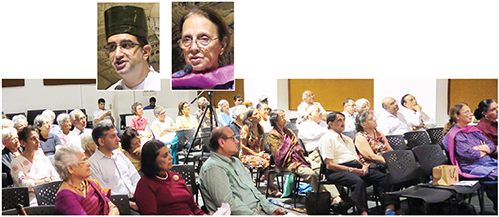
Top: Dr Dadabhai Naoroji; (above) Dr Dinyar Patel (far left) and Dr Pheroza Godrej;
Audience Photos: Farrokh Jijina
Commenting on Naoroji’s founding in 1848 of The Students Literary and Scientific Society and the Gyan Prasarak Mandali, Patel said that the then 23-year-old gave public talks on subjects as diverse as mathematics and "the running of steam engines.” With funding from influential families like the Banajis and the Sunkersetts, and help from Erskine Perry, president of the Indian Board of Education, Naoroji and 12 colleagues established a school for girls "under the Fort walls.” From 1849 to the early 1850s, he and his colleagues taught there before proceeding totheir regular day jobs – teaching at the Elphinstone College. The educator also used his influence with the native ruler of Indore to institute prizes for "good girls in the Fort schools.”
It was not feminist ideals that kick started and encouraged female education in the country, said Patel. "Welfare of women was not the first priority… early educationists wanted women to be better mothers to their sons… the recent crop of college graduates were not happy that they had uneducated wives they could not hold intellectual discussions with.” In response to Parsiana’s follow-up question, Patel said, "I think it would be fair to call Naoroji a feminist for his day. He mentored several Indian women who went to the UK for higher education… At the same time, he believed in the idea that educated women would be better mothers to sons.”
Gulbai, Naoroji’s wife was unlettered, he said. "Her name hardly comes up in any of his correspondence… his efforts to educate her fell flat.” This was corrected in the next two generations of the Naorojis: one daughter, Maki, became a doctor in Bombay and looked after him in his final years; Meher, a granddaughter, was a doctor in Kutch. Two other granddaughters studied at Cambridge and the Sorbonne, while another, Khurshid, toured the North West Frontier Provinces to preach non-violence. "Education lifted Naoroji out of poverty and kept it away from his descendants,” he said.
On a national level, Naoroji was concerned about the financial drain to the country which he expounded on in his tome Poverty and Un-British Rule in India, the other one being moral drain: the thinker was concerned about the non-availability of good jobs for Indians as they were reserved for the British. In a scenario when only one out of 172 Indian men received any form of education and only 100,000 women out of a population of 13 million were educated, Naoroji "excoriated the British for their low investment in education… he was convinced that a college education was the solution to India’s financial and moral drain.”
The leader’s nearly five-decade stay in London and Liverpool saw him liaise with many reformers, suffragettes and educationists. Among them was the champion of female education Mary Carpenter, who he encouraged to visit Bombay on a study tour in 1866. She visited The Alexandra Girls’ English Institution, Patel said, as an aside. Naoroji’s writings of the time show that he used Carpenter’s visit to put pressure on the British government to increase their spending on education, which at the time was a low Rs 300 per individual. The leader served as a conduit for funding from private British individuals to establish and strengthen schools in Karachi and Bombay. "In 1840 when Naoroji started campaigning for better education for Indians, all instructors were male,” he reminded the audience. "No other project was as important as education to the politician in him,” said the academician.
Naoroji’s last public appearance was on January 20, 1916, a year-and-a-half before his death at 91. As the recipient of an honorary doctorate of laws from Bombay University, he was led in a procession along Hornby Road (now Dr Dadabhai Naoroji Road). The procession stopped outside the Young Ladies High School (established in 1889 by Dadabhai’s namesake, Dadabhoy Pestonji Master) which was then located on the main avenue. There he was felicitated by the lady principal, Aimai Patel with a bouquet of flowers.
In response to questions from the audience, Patel elaborated on Naoroji’s links with other prominent Parsi families of the time. While there is very little archival material on the subject, Patel speculated that there would have been linkages: Naoroji’s protégé, inventor Shankar Bhisey was funded by Sir Ratan Tata when Naoroji was unable to. Naoroji "took his students on field trips to the Wadia shipbuilding yards,” he said.
In her welcome address before the lecture, chairperson of the Museum Society, Dr Pheroza Godrej reminded the audience of American writer Henry Longfellow’s words: "Lives of great men all remind us/ we can make our lives sublime.” Getting a speaker for the occasion to do justice to Naoroji’s life and work was "a maze to navigate… it was fortuitous that he (Patel) happened to be in the city just then.” Immediate past chairperson of the Society Arti Mehta presented the academician with a memento. Committee member of the Museum Society Mudit Jain proposed a vote of thanks.