Despite being part of Mohandas Gandhi’s
coterie, little is known of the later life of fearless satyagrahi Khurshed Naoroji
Farrokh Jijina
How did soprano Khurshed Naoroji (1894-1966?), known for her performances in Bombay of Puccini’s arias and dance performances based on Indian classical themes, go on to become a trusted lieutenant of Mohandas Gandhi? A granddaughter of politician and liberal thinker Dr Dadabhai Naoroji, she "picketed liquor shops; preached Hindu-Muslim unity; spun khadi” in the years leading up to Independence, stated Dr Dinyar Patel, assistant professor of history at the University of South Carolina. "Not much is known about her later life… It is ironic that a woman Gandhi promoted is forgotten today,” he rued. Titled "Remembering a Forgotten Gandhian: Khurshedben Naoroji,” Patel’s talk at Mani Bhavan, organized by the Mani Bhavan Gandhi Sangrahalaya and Gandhi Smarak Nidhi on October 19, 2019, pieced together many facets of her life. Patel is writing a paper on the life of Khurshed (also known as Khorshedbanoo), to be published in a festschrift volume for Gandhi’s biographer Ramachandra Guha (see "Stalking a satyagrahi” pg 26).
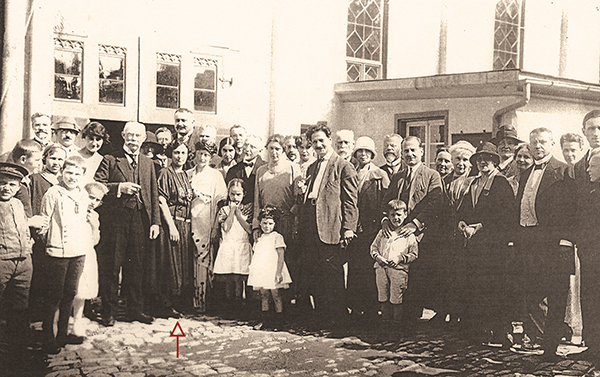
Khurshed Naoroji (see arrow) with Eva Palmer Sikelianos (in white dress) at
Steinmeyer factory in Oetingen, Bavaria, 1924
Photo: Konstantinos Psachos House Archive, Hellenic Folklore Research
Khurshed played many roles, Patel said – translator and interpreter for Gandhi at his Sabarmati Ashram; a preacher of non-violence in the dacoit-infested districts in the North West Frontier Province (NWFP); a supporter of Khan Abdul Ghaffar Khan’s ("The Frontier Gandhi”) Khudai Khidmatgars (the Pashtun nonviolent resistance movement against the Raj); and even someone who did not hesitate to tick off Gandhi when she felt he was in the wrong, stated Patel.
"Do not support the Raj,” she unequivocally wrote to Gandhi when the Congress was prevaricating on whether to support Britain’s World War II (WWII) efforts. Referring to the senior political leader as a "generalissimo who fiddled like Nero,” Khurshed was scathing about the "acolytes” she thought Gandhi had surrounded himself with. "Cease being a Mahatma and be one with the poor… you are negotiating for 35 crore people, not only for yourself,” she exhorted in one letter to Gandhi. His response to that volley from Khurshed does not survive, Patel stated. She volunteered to resign from party work if she was talking out of line, the academician noted.
Born in 1894, "probably in Bhuj” as a posthumous child, her mother Virbai (née Dadina) went to work as a tutor to the children of the Maharao of the princely state of Kutch. Her father Ardeshir, Dadabhai’s son, had served as a doctor there. One of eight siblings ("Yes, that was an age when Parsis actually had children,” quipped Patel), Khurshed’s earliest letter that Patel came across was to her grandfather. As an 11-year-old she told Dadabhai that "the Easter holidays are here and I am so happy to be away from school.” Other than that, not much is known about her childhood, bemoaned Patel.
Khurshed did not go through the radical phase of the political spectrum that her elder sisters Perin and Gosi did, the historian said. However, in 1919, at age 25, she was writing to Jawaharlal Nehru that her activities were being tracked by the French government as she was in touch with liberal elements in French Indo-China. (While living in Europe, Perin was a close comrade of the revolutionary Veer Savarkar. She was "simultaneously working with Polish revolutionaries to learn to make bombs,” noted Patel. "While we have less material on Gosi, both Perin and Gosi were under surveillance by the British authorities,” he stated. Both sisters had relinquished their radical views by 1915, added Patel.)
In Paris for higher studies in music, Khurshed befriended Eva Palmer Sikelianos, an American best remembered for her promotion of classical Greek culture. The Parsi woman furthered her interest in Indian classical music, learning how to prepare notations for Indian music. "By 1920, she decided to tour Greece to study ancient classical notations for western music,” shared Patel. "Seeing the Greek countryside, she seems to have been reminded about India…probably the only instance where Greece has inspired Indian nationalism,” said Patel. It was there that she renounced western clothing and adopted Parsi saris.
Dr Artemis Leontis, biographer of Khurshed’s American friend notes in Eva Palmer Sikelianos: A Life in Ruins that the Indian woman wrote to Sikelianos in 1925 that she would give an ultimatum to her family that she wanted to begin her work in Indian music "with a view to a profession” as soon as she could grasp it. "If not, I want to try yoga. I do not wish to open an academy of European music before we have one for purely Indian music,” she wrote.
Spurning Sikelianos’s request to help her propagate Greek culture, she returned to Bombay in 1926. Unhappy in her mother’s Napean Sea Road bungalow, she wrote "How can I live in a large house and be ferried in cars?” A worried Virbai approached Gandhi asking for his suggestions on ways to occupy Khurshed. It was "motherly intervention” that forged Khurshed’s link with Gandhi whose popularity as the moderate face of the Independence movement was then increasing, said Patel. Starting off as translator of the letters Gandhi received from his French correspondents, she served as interpreter for the leader when he met a delegation from Indo-China. "Between 1927 and 1931, we see her moving into Gandhi’s inner circle… she was teaching women to protest at liquor stores in Ahmedabad… she was farsighted…she even asked Gandhi what she should do, if as a Parsi, she came across a Parsi-owned liquor store,” narrated Patel.
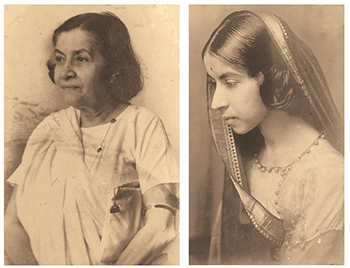
Perin (far l) and Gosi Captain: Naoroji’s sisters "under surveillance
by the British authorities" Photos: Gandhi Seva Sena - Village Industries
Aware that Gandhi was averse to women joining the Dandi March to protest against a tax on salt in 1930, she wrote a "stinging letter” to the leader. This possibly resulted in Gandhi relenting to the extent of allowing an advance party of Khurshed, Mridula Sarabhai and other women supporters to march ahead of him, noted Patel. The women spread the message of cleanliness in the villages they walked through, which "impressed Gandhi.”
"And in 1932 she surfaced in Lahore… Gandhi was using her to collect information about Khan’s activities…she rubbished the general speculation that Khan was an Afghan agent,” stated Patel. She was "distributing copies of Gandhi’s writings and defusing Hindu-Muslim tension,” and preaching the mantra of nonviolence among the Pashtuns of the north westernmost corner of the subcontinent. For her efforts, she was promptly jailed in Peshawar, "where the fleas and I kept each other warm,” she wrote. When she started spreading Gandhi’s message among other jail inmates, the British authorities put her on the Frontier Mail back to Lahore where she again courted arrest. "We sense major political purpose in her in that phase of her life,” stated Patel. She wrote to Gandhi that Khan’s efforts should be buttressed: "We must keep sending more people (to the NWFP) to keep their spirits up.”
By 1940, she was back at the frontier, extolling the virtues of khadi and encouraging women to weave. In November of that year alone, she wrote that she walked through 40 villages, covering 60 miles. "What a sight that must have been…a Bombay woman in a Parsi sari travelling alone,” in that bleak terrain, noted Patel. It was a lawless region, "with bullets whizzing next to me,” wrote Khurshed. Having picked up local dialects, she wanted to spread Gandhi’s message of nonviolence in the dacoit-infested regions. That idea, even the Mahatma found "audacious.”
"Dacoits may chop my ear or finger and ask you for a ransom, but I need to go,” she wrote to Gandhi, before proceeding to a particularly dangerous area of Waziristan district in NWFP. She was able to persuade dacoit gang leaders to release two Hindus from captivity. The Parsi woman worked with local imams to promote harmony. The mother of one dacoit was so moved by Khurshed’s message of nonviolence that "she vowed never to cook for her son,” narrated Patel. While the British deputy commissioner of the area appreciated her efforts for Hindu-Muslim unity, she was deported from NFWP, barred from going back, and indeed ordered to remain only within Bombay city limits. "I will be violating this order soon,” she wrote, before proceeding to Sevagram in Maharashtra to visit Gandhi at this ashram there. Sure enough, she was arrested and jailed, this time in Poona, a motif that repeatedly occurred between 1941 and 1945.
"We see from her letters in 1944 that she did not have a wholly rosy picture of the Congress policies…An astute commentator, she urged the leaders to be more realistic in their vision… She wanted them to understand the Pashtun people.” Concerned about the impact the end of WWII would have on India, she wrote about her apprehension that as an appeasement measure, the British government could give away some part of the frontier provinces to Germany, narrated Patel.
By the end of WWII, Khurshed slipped into obscurity. She received her last letter from Gandhi in January 1948 when working in Jullundur in the Punjab with victims of Partition. In the first two years of the 1950s she again took to singing at the Cowasji Jehangir Hall. French, Italian and Spanish music was her forte. After one concert, the music critic of The Times of India wrote that the timbre of her voice may have deteriorated, but that was understandable considering her 20 years of hard labor, quoted Patel.
"After 1952, we know nothing about her… We are unsure when she passed away,” noted Patel. The generally accepted year is 1966, though some believe she died much later, only in the 1990s, noted Patel. While the Bombay Chronicle carried obituaries for some of her siblings, none appeared for Khurshed. The last of her siblings passed away in 1980. None had any offspring, he said.
Critical of the state of some of the archives he accessed in India, Patel commented that "Khurshed’s life is the perfect example why biographies are so difficult to write in India… How do you do justice to someone like her, when we do not have complete information about this Gandhian?”
Dr Usha Thakkar, president of the Sangrahalaya offered a vote of thanks to Patel and the audience.
Stalking a satyagrahi
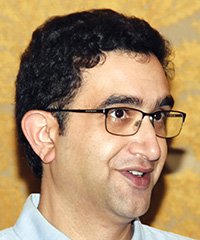
Assistant professor of history at the University of South Carolina Dinyar Patel (pictured) says he "first encountered freedom fighter Khurshed Naoroji’s name over 10 years ago, while going through the Collected Works of Mahatma Gandhi. Gandhi wrote an extensive article on her work in the North West Frontier Province (NFWP) in 1941 to highlight how the British were unfairly going
after someone who had done so much good work.”
Over the years, he found some of her correspondence in other sources. "I found out that a professor from the University of Michigan, Artemis Leontis, was writing the biography of Eva Palmer-Sikelianos, Naoroji’s American friend in Greece, and that she had also written a paper on Naoroji’s friendship with Palmer Sikelianos.” Leontis was "generous enough to send me copies of Naoroji’s letters that she found in an archive in Athens. In the New York Public Library, I found some letters that Gandhi wrote to Naoroji and her sisters — these were in the papers of Louis Fischer, a prominent journalist who was very pro-Indian independence,” Patel stated. The Maharashtra State Archives has correspondence relating to her incarceration during World War II, he added.
"The largest trove of material related to Naoroji is in Teen Murti House (museum and library) in Delhi. Gandhi’s papers (which are voluminous) include many letters from Naoroji — most from 1940 and 1941. Gandhi wryly remarked that she was "raining letters” on him during that period — significant since Gandhi himself was a formidable letter writer. Aside from Gandhi’s papers, there’s more material in the papers of his son, Devadas Gandhi, as well as in the papers of a Congress leader that she helped recruit in the NWFP, Fateh Chand. I don’t think anyone had bothered to look at Fateh Chand’s papers before me, so they had to be paginated before I was allowed to consult them!”