A workshop on Parsi commercial history paves the way for
closer cooperation between like-minded scholars and historians
Farrokh Jijina
"The Parsis made Bombay as much as Bombay made the Parsis,” according to Prof Tirthankar Roy of the London School of Economics, Department of Economic History. He was chairing the morning session of a workshop on "The Parsis of India and their economic and commercial enterprise: 18th-20th centuries” at Godrej Bhavan on April 7, 2017. The city had many multi-cultural groups, "observing and learning from other groups… such interaction is not possible in inland cities,” he said. Lauding the community members’ generally "strong ties within themselves,” Roy remarked that the Parsis were "not always” a cohesive community! The academician clarified that historical documentation of business families has been "from a political angle so far.” The story "is now changing to documenting how communities grabbed the opportunities thrown up.” He reminded the scholars present that while the early Parsis were focused on business enterprises, in later years, many entered ‘knowledge dissemination,’ his terminology for those involved in intellectual endeavors. The community "had qualities to succeed in business,” but were "not necessarily a business community,” he said, summing up his opening remarks.
Earlier, Dr Pheroza Godrej welcomed the 13 historians, journalists and academicians present: "you are the think-tank,” she said, urging the group to not only look back into Parsi history, but also to look at what lay ahead for the community. Dr Ghulam Nadri, the organizer and convener of the workshop commented that this was "not a formal conference, but an informal conversation with interested collaborators for a forthcoming international conference on Parsi commercial history. He acknowledged the support of The British Academy in co-sponsoring the event. The associate professor of history at Georgia State University, who has written two monographs on the political economy of 18th century Gujarat and on the political economy of the indigo plant is currently researching the dynamics of economic and commercial enterprise of the Parsis.
Commencing his talk on "Together they grew: Parsi commercial enterprise and the East India Companies (EIC) in 18th century Surat,” Nadri set the background: the south Gujarat city was undergoing political instability in the 1720s and 30s… the British EIC took over Surat Castle in 1759. "The Parsis in Surat did much better than other communities… maybe the Turks came second,” he noted. His reasons: they were open to explore and take every opportunity available; they diversified from traditional occupations like weaving into shipping, ship-owning and financial intermediation; they were not hesitant to form partnerships within themselves and with members of other communities, including Europeans.
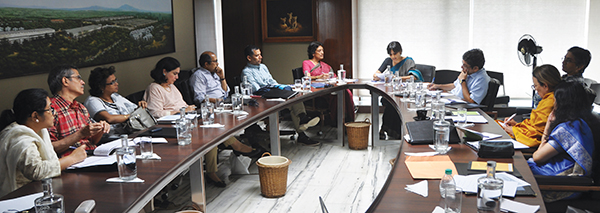
Deliberations at the seminar
From left (sitting): Dr Mariam Dossal, Dr Namrata Ganneri, Dr Louiza Rodrigues, Firoza Punthakey Mistree,
Dr Pheroza Godrej; (standing): Dr Manjiri Kamat, Dr Simin Patel, Dr Meher Mistry, Rashid Wadia,
Prof Tirthankar Roy, Murali Ranganathan, Parsiana representative, Dr Ghulam Nadri
Giving examples of Rustomji Maneckji and Mancherji Khurshedji, prominent merchant princes, Nadri explained that Maneckji was very closely allied with the Europeans despite challenges faced from the "Bania Parekhs.” Khurshedji was associated with the Dutch EIC for over 30 years, including for a while, in partnership with a Bania family, he added. "He was a portfolio capitalist, not only a broker,” he said. The businessmen of the time made strategic alliances that were mutually beneficial to the Europeans as well as themselves, he said. "There were many instances where the Parsi merchants dominated the relationships” with the foreign trading companies and "even got them to work on their terms and conditions,” he lauded. Brokering services, agency services and trade provided social status to the Parsi merchants as well as earned them protection from the EIC against external threats. "When Dhunjeeshah Munjeeshah’s vessels were captured by the Portuguese at sea, he reported this to the British EIC and it became an international incident,” said the associate professor. "It was a dynamic relationship…Parsi fortunes did not depend solely on this equation.” There was a need to ‘elevate’ the relationship question from an Anglo-Parsi one to a European-Indian one, he concluded.
Parsi merchant princes in Surat were not averse to switching loyalties between the EIC, according to Dr Meher Mistry, assistant professor of history at Ramniranjan Jhunjhunwala College. Speaking on "A tale of two cities, two calendars and two Parsi merchants in 18th century Gujarat,” the academician said that Khurshedji, a leader of the Shahenshahi sect, who enjoyed the protection of the British EIC, became a broker to the Dutch EIC after his patron within the British Company was expelled. Khurshedji "harassed merchants who had British protection,” and ultimately "suffered a gradual reversal in fortunes.” Leader of the Kadmis, Munjeeshah, who had extensive jagirs, in addition to being a broker to the British EIC, "bribed the Nawab of Bharuch” to have the head of the Shahenshahis there deported to Surat, according to Mistry. When riots broke out between the two sects in 1768 in Surat, Munjeeshah’s contract with the British EIC was awarded to one Dadabhai Maneckji, who was instrumental in complaining to the Bombay administration about Munjeeshah’s role in the riots. "They (Parsis) used religious controversies for economic ends,” Mistry concluded.
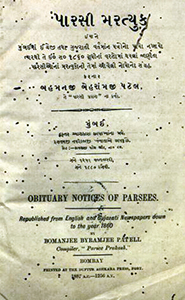
Parsi Martyuk Image: Murali Ranganathan
Portrait of Gulbai Panday (center) and her daughters; Photo: Peonies and Pagodas
Dr Louiza Rodrigues, associate professor of history at Ramnarain Ruia College believes that "family histories… when revived through genealogical research can create interconnections between … history that was left unwritten and that that was known…” Speaking on "Economic trends of the Seth/Sethna family: A historical perspective,” Rodrigues explained that the descendants of the family patriarch Maneckji moved to Bombay from Surat in the mid 18th century to beat a slump in trade there. "Their orientation changed after they moved to Bombay… they went into philanthropy in a big way… 25 trusts were set up by Maneckji’s descendants for religious and charitable purposes… later diversified to social infrastructure.”
The early 19th century saw their foray into the China trade and by the mid 19th century, they were among the first to establish cotton mills. Lady Navajbai Tata, a scion of that family was the first, and for a long time, the only woman director on the board of a Tata company. Echoing Roy’s thought that Parsis from business families moved into ‘knowledge dissemination,’ Rodrigues recalled Dr Sam Sethna, who was a director of fisheries and founder of the Taraporewala Aquarium in Bombay, and made several improvements in fishing methods after being deputed to Japan and Norway to learn the latest technologies in the field. Sir Pheroze Sethna, she noted, was a pioneer in providing cotton for upcountry mills; he held directorships in several companies and was also one of the founders of Bombay Talkies: "one of the early doyens of modern Indian industry,” she said.
Partners, refugees and texts
Chairing the afternoon sessions of the workshop, Dr Mariam Dossal, former head and professor in the department of history, Bombay University exhorted the scholars to look beyond Bombay. "There is a wealth of Parsi business history in smaller cities in western and northern India,” she said.
"Partners in building the second city of the British Empire: Parsi enterprise and philanthropy in India” was the focus of Dr Manjiri Kamat’s talk, the first session of the afternoon. The professor and head of the department of history at Bombay University rued that "not enough research on family histories or Parsi managerial cadres in Parsi-owned businesses” was carried out. Kamat said that it "was not easy” for the trading families to move to building cotton mills. "Cotton was then to be exported (to the mills in England), not processed locally!” she said. The academician recounted various Parsi firsts in infrastructure building, healthcare, housing and education and appreciated the dynamism of the community: "when the cotton trade was in decline, they quickly moved to other industries,” she lauded.
Dr Simin Patel, historian and diligent documenter of city structures on her blog bombaywalla.org believes that the Persian Parsis (Iranis) who came to India to beat the famine in their home country in the last half of the 19th century fostered cooperation between the Parsis in various pockets in the country. Community members in Surat, Ahmedabad and other cities in the interiors of the Bombay presidency contributed towards "Amelioration and accommodating the ‘Persian Parsees’ during the great famine of 1871-72.” Parsis in Gujarat who had been the recipient of charity till then, started aiding the refugees. Various funds and charitable organizations competed with each other to aid the newcomers to India, she exulted.
Migrants to Bombay partook of the city’s Parsi landscape of firetemples, asylums and the Towers of Silence and were formally organized into an Iranian Zoroastrian Anjuman in 1918. The newcomers took up the occupations of planters, gardeners and florists, having been agriculturists in Persia. Some migrants found employment as gardeners at the Bombay Doongerwadi — they could reside there and were entitled to meals at a nearby asylum for invalid and blind Parsis. Space constraints in the asylum caused by the increasing refugee population prompted philanthropist Cowasji Jehangir to fund the construction of a chawl in the vicinity. In total, the original and new structure for the Persian Parsis could accommodate 200 inmates. "While women and children were allowed to stay as long as they chose, male migrants could avail of the accommodation only until they found employment,” Patel quoted.
The historian suggested that the refugees of the early 1870s were not accommodated within Parsi families as was the case with previous waves of migration as "the accounts of the impoverished state…of the refugees that were circulated by the Press lent to the image of the refugee as a liability.” For the Persian Parsis, the migration to Bombay "resulted in being subsumed into the lower orders of the Parsi community… It was perhaps the association of ‘Persian Parsis’ with ‘poor Parsis’ that spurred the migrants to more actively adopt the identity of ‘Iranis,’” Patel concluded.
Magazines like Vidhyasar, started in 1842 by Naorojee Fardunjee, and others like Jagat Mitra and Jagat Premi carried various accounts of trade with Canton, according to independent researcher Murali Ranganathan, the last speaker of the day on "The Bombay country trade: mining early Parsi Gujarati texts.” A travelog Cheen no heval by Cowasji Patel published between 1842 and 1848 in two volumes describes every province of China in detail, according to Ranganathan. The tome is a compilation of accounts of previous British travelers, and "was the first detailed account of China in any Indian language,” he added. A debate on the morality of the opium trade was started for the first time in the 1850s by Mancherji Langdana, writing under the pen name of Mansukh. Epic poems giving philosophical reasons why the opium trade was "wrong” were composed. The Vepar Kosh provided detailed conversion tables for measures in use in China, UK and India, he demonstrated with slides. Mumbai no bahar, written in very archaic Gujarati, even for that time, by one Ratanji Vachha gave biographical sketches of Bombay traders and is "one of the more reliable sources of information on Parsi traders,” of the 19th century. The newspaper Rast Goftar contended, however, that "several unworthy families were included” in it!
Though the Parsi Prakash brought out by Bomanjee Patell was a detailed calendar of events (Volume I — up to 1860 and Volume II — up to 1880), being a compilation from newspapers and magazines, it cannot be relied on for Parsi business history; also, there was very sketchy information about events prior to 1850, he added. Ranganathan recommended Parsi Martyuk, — the announcements of Parsi deaths as a very detailed source of business history as the obituaries, also compiled by Patell, "were almost biographical” in nature.
Takeaways
Summing up the day’s proceedings, Nadri said that binary definitions of "colonial and post colonial” are not good. Scholars need to look at a longer horizon to document the Parsi contribution. The role that culture plays in economic history and Parsi businesses that failed are under-researched topics, he said, as is the role of Parsis in the labor movement and trade unionism. "Look at other locations beyond the Bombay-Surat axis and even the diaspora,” for Parsi business histories, he exhorted those present.
Roy advised the scholars to identify and focus on a few themes for the conference proposed for the end of 2018; "build a database of what is available in which library,” he suggested. An interactive bibliography was the need of the hour, he said. Historian Firoza Punthakey Mistree recommended the setting up of a central depository where folks who did not wish to retain documents connected with their history could send their material. "We need to encourage the community to retain material connected with their history,” she added. Capacity building, to enable scholars to read Gujarati texts of the time was needed, according to Ranganathan, while Nadri suggested revitalizing a previously started project for translation of Parsi Prakash.
The scholars present agreed to be networked to share ideas and work on a restricted website for the group present.