Selling the jewelry inherited from Avabai Petit,
her daughter founded an orphanage and school for Parsi girls
Yasmin Charna and Nawaz Merchant
Bai Hamabai Mehta was the granddaughter of millionaire brothers Sir Dinshaw and Seth Nusserwanji Petit. Though born into wealth, she inherited the spirit of benevolence of both these philanthropists.
Born in 1883, in her youth Hamabai was reputedly a great sportswoman, a keen rider and once owned prize-winning race horses. She was also one of the first Parsi lady motorists. She toured the world, visiting the remotest regions.
On the death of her mother Bai Avabai in 1907, young Hamabai inherited jewelry estimated at about Rs 12 lakhs which she sold and donated the proceeds towards the foundation of the Parsi Girls’ Orphanage at Pali Hill, Bandra. It was named the Bai Avabai Framjee Petit Parsi Girls’ Orphanage, after her mother.
In 1919 at the age of 36, Hamabai married Jehangir K. B. Mehta, a nephew of Sir Pherozeshah Mehta. He was a consummate rider and had toured the world. With the concept of philanthropy ingrained in him he was a constant helpmate to his wife and took a lively interest not only in the charitable institutions endowed by the Petits but also the welfare of the larger Parsi community.
The institution, now named The Bai Avabai Framji Petit Girls High School, is nestled between the wide seaside sweep of Carter Road and Pali Hill. Hamabai decreed in the trust deed that "the principal and primary object of the said institution shall be able to provide for the bringing up, maintenance and education of Parsi orphan girls or fatherless/motherless Parsi girls left or being in destitute or helpless circumstances and professing the Zoroastrian religion.”
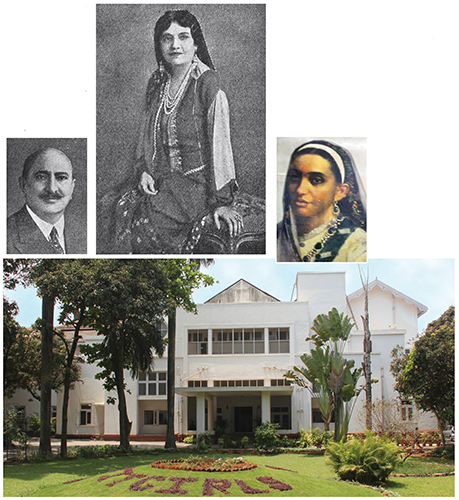
Clockwise from above l: Jehangir and Hamabai Mehta;
Avabai Petit; Bai Avabai Framji Petit Girls High School
1st and 2nd row: various activities at the School Illustrations by Jennifer Dinshaw;
3rd row: School logo; sports ground;
bottom l: Fasli Atash Kadeh at Churchgate Photo: Parinaz M. Gandhi
From its inception in 1913, the aim of this institution was liberal and far-seeing. Its main object was to give such girls the advantage of an education which would enable them to become useful members of society and as future wives and mothers. If circumstances so compelled, they would be able to earn their own livelihood by turning their hands to any honest toil befitting a woman, instead of relying on charity or becoming a burden to society. The education to be imparted in this institution was hence both practical and purposeful.
The main building originally belonged to a British company and was sold to Hamabai to fulfill her mother’s dream. It was palatial with large halls, lustrous marble flooring at the ground level, gleaming wooden flooring on the upper storey, two huge staircases with gorgeous stained glass panels on each landing, large doors and windows with elegant wrought iron grills on the mosaic tiled veranda facing the sea. This building was later renovated to make way for the building that stands in its place today. There are also on the premises six cottages donated by charitable Parsis in memory of their loved ones — Bharuch Cottage, Cama Cottage, Judge Cottage, Bharda Cottage, Tata Cottage and Bamji Cottage. These have endured the passage of time and can be seen on the premises even today. The school opened its doors to all communities in 1963 and offered the ICSE (Indian Certificate of Secondary Education) exam around 2012.
Every year on Founders Day it was a tradition for the Petit school to organize the navjote ceremony of one or more students from the orphanage. During her lifetime, Hamabai often graced the occasions with her presence. While preparing for the navjote, it is recalled that she would take the little girl aside, embrace her warmly and speak kindly to her.
In later years, Hamabai, though petite, looked dignified and had a gentle, benign face. She had bobbed hair and would cover her head with her sari. She was deeply religious.
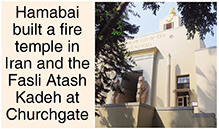
To commemorate her father Framji Petit’s long-standing family connections with Iran, Hamabai built a fire temple in Iran and the Fasli Atash Kadeh at Churchgate, structured on the Iranian tradition. The entrance to the fire temple is guarded by winged bulls reminiscent of the Gate of All Nations at the city palace of Persepolis.
Hamabai died in 1955. Though she had no children of her own, she impacted the lives of thousands of girls who were educated at her School. Undoubtedly the most enduring legacy she passed on to all the boarders at the School would be the respect, values, faith and dedication on which she built her life. Hamabai’s philanthropy to both the Zoroastrian community and the cosmopolitan world was considerable. Although she had access to everything the world has to offer that men and women desire, she had a better way of achieving happiness, using her wealth for the benefit of suffering and needy humanity. By her numerous acts of charity, she made a significant contribution to the reputation for benevolence of the Parsi community.

Yasmin Charna (left), an ex-student of Bai Avabai F. Petit Girls High School, is currently in charge of its boarding section for Parsi girls. Nawaz Merchant is also an ex-student and the award winning author of Murder in Old Bombay.