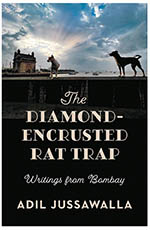
The Diamond-Encrusted Rat Trap: Writings from Bombay by Adil Jussawalla. Published in 2025 by Speaking Tiger Books, 125A, Ground Floor, Shahpur Jat, New Delhi 110049. Pp: 191. Price: Rs 499.
Adil Jussawalla never ceases to amaze us. He is both an accomplished poet as well as a writer of prose, both creative and journalistic. Fast on the publication of It Remains To Be Said: Poems in Time, in Wilderness, Jussawalla has published a collection of his prose work, The Diamond-Encrusted Rat Trap: Writings from Bombay. He has already published several such volumes earlier. In addition to his editing of the path-breaking anthology, New Writing in India which was published more than 50 years ago, his other prose collections include Maps for Mortal Moons, The Magic Hand of Chance and the recently published, Body of Evidence in sickness & in health. He has been honored with the Sahitya Akademi Award for his collection of poems Trying to Say Goodbye as well as nominated the Poet Laureate at the Tata Literary Festival in 2021.
Adil Jussawalla: creative journalist
The very title of the collection, The Diamond-Encrusted Rat Trap very aptly and concisely captures the essence of Bombay. A parchment is found in a diamond-encrusted rat trap. When it is decoded one realizes it is a document written by a pundit whose services were engaged by a wealthy man, Chamanlal Bhogilal, to teach his eldest daughter. Bhogilal played an important part in the reclamation project in the city and became very rich and arrogant. He then invested in a textile mill which also brought him great returns. But poison entered his house ironically in the form of a "pox ridden Italian monk,” who infected the entire family; in spite of all his wealth Bhogilal died a broken man. His only friend in the last few days of his life was a rat, which is ironical because he had destroyed rats indiscriminately when he was reclaiming land. Just as the wealth and riches of Bhogilal conceal the pox from which he is suffering, this City of Gold, this emerald-encrusted rat trap, harbors suffering and corruption.
The city can be a nightmare especially for the poor and the downtrodden. The well-heeled go for long and luxurious holidays. In "Want to Get Away? Let Others Do it for You,” the cacophony which assaults the inhabitants of the city never seems to lessen even during the holidays. How should one take a break from struggling against the "severe city-induced nervous disorders?”
And what about the poor who can’t afford holidays? In "Voices from Homeless Areas,” Jussawalla writes very movingly about the plight of homeless and destitute children. He compares poems written by children in America whose major concerns are "dirt, mess, and the need to live in places that are clean” with the suffering and the sorry plight of the Indian street children, as voiced by them in a poem in Hindi, "Your Victory, Our Loss,” which needs to be quoted in full:
"City yours, Footpath ours
Language yours, Curses ours
Price yours, Work ours
Earnings yours, Labor ours
Medicines yours, Illness ours
Government yours, Thrashings ours,
Life yours, Death ours,
Victory yours, Loss ours.”
Once again in "Utopias for the Houseless,” Jussawalla refers to the difficulties of living in the city. He expresses sympathy for individuals who have lost their houses due to various factors and have to "devote all their energies to finding a new roof over their heads that very day.” Newspapers speak about the "cruel problems” of housing shortage faced by a large percentage of the population living in our city. Jussawalla reminds us that it is only when Lear loses his kingdom and his luxurious palace in Shakespeare’s King Lear does he realize the plight of the "poor naked wretches.” The article ends with the suggestion that maybe Lear’s realization could hold good "for our rulers today.”
The city is obsessed with wealth and riches. Jussawalla quotes American novelist and travel writer Paul Theroux who noted that Bombay "smells of money.” In "O City, City…,” Jussawalla once again uses King Lear as the starting point of his argument. He compares Lear — who lost his mind and his kingdom — to "King-pin” (Harshad) Mehta, who may have lost very little himself but his exiting the stock market caused "the entire edifice to come crashing down.” All the journals speak about Bombay being the City of Dreams, the City of Gold and believe it will live forever. They speak about the city’s "power of recovery” and its "indestructible spirit,” but one tends to ignore the millions of poor people who have not recovered and whose spirit has been totally crushed.
But all the articles are not about the schism between wealth and poverty in Bombay. Jussawalla’s love for nature — which has inspired a chapbook (booklet) of poems entitled Earth — is also reflected in his perceptive, warm and informative review of The Oxford Companion to Gardens. The review begins in a humorous manner about his own unsuccessful attempts at gardening. Even when plants tend to sprout, his "leggy but stately avocado now looks like Whoopie Goldberg in a state of shock, its crown spindly and charred, like an Afro undone.” In "In the Beginning Was the Bird,” Jussawalla expresses his concern for nature and the environment. He does not deny the need for the lepidopterist to sedate the butterflies and the ornithologist to capture birds to study them or the sawing of trees to make way for essential roads. Though he admits that these are useful, they come at a cost. Jussawalla poses the question: "How do we interact with nature which we desperately need, how do we become a part of it without destroying it in some way?” One sees his love especially for birds when he refers to Indian author and lawyer Khushwant Singh’s short story, "The Portrait of a Lady.” Singh’s grandmother fed birds every morning, but, as a mark of respect and affection, they refused to eat even a morsel when she died and refrained from twittering till her body was taken away. Jussawalla quotes the last stanza of American poet Wallace Steven’s poem, "Sunday Morning.” Especially significant, the last few lyrical lines:
"At evening, casual flocks of pigeons make
Ambiguous undulations as they sink,
Downward to darkness, on extended wings.”
His affection for nature also extends to the sea. Living on the 18th floor of a high rise, he recalls entering the vacant flat for the first time, when "the sea and the sky rose before our eyes in dazzling splendor.” The sight of a fishing dock and trawlers mesmerized him. In "Setting Herself Right,” he thinks of Polish-British novelist Joseph Conrad’s The Nigger of the Narcissus. Not many people know that Conrad stayed in Bombay at the Royal Alfred Sailors’ Home, now the Headquarters of the Maharashtra State Police. The ship, the Narcissus, had spent a day picking up crew. Conrad describes the departure from the harbors of Bombay in vivid and poetic terms. "A slight haze blurred the horizon. Outside the harbor the measureless expanse of smooth water lay sparkling like a floor of jewels…” Jussawalla wrote a magnificent poem, "Shorelines,” and also gave the same title to the collection; however, he rightly raises the issue that though Bombay has always been the center of maritime trade — a strategic port with docks and shipyards, the inhabitants of the city have written so little about it especially in fiction and drama.
Topics as varied as meetings with author Mulk Raj Anand and poet Nissim Ezekiel, his Tuesday readings called "Loquations,” which were devoted to poetry, lunar eclipses, babies, books, Indian festivals find mention in the book. Above all, his role as "one of the great unrecorded archivists of the city,” makes the collection a joy to read, says writer, Indian poet and novelist Jerry Pinto in his Introduction. It delights and it instructs in equal measure. FIRDAUS GANDAVIA
Gandavia holds a doctorate in English literature and is a retired chartered accountant. He is a compulsive reader of fiction.