"It’s always an honor when your work gets recognized and awarded by the Academy (of Motion Picture Arts and Sciences)… Tenet is very special, considering the amount of challenges the whole world is facing right now. To continue to collaborate with all the global sites and deliver such high-quality work brings immense pride and joy,” Merzin Tavaria, president, global production and
.jpg)
operations at DNEG (Double Negative) India communicated to Parsiana. DNEG was recognized at the 93rd Academy Awards, the Oscars, for their work in the area of visual effects (VFX) for Tenet on April 25, 2021. "I am thrilled with this honor and look forward to the opportunities that lie ahead of us,” Tavaria wrote. The Christopher Nolan directed movie follows a secret agent who learns to manipulate the flow of time to prevent an attack from the future that threatens to annihilate the present world.
A press release from the company notes that DNEG’s VFX team, "led by overall VFX supervisor Andrew Jackson and DNEG VFX supervisor Andrew Lockley, helped to deliver highly complex sequences to convey the film’s concepts of time inversion.” Jackson reportedly "consulted with world-renowned physicist and Nobel prize winner Kip Thorne… to ensure the film was grounded in scientific theory… This enabled the team to shoot sequences that depicted the movement of objects through an inverted timeline, a solution that required an unprecedented level of pre-production VFX input to reduce the amount of VFX required in post-production.”
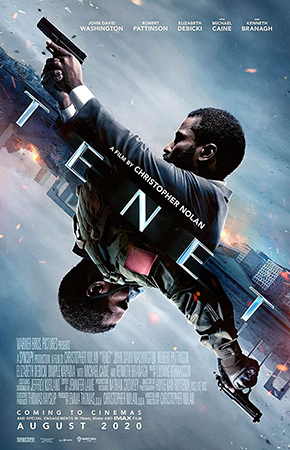
Top: Merzin Tavaria; above: poster of Oscar-winning film Photo: Wikipedia
DNEG’s chief executive officer Namit Malhotra was quoted in the press release as stating: "Working with visionary filmmakers like Nolan elevates the work of every single department involved in the filmmaking process. That Nolan and Warner Bros have put their faith in our teams once again, to design the visual effects sequences for Tenet, is an honor and a privilege.”
Prime Focus, the company Tavaria founded in 1997 with three others, Malhotra, Prakash Kurup and Huzefa Lokhandwala, merged with the global UK based DNEG in 2014. The win this April is DNEG’s sixth Oscar, previous accolades in visual effects being for First Man (2019), Blade Runner 2049 (2017), Ex Machina (2015), Interstellar (2014) and Inception (2010).
Reporting on the Oscar win on April 28, The Mint stated that the Indian animation and visual effects industry, which commands around 10% of the global market share, has the potential to reach 20-25% by 2025, according to a recent media and entertainment industry report by the Boston Consulting Group (BCG) and Confederation of Indian Industry (CII).