Community leaders detail the successes and set backs faced by their associations
Arnavaz S. Mama
The proposed amendments to the Federation of Parsi Zoroastrian Anjumans of India (FPZAI) constitution and other contentious issues discussed at it’s executive council meet on March 25 and 26, 2006 were published in Parsiana, April 7, 2006. The second installment reported on questions of demography and defunct anjumans. This final instalment speaks of happenings in various parts of India.
Issues of demography assailed anjumans big and small. While deaths are easier to register and tabulate, a record of births has not been easy to maintain. Some, like the Bombay Parsi Punchayet (BPP), the Calcutta Zoroastrian Community’s Religious and Charity Fund (CZCRCF), the Parsi Zoroastrian Anjuman of Secunderabad and Hyderabad (PZASH) are presenting the parents of newborns with a cash gift in an effort to get them to register. A parallel concern for the optimum use of resources has led to renewed calls for individual trusts to come together to hammer out a common and equitable policy on donations so that unscrupulous beneficiaries do not benefit to the detriment of the genuinely needy.
Pervez Irani, vice president of the Iranian Zoroastrian Anjuman (IZA), sought a list of five to 25-year-old students in conjunction with the BPP in order to monitor each child’s progress up to graduation and earmark those who show promise. Irani said the Saifee community maintained such data while providing educational grants and seed money for entrepreneurship. With an eye on demography simultaneously, Irani noted, "Our total number is only 69,000. (It would) help us channelize funds — some get more from various trusts.”
While FPZAI joint honorary secretary Keki Gandhi acknowledged that the Bardoli and Mhow anjumans also provide scholarships, BPP CEO Behram Dastur recalled the Punchayet’s six-year-old effort to coordinate data sharing with trusts and anjumans: "Except for the IZA no one responded.” Three Tata trusts including the Sir Ratan Tata Trust and the Sir Dorab Tata Trust are the only ones who work with the BPP, he noted.
Irani and Jamshed Mohta, president of the Bardoli Jarthosti Anjuman had information of value to all India Zoroastrians: Irani informed the gathering that the Maharashtra government forest department provides land on nominal lease for 20 to 30 years. The stipulation is that 50 percent of the produce has to be given to the government. Irani suggested that individuals or anjumans can avail of the scheme to grow bawal for the fire temples. BPP chairman and Federation president Minoo Shroff suggested the use of such land for adventure tourism: "Encourage people to start a tiger preserve.”
The villages around Bardoli are developing with the Gujarat government having finalized road linkages. Mohta offered his anjuman’s assistance to Parsis interested in establishing shops there. Gandhi agreed to circulate the information to survivors of defunct and dwindling anjumans on receiving a note from Mohta detailing his offer.
Areez Khambatta (L) and Farrokh Kavina
Ahmedabad
Ahmedabad Parsi Panchayat (APP) trustee Farrokh Kavina spoke of the anjuman’s disbursal of Rs 4.97 lakh in medical aid, Rs 5.17 lakh for education plus a loan of one lakh for higher education. Additionally, the anjuman provided aid for entrepreneurship and for relief of poverty. The punchayet held three gahambars and a pilgrimage to all the atash behrams as it does annually. But the high spot was the two-day matrimonial meet at a holiday resort they organized at a cost of one lakh rupees when 150 youths participated. The development of 50 shops and offices at their doongerwadi has led to increased income plus non-refundable deposits of 36 lakh rupees. A second mobile phone tower on the open land is slated to increase their income by 50 percent, said Kavina, attributing it all to "the expert leadership of (APP president and vice president of the Federation’s west zone B) Areez Khambatta.”
Jamshed Mohta
Bardoli
The Bardoli Anjuman has found a way of dealing with its troublesome tenants, according to Mohta. Taking legal advice and the advantage of the contract system adopted by the Gujarat government, Mohta said all their tenants were made to sign contracts for a maximum period of three years. According to the terms of the contract a tenant can be thrown out for misbehavior.
The medical center set up by the anjuman has a daily attendance of well over 60 persons. A lady doctor now attends to gynecological problems. At an eye camp they organized, 12 persons were operated for cataract. There were no failures, noted Mohta.
L to R (top) B. Dastur, M. Colah, C. Panthaki; (above) H. Mullan and P. Patel of the BPP
BPP
With 98 percent of the community opting for the towers of silence, the BPP is fairly sure of its death count in Bombay. The birth figures however are elusive. Hence the BPP has evolved a policy of sending a congratulatory note and a cash gift of Rs 501 to the parents of newborn babies who write to the BPP about the happy event and enclose a copy of the municipal birth certificate, said Dastur. The BPP spends Rs 104.24 lakh rupees on various religious requirements, including the maintenance of doongerwadi and two agiaries. Medical and poverty relief claim Rs 70 lakh and Rs 69 lakh respectively. Maintaining its other properties drains over 359 lakh rupees, noted Dastur
B. Postwalla
Calcutta
The Calcutta community missed its long serving trustee Dr Russy Anklesaria who died in saddle after celebrating the golden jubilee of his marriage. "One of the ribs punctured his lungs when he fell,” noted Bahadur Postwalla. It was Anklesaria who during his 28-year stint propelled the community to build the Olpadvala Hall and five-storey building on the land gifted by Olpadvala which now yields a one crore income per annum, added Postwalla.
The income also underlines the difficulty faced by Calcutta and other anjumans: How do you distribute the largesse between senior citizens and the youth? Must it be one at the cost of the other? Calcutta gifts each newborn member of the community Rs 5,000 on its first birthday. "We only want to know from the parents what they have done with it,” notes Postwalla. With middle income families in mind they are trying to provide better housing in the hope of stopping migration away from Calcutta. A once 30,000 strong community has dwindled to 600, rued Postwalla. They also provide free annual medical checkups for the 65+ category from the funds bequeathed by the late Baji Mirza.
Postwalla informed the gathering that the national insurance guidelines have widened the group scheme to include up to 70-year-olds for hospitalization.
There are plans for the installation of a solar reflector at the dakhma in the next two months. Over the past six months Postwalla reported two births and 10 deaths. Apart from the usual medical-educational-poverty support totaling 37 lakhs, 49 lakhs have been assigned for the construction of charity blocks for senior members.
Of Calcutta’s six to seven institutions, two are celebrating their centenary. The Dramatics Club is 98 years old, its votaries very grateful to the late Dorab Mehta for his nataks (plays). The Parsi Club is due to complete its 100 years in 2008. The celebrations will begin in 2007, said Postwalla.
Aspi Debara (left) and Omim Debara
FOZYA
A victim of shortened discussion because of power cuts was the regional statements on youth activities though it may be mentioned here that most youth representatives had not attended in deference to the host anjuman’s stipulation to send one representative per anjuman. Shovir Irani, the FOZYA (Federation of Zoroastrian Youth Associations) representative on the Federation’s executive council, referred to the talent search instituted by FOZYA president Nozer Kasad. The search has been completed and the details were expected to be emailed to all youth organizations/anjumans. They had held their last annual youth meet in Bordi and were on the lookout for a location for 2006.
Hyderabad-Secunderabad
PZASH’s legal battle with the State Endowment Department continues. An attempt to take over the functioning of the anjuman had been stayed by a legal decree which had asked the Department’s assistant commissioner to go into details and present its findings. The findings proved favorable to the anjuman but the Endowment Department’s commissioner rejected the report, reverting to the earlier stand. The anjuman moved the court and got a suspension of all proceedings. The matter currently rests with the city civil court, PZASH representative Omim Debara informed the gathering.
PZASH reported one birth, four navjotes, and four deaths to date in 2006.
A solar concentrator has been installed on both their dakhmas, thanks to the munificence of businessman Boman Mirza and his family. The Hyderabad chapter of the World Zarathushti Chamber of Commerce, inaugurated by Shroff in September 2005 now has 23 members. Shernawaz Baria, principal of the B.R.J.C. Parsi High School received the Rajiv Gandhi Rashtriya Ekta Samman Award from the National Unity Conference in New Delhi for promoting national unity. Other teachers of the school were presented state level awards, reported Debara. The accomplishments of youth achievers was also referred to (see "Twin cities celebrate,” Events and Personalities, pg 10.)
PZASH’s most important contribution was the initiation of a debate on their presentation of a reframed constitution of the Federation (see "Equalling the odds,” Parsiana, April 7, 2006).
Indore
The construction of the dakhma’s boundary wall which had ground to a halt for lack of funds was completed thanks to a timely donation from the World Zoroastrian Organisation, said Indore Parsi Jarthosty Anjuman president Bomi Heerjee. The Indore Development Authority (IDA) is using the road to the dakhma for development work on either side. It is a private road belonging to the anjuman. The anjuman offered to sell it to the IDA at a rate fixed by the collector. Instead they found a bulldozer on it with the IDA seeking to concretize the road. The anjuman moved the court and was granted a stay but "it was a letter from [Federation vice president (north zone) and president of the Delhi Parsi Anjuman (Registered Trust) Lt Gen (retd) Adi] Sethna a few days later that worked magic!” said Heerjee. The chairman of the IDA called the anjuman and invited the trustees for talks where he was at pains to explain that "we recognize your possession of the road; we are doing this for a public purpose.” The anjuman is prepared to hand over the road, but will not withdraw from the court until the IDA accepts its terms, Heerjee informed the council.
Like with other small anjumans, the state of the dakhma is a "burning question” for Indore. With paucity of funds — and people — solar reflectors are out of the question. But, without vultures, bodies continue to languish. Heerjee has found that donors will not part with funds without an 80G certificate but despite prolonged and continuing pursuit, this exemption from the income tax department has been beyond their grasp.
B. Heerjee
IZA
Pervez Irani reported that the IZA’s legal battle for their Palghar land, which the Maharashtra government had sought to acquire under the Agricultural Land Ceiling Act, had nearly come to an end when certain members of the anjuman have challenged the agreement reached. The proposed sale of their Lonavala building, donated by the late philanthropist Peshotan Marker, awaited the verdict of the charity commissioner.
A recent Government of Maharashtra notification extending reservation to "nomadic tribes” including "Bharatiya Iranis” proved to apply only to Muslims from Iran, said Irani who had been following up on the matter with the authorities.
The income from their Palghar grassland enables the IZA to defray scholarships amounting to one term fee and a little more per student, pay hospital charges directly as well as medical bills and expenses of those who needed aid. Its annual free Jamshedi Navroz gahambar where the Iranian vice consul was an honored guest, had been patronized by an estimated 4,000-4,500 people, noted Irani.
(L to R) Pervez Irani, Mehrwan Irani, Shovir Irani
Mhow
The Mhow anjuman also has a problem with its road to the dakhma which lies five miles outside the city limits. The road and a lake to which it leads were both built by a Parsi and handed over to the Cantonment Board, says Mhow anjuman president Behram Masani. The road is now in considerable disrepair and though the army uses it for practice purposes, refuses to resurface it on the plea that the Board is out of funds, relates Masani. Even Sethna’s intervention has failed to produce results. "Should we take recourse to legal action to enforce our rights?” asks Masani.
Mhow has a fund for marriages from which they have spent Rs 45,000 so far. They also donate for the education of children from Gujarat and Bombay but the nagging feeling remains: In the words of Masani, "without cooperation from other trusts we don’t know if the money is going into the right hands.”
B. Masani
Once more Masani invited the community from all parts of India to come to Mhow, use the accommodation lying redundant with the community and help preserve the properties. "Indore (with its employment opportunities) is only 15 miles away. Mhow has the only adarian in northern India and we need a (second) mobed.” Khambatta stated that the World Alliance of Parsi Irani Zarthoshtis (WAPIZ) had arranged for a mobed to go to Mhow in early April for a short period while the incumbent mobed goes on leave. But Masani said the mobed has decided not to go because two mobeds who were expected failed to come.
Poona
With the rise in population due to migration from other parts of India because of Poona’s mushrooming information technology and business process outsourcing (BPO) centers, adequate housing and an encouraging birth rate, the community there is on a happy wicket, according to Poona Parsi Panchayat (PPP) trustee Tehmasp Bharucha. The city has always been a good educational center and now with ample job opportunities the PPP is welcoming youths with a new hostel in the heart of town with round the clock security available.
T. Bharucha
The PPP maintains two dakhmas, provides free kusti wool to encourage kusti weaving, distributes 4.5 lakh rupees for education and 2.8 lakh by way of medical help. The Zoroastrian Co-operative Bank encourages youths seeking self-employment. Navroze, Khordadsal and other events including games and matches are routinely enjoyed. PPP "trustees are available for any help,” added Bharucha. He also informed the council of a new cosmopolitan old people’s home being floated in Poona on commercial terms by a former merchant marine officer.
.
R. Cursetji
Thana
Reporting five marriages, 11 births (nine boys, two girls) and 18 deaths among the 511-member community of the Thana Anjuman, its president Rustom Cursetji said they planned to register the events as they happen, henceforth. In their recovery and rehabilitation efforts on behalf of the anjuman they have been trying to revive the Byramjee Jeejeebhoy School. The trust had handed over the management of the institution to the zilla parishad and now only enjoys the rights of a settlor. "We are trying to ensure that it does not become a shopping mall but continues as a school.” With that end in view they are trying to help the trust find funds for rebuilding and running the school.
Possession of the anjuman cottage next to the agiary with a market value of over a crore rupees continues to remain with the Shiv Sena despite a legal order to hand it back to the anjuman, said Cursetji, attributing the brunt of the legal effort to the anjuman’s vice president Pervez Bhesania. In the meantime the anjuman defrayed Rs 35,000 in educational aid, Rs 35,000 for medical relief and Rs 25,000 in family relief from the total income of five lakh rupees generated from the 40 lakh rupee corpus. Membership fees are pegged at Rs 250 though the anjuman spends nearly 1,100 per head. A highlight from the recent past was the celebration of the golden jubilee of the anjuman.
"Children find it difficult to gain admission to institutions of their choice. Simultaneously we surrender seats by default,” Cursetji pointed to the anomaly facing the community. "Information on the availability of seats should be better disseminated. In the Don Bosco School in Kurla the seat for Parsis remained vacant,” he added.
"We used to publish such information, especially about seats in Mysore University, in (then member of the National Commission for Minorities, Homi) Taleyarkhan’s time. But who wants to go there?” Gandhi’s words underlined Taleyarkhan’s wasted efforts. "There are seven institutions (in Poona) under (industrialist and Wadia scion) Nusli Wadia. Where are the takers?” added Sethna. He stressed the requirement that even to avail of such reserved seats, a student had to participate in the Common Entrance Test (CET).
Congratulating Shroff, BPP trustee Dinshaw Tamboly, noted dental surgeon and president of the Rustom Baug Association Porus Turner and the governor of Mangalore’s Nitte Education Trust for providing two seats each in medicine, dentistry and engineering for Parsi students forwarded by the BPP, Dastur noted that parents remained stuck on such trivialities as "Will my child get a bed to sleep on?” "Will he get only vegetarian food?” "Four seats were lost and we cut a sorry figure!” said Dastur adding that a similar situation arose regarding the two seats for engineering at Sangli. BPP senior executive Cawas Panthaki informed the gathering that information about the institution is available on their website www.nitte.net The Karnataka University requires the student to take the COMDEK exam which is similar to the CET, he noted.
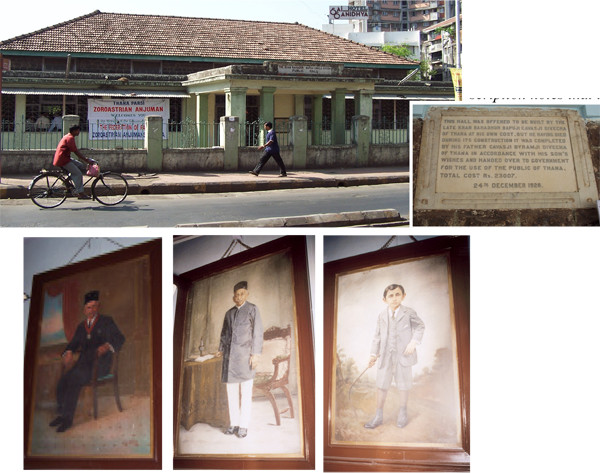
The Khan Bahadur Bapuji Cawasji Divecha Public (Town) Hall, site of the Federation meeting, was donated by him and his family to the public of Thana on December 24, 1928 at a total cost of the Rs 23,007. The marble inscription notes that the hall was completed by his father Cawasji Byramji (center) "in accordance with his son’s wishes” as Bapuji (left) died during the construction. Bapuji’s son Eruch (right) also died at the age of 10
Miscellanea
Gandhi briefed the council on the application for membership from Abu, Nanpura and Olpad anjumans. Describing the issue as "delicate,” Gandhi said the application in English had been signed by Olpad in Gujarati. Moreover, the latter two were accompanied by a Rs 500 draft issued by the Lalbaug branch of the State Bank of India. Noting that he had not encashed or replied to any of them, Gandhi explained:
"Nanpura and Olpad (parts of Surat) can’t be members because the Surat Parsi Panchayat (SPP) is a member. Otherwise, small associations from Bombay would want to be members.” Mohta, disagreed with Gandhi’s description of Nanpura as a mohalla (locality) of Surat, preferring to describe it as a suburb. He said Olpad is a separate village. Both, according to Mohta, have their separate anjuman and agiary. "Borivli is a part of Bombay,” he pointed out but Borivli is a member of the Federation in its own right. "Abu came in person,” he added.
The issue triggered suggestions. "I agree with Mohta. Olpad is a separate village,” stated Tamboly. Postwalla suggested that new memberships be held in abeyance until the proposed changes in the rules are finalized. Countered Federation honorary treasurer and CEO of Sir J. J. Group of Trust Farrokh Rustomji: "In the past Surat was small and these places had separate anjumans. Now Surat includes all these. Ask SPP for their view,” he suggested. "PZASH has a 50 km radius. What about SPP?” asked Omim Debara.
Noting that membership applications have to be placed before the executive council — this being the first since the applications were received — Gandhi stated, "We cannot accept fees until the member is accepted. I am not rejecting but keeping the issue pending…The Federation (is based on) one anjuman, one vote. Are we giving Surat 20 votes by making 20 anjumans members? Also, the application has been signed in Gujarati. I am not casting any aspersions but I want to talk to Olpad in person…The Delhi Parsi Anjuman (Registered Trust) includes Gurgaon from Haryana and Noida from UP. If 20 Parsis from Gurgaon try to split, would we acknowledge the split?...The voting structure should be consistent.”
Entirely agreeing with the analogy Sethna said, "Please implement the rules. The anjumans were founded wherever there were Parsi settlements... I agree with the ruling that the matter be deferred.”
"The expenses of the quarterly Fed Newsletter are met by the generosity of the anjumans who sponsor it,” noted Gandhi who had exhausted sponsorships to date. Four issues are routinely sponsored by the BPP plus two more from BPP president emeritus Jamshed Guzder in his personal capacity. Apart from the cost of paper, printing and postage the cost includes honorariums to Gandhi’s secretary and a peon in his office who receive Rs 2,000 and Rs 250 per month respectively. He sought an increase in these amounts.
While Baroda president Jal Patell wanted a comparison with the previous year’s figures, Federation vice president (south zone) Jehangir Bisney of PZASH suggested newsletters on e-mail and Postwalla said, "If you want approval of even one rupee, put it on paper,” Shroff, an economist and management expert, sniffed, "It’s a measly budget.” Raising the honorariums to Rs 3,000 and Rs 500 respectively and commending Gandhi for running the Federation office on such a shoe-string budget, he added, "Feel free to ask for more staff. We’ll sanction it.”
"I am eternally grateful to my company [he is director and company secretary of Machine Tools (India) Ltd] for allowing Federation work to be done by my office. Therefore I hope you will not insist that the BPP carry this load also.” Gandhi was referring to scathing criticism from Khambatta who believes that the Federation secretariat should be lodged at its registered office which is the BPP. "The Federation survives because all of you are taking interest in it — not because of Keki Gandhi,” he noted.
Those attending the Federation meeting were: Areez Khambatta and Farrokh Kavina from Ahmedabad; Rustom Gandhi from Allahabad; Jamshed Mohta from Bardoli; Jal Patel from Baroda; Minoo Shroff, Dinshaw Mehta, Dinshaw Tamboly, Behram Dastur, Meheli Colah, Cawas Panthaki, Homi Mullan and and P. D. Patel from Bombay; Bahadur Postwalla from Calcutta; Lt Gen Adi Sethna and Keki Gandhi from Delhi; Bomi Heerjee from Indore; Mehrwan Irani and Pervez Irani from the Iranian Anjuman; Behram Masani from Mhow; Tehmasp Bharucha from Poona; Jehangir Bisney, Aspi Debara and Omim Debara from Secunderabad and Hyderabad; Rustom Cursetji and Pervez Bhesania from Thana; Federation’s honorary treasurer Farrokh Rustomji; defunct anjumans subcommittee coordinator Sohrab Katpitia and FOZYA representative Shovir Irani. The press was represented by Jam-e-Jamshed and Parsiana.