From humble beginnings Behramji Damania became one of India’s committed engineers who could afford aviation as a hobby early aviators
Dr Ardeshir B. Damania
My paternal grandfather, Mancherji, died suddenly in Navsari in 1904 leaving behind a widow, my grandmother Cooverbai, and six young children. Having no means to earn a living in Navsari or Billimora (her parents’ hometown) Cooverbai came to Bombay with her children and found accommodation in a single room in the N. M. Petit Widows’ Chawl (built in 1892) at Parsi Bazar Gate at a rent of eight annas (half a rupee) a month. She placed her eldest child, my father’s older brother, Dorabji, in the Seth Bomanji Dinshaw Petit Orphanage for Parsi boys at Lalbaug, Bombay. She then decided to concentrate her meager resources on the education of her second male child, my father Behramji who was born in 1893, since she foresaw that one day he would single-handedly pull the entire family out of poverty. Accordingly, Behramji began to attend the nearby Byramjee Jeejeebhoy Parsee Charitable Institution at Charni Road. My grandmother lacked the means to send her four daughters to school, and so they were basically home-schooled and taught cooking, sewing and other household skills.
My grandmother would do odd jobs like stitching, baking and cooking in the homes of well-to-do Parsi families in the Fort area to earn some money. The family passed through some very hard times. On some days there was no money even to buy food and they went to bed hungry. The monthly rent of eight annas had to be paid nevertheless to the Widows’ Home. Sometimes, when there was no money for Behramji’s school fees, the headmaster of the school would pay from his own pocket (even though his own salary was very modest) so that Behramji could continue his studies. One day, their financial situation got so bad that Behramji left school, went to a stationery store at Parsi Bazar Gate Street and with the store owner’s help took up hawking of notebooks, pencils and other stationery on the streets. (Even after almost 100 years from the time these events took place, my eyes get moist merely remembering his difficult times and struggles as a young boy. A few years before he died in 1982, he would demonstrate to me his hawker’s cry in Gujarati, on the streets in the Fort area. I would get goose bumps all over, but he would merely smile!) After a few days of hawking, his mother Cooverbai persuaded him to re-join school, which he did and passed his matriculation exams. Subsequently he joined the Victoria Jubilee Technical Institute (VJTI) from where he was awarded a Licensed Electrical Engineer (LEE) Diploma in 1918.
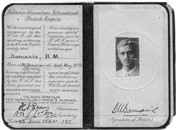
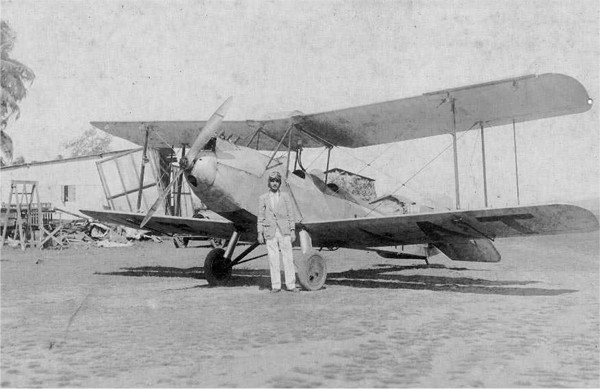
(Top): Behramji Damania at Juhu aerodrome; (above) the aviator’s flying license
After working as a self-employed wireman in Parsi homes in Fort and Colaba, Behramji got a job at the Parel Receiving Station of the Tata Hydro-Electric Company in 1919. Subsequently, as construction and electrical engineer for the Andhra Valley Power Supply Company, Behramji undertook the vital task of erecting from scratch (right from excavation of the grounds to putting into full operation) the Dharavi Receiving Station of the Tata Power Company. Through sheer genius and hard work he rose rapidly and soon became superintendent of the station at Dharavi. His important position (responsible for uninterrupted electrical supply to the railways, tramways, cotton mills, factories and all residences in the city) and good salary finally permitted him to buy a car, get married to my mother, Dr Goolbanoo Ardeshir Lal, and indulge in his hobbies, one of which was flying!
Behramji did not forget the sacrifices his mother had made and the hardships his siblings (Dorabji, Ratanbai, Jerbai, Dhunmai and Aimai) had gone through in those early days. He came to live in the Dadar Parsi Colony in a rented three-bedroom flat where the entire family resided in comfort. His mother passed away knowing that her son had done well for himself.
Behramji fought an epic court battle and got back his father’s home in Navsari from his uncle. He then spent a colossal amount of money in the early 1950s to renovate this house with the best fittings and fixtures. The contractor told him on completion that "Seth, mané mallum hoté ké tamé étla badha paisa kharachwa taiyar hataa, toh hun tamuné akhoo navoo makan banawee apté (Sir, if I had known that you were ready to spend so much money, I would have built you a new house).” What the contractor did not understand was that Behramji did not want a new house. He wanted his father’s house! All his sisters and brother were ultimately married except one, Dhunmai, who lived in the Navsari house until her demise. Today, the children of Behramji’s siblings are well settled in Bombay and throughout the world.
Some of my father’s other hobbies, apart from flying, at which he was successful were photography (movies and still), gardening, fishing, equestrian sports, beekeeping and trying his hand at various small businesses (which will be the subject of another story). Here I write about his days as an aviation pioneer in India.
(Left): At Mahalaxmi Race Course, governor Sir Roger Lumley, A. C. P. Wadia and Damania watch F. H. Irani in glider’s pilot seat; (right): P. M. Kabali with Sarojini Naidu before his flight from UK
Behramji took flying lessons at the Bombay Flying Club (BFC) and soon got his pilot’s license. He began to instruct young, enthusiastic would-be pilots at the BFC on Sundays. Later he became secretary of the Club. When he was instructor at the BFC he supervised the repairs of the Spartan VT-AAT aircraft owned by Purshottam Kabali, the first Indian to earn a Commercial "B” flying license. After taking delivery of the Spartan in 1929, Kabali had intended to fly the delicate and underpowered bi-plane, made essentially of wood, to India. Somewhere between Tobruk and Tripoli (Libya) the aircraft ran into a dust storm ("haboob”). With the single engine spluttering and eventually failing, Kabali had to crash land in the sand dunes, damaging the propeller and nose but the pilot suffered no serious injuries. The damaged plane that had broken into several pieces had to be carted by ship and thence by truck to one of the hangars at Juhu aerodrome.
After the aeroplane was fully repaired with several tests on the ground and the runway at Juhu, Behramji was eager to test the aircraft in actual flight. However, the Certificate of Airworthiness (CofA), which had been cancelled after the crash in Libya, had not been renewed. One day, unable to wait any longer for such "formalities,” Behramji sat in the cockpit of the aircraft, put on his leather flying helmet and goggles, fired up the engine and took off! The plane flew beautifully over the Arabian Sea. However, when he landed he was reprimanded by the British head of flight operations at Juhu for having risked his life in a breach of the flying rules. A CofA was subsequently issued to Kabali on April 1, 1930, after which Behramji made many flights in the Spartan aircraft VT-AAT. On January 1, 1931, VT-AAT was photographed at the BFC with Behramji standing proudly in front of the aircraft. In August 1934 the aircraft was finally retired and was stored for several years on the grounds of the Kabali family’s bungalow at Ghatkopar until it was sold off to scrap merchants one day.
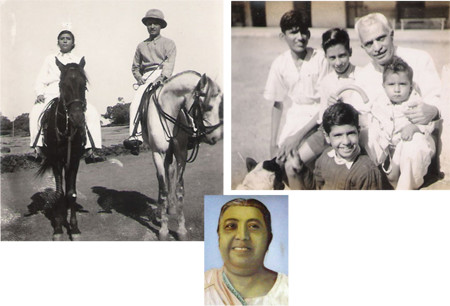
(Top, l): Dr Goolbanoo and Behramji Damania on horseback in Matheran; (above) Behramji with his sons and their minder; (below) painting of Goolbanoo
Behramji and after him Kabali were also presidents of the Indian Gliding Association. Gliding had been started in Poona in 1929. Subsequently, during World War II gliding shifted to Bombay to attract more funding and was done on the Mahalaxmi race course. The governor of Bombay donated one of his Rolls Royce cars to be used for launching gliders. Some time in 1950, the Indian Gliding Association moved back to Poona. Pandit Jawaharlal Nehru was invited for the opening ceremony on November 7, 1950 and was given a ride in a glider. "I have had a delightful, but all too brief experience — my first glider flight. I should like to repeat it for a longer period and feel for a while less earthbound,” wrote the Prime Minister in the Gliding Center’s visitors’ book. Nehru was so impressed by Fardun H. Irani, the pilot and chief glider instructor, that he was later appointed to an important post in the central government. Nehru also arranged for a substantial government grant to the Gliding Association. I still have a color film made by Behramji on July 22, 1951 of my mother, Goolbanoo, going up in one of the two gliders at the Poona Gliding Club. The film was made on a hand held 16 mm winding Keystone movie camera. In 1956 the Indian Gliding Association was shifted permanently to its present location at Hadapsar, Poona. Young Indian pilots today owe a lot to Indian aviation pioneers like Kabali, Damania, Irani, and J. R. D. Tata.
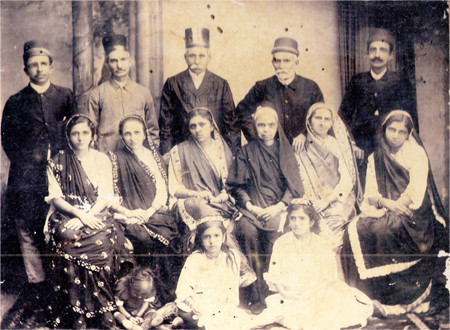
The Damania family in Navsari in the early years of the 20th century
Behramji was fond of good toddy (as a lot of Parsis of that generation were). Some of the best toddy in Gujarat was to be found near the village of Maroli (the tiny railway station between Navsari and Surat). Savaksha Jilla was the patel of Maroli and owned large tracts of land where he used to grow sorghum (jowar) and millet (bajra). Jilla also owned the only milling station for miles around where farmers brought their grains for threshing, milling and grinding into flour. Jilla’s bungalow was located on the one and only street in Maroli. It had the only electric lights obtained from a petrol-driven generator and a soda water bottling machine for his personal use. Behramji knew that a small airstrip constructed during World War II by the British existed a few miles from Maroli between the sorghum fields. His instruction to Jilla was that if he saw and heard an aeroplane circling above his house, he should come to the airstrip with his car. Some time in the early 1950s Behramji with Ardeshir C. P. Wadia at the controls of a four-seater C33 Beechcraft Bonanza VT-CSF flew from Bombay to Maroli. It took them a little over an hour at a comfortable cruising speed of 250 km/hr. After circling over Jilla’s bungalow a few times at low altitude they landed at the airstrip and were picked up by Jilla in his 1937 black Ford Pilot V8 car. Some local varlas were hired to guard the plane which was tied down. They then drove on mud roads to a small village nearby where the best fresh toddy, tapped that very morning, was available. After lunch at Jilla’s bungalow and a nap, they took off and returned to Bombay. I once asked my father how he managed to find the tiny village of Maroli from the air. He replied, "After taking off from Bombay I just followed the BB&CI railway line!”
As a footnote I would like to mention that a Medium Altitude Long Endurance Unmanned Aerial Vehicle (UAV), being developed by the Defense Research and Development Organization (DRDO) of India for the armed services has been named "Rustom.” The early development of this project was carried out at the National Aeronautical Laboratory (NAL) at Bangalore by a team under the leadership of my late brother Prof (Dr) Rustom B. Damania in the 1990s. He inherited his love for aero-planes from my father.