Honored as Poet Laureate at the recent Tata Literature Live!
festival, Adil Jussawalla’s verse strives to give a voice to the voiceless
Firdaus Gandavia
I see myself as a maker, not a poet, a composer of words, a craftsman,” said Adil Jussawalla when the Poet Laureate Award was conferred on him at the Tata Literature Live! The Mumbai LitFest 2021 at an online event on November 20, 2021. Jussawalla thanked the organizers of the Festival for this honor which he accepted with feelings of both gratitude and trepidation. "(I prefer) not to be called a poet,” he modestly said.

This sentiment was not shared by the poets who had come together to speak about Jussawalla’s poetry which has spanned almost six decades: his first book of poems, Land’s End, was published in 1962 and his latest collection, The Tattooed Teetotaller and other wonders, in 2021. Jerry Pinto, journalist, translator, poet and a very close friend of Jussawalla, read out the citation. Pinto praised him for the precision and the beauty of his poetry, for illuminating the human condition and never compromising his integrity. Jussawalla, he felt, was the main force behind the cooperative Clearing House and the Praxis Foundation, which had been created for the sole purpose of publishing poetry and plays. He has generously nurtured the talents of two generations of poets and started a series of public readings of poetry, Loquations, every Tuesday for several years, at the National Centre for the Performing Arts’s sunken garden. Pinto then presented Jussawalla with the plaque, a silver salver, a scroll and the ceremonial shawl.
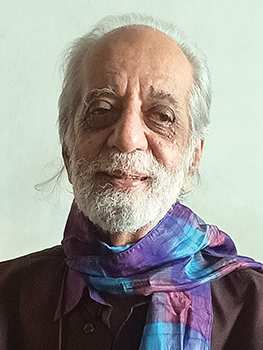
Adil Jussawalla: keeping balancePhoto: Firdaus Gandavia
In his acceptance speech Jussawalla decided to play on the word "acceptance”: What poets have had to accept in the past, and what they have to accept now. Should a poet condemn and protest against war, murder, injustice and all the other evils rampant in today’s world? Jussawalla believes that poetry, like every art, has its limitations. This, he feels, is difficult for poets to accept. They strongly believe that their words are capable of effecting the change they desire and are overwhelmed with the necessity of taking a stand. Jussawalla refers to Dylan Thomas’s poem Do not go gentle into that good night, where he urges the reader to "Rage, rage against the dying of the light.” But, Jussawalla feels that rage is not a solution and that acceptance is a far wiser alternative: acceptance, for him, is "not by escaping or by defeat but by facing the limits of what poetry can do and at the same time asserting our constant need of it with full knowledge …and serenity.”
This was followed by an interview with poet and author Arundhathi Subramaniam. She quoted some lines from Jussawalla’s poem Watch Your Step Old Man [From the collection, Trying to Say Goodbye (2011)]:
"Standing on one leg
ever since we learned to walk —
not strutting our stuff —
you can’t on one leg —
but saying it
saying it
was our way of keeping balance.”
She believes that this is Jussawalla’s legacy, as he has never stopped saying it, "with a fierce intellectual, aesthetic and moral commitment and… a quiet, resolute, unwavering dignity.” Jussawalla admitted that when he was young, his interests were basically visual — drawing, colors, paint — and he never set out to write poetry. He was very introverted during his school days so he found poetry a way of expressing himself. His interest in writing was fostered by excellent teachers who saw a lot of promise in his prose, who encouraged him and who instilled in him an interest in modern poetry. He wrote satirical verse which was published in the school magazine. When he went to study architecture in London, he suffered a breakdown becoming more and more voiceless and introverted. After attempting two unsuccessful plays, he began to write poetry. He published Land’s End to great acclaim when he was merely 22.
What has remained constant is his effort to always give a voice to the voiceless which has enabled him to find his own voice. As a result of the poverty and the disparities of income he witnessed when he returned to Bombay in 1970 and the famine of 1972-73 in Maharashtra, he realized that socialism had failed in India. He even commenced and abandoned a novel about a foreigner of Indian origin who is sent to India to photograph the monsoons and is faced with famine and drought. Extreme changes were required and what was certain was that no political change could be brought about by his verse. This resulted in a pivotal change from Land’s End to Missing Person (1976). What has changed in his poetic voice? Subramaniam asked. Jussawalla replied that, over the years, he had begun to believe that poetry is a fusion of reason and music and as a result he has become more conscious of the sound and the music of his words.
Jussawalla was asked whether while "mentoring” poets, he had himself learnt from their work. The senior poet replied that he disliked the word mentoring. He modestly stated, "Poets do not need my mentoring” and has, in fact, been greatly enriched by the work of the younger poets. Even at Loquations, Subramaniam remembered that he never took center stage and the "inadvertent mentoring,” if any, was his transforming the reading of poems into "an energized and participative activity.” During the question answer session, Jussawalla was asked if he was ever influenced by the Beat Generation to which he replied that though he was attracted to them, he was never satisfied with his poems he wrote under their influence — the poetry needed form in a traditional sense which was anathema to the Beats.
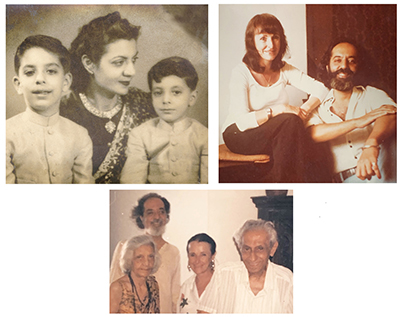
Top row, from l: Adil Jussawalla with mother Mehera and brother Firdausi;
wife Veronik and Adil; above: Mehera, Adil, Veronik and Dr Jehangir
At Subramaniam’s request, Jussawalla read out Clay, a poem written for a celebration of the sculptor Pilloo Pochkanawala’s work, in which he gives a voice to the materials she used. In her closing words Subramaniam paid tribute to Jussawalla’s kind, gentle, and self-effacing assistance to two generations of poets: "Thank you for being there. You matter more than you know.”
Four of Jussawalla’s closest friends read out their poems on the occasion. Arvind Krishna Mehrotra read Telegram for A.J. (1981) and Our Generation (2015), written long after the death of their friend and poet, Arun Kolatkar, whom he feels was the "reviving sort.” In this moving poem he wonders, as they grow older, what fate awaits Jussawalla, Gieve Patel and himself — "the ones who survive” — who have been friends and fellow poets and who have known each other closely for the last 60 years. Subramaniam composed a "rage” poem in which she attacks a Welsh critic and German curators but is greatly sustained by a line from one of Jussawalla’s essays in which he mentions that a certain type of reader from a western audience will take time "to accept that the literatures of India are not colonies in his empires of taste.” Tenzin Tsundue affectionately called Jussawalla "the ponytail demigod” — a ponytailed Ganapati whom the people of Bombay drown every year at Chowpatty; but who resurfaces each time, rehabilitated as a teacher, mentor, editor and now Poet Laureate. Harnidh Kaur mentioned that Jussawalla was an important part in her finding her voice as a poet.
Amy Fernandes, festival director, said that the award of Poet Laureate was instituted "to honor a literary form that encapsulates the very essence of literature.” Poets, she said, were chroniclers of events and emotions and poetry, not merely a collection of words or meter, but the very distillation of thought and emotion. How well this sentiment reflects the poetry of Jussawalla.
Becoming a writer
My parents Mehera and Dr Jehangir, brother Firdausi, wife Veronik and step-daughter Katia have been supportive. My education abroad was paid for by my father. Through the late 1950s and early’60s it was 600 pounds sterling a year. My parents were naturally upset when I quit architecture to write a play and try and make my living as a playwright in London, but not for long. They, and my paternal grandmother Aimai, were overjoyed when I got admitted to University College in Oxford. Grandmother said, "No one in the family went to Oxford before you.” Everyone was devastated when I quit Oxford too to try and continue my education in India. After a little more than a year in India I crawled back to Oxford. Many years later, my father told me, "When you told us you’d given up Oxford, I felt I’d been given a death sentence.” I was also helped out financially by Veronik and my family when I didn’t have a job in Bombay.
Family, trying to find ancestors I never knew, are very much part of my writing. More than an influence, they are organic to it.
There was never ever any indication from my parents that I should marry a Parsi, nor did they object to my marrying Veronik, a foreigner. My parents were religious but moderately so, certainly not over religious. I vaguely recall my navjote which — surprisingly, since my parents were hardly ‘society’ people — was performed at the now defunct Green’s Hotel in Colaba. My brother Firdausi’s was done years later at the Taj. What I do remember is visiting Dastur Framroze Bode at his Atash Kadeh on New Marine Lines, to be tutored in saying my prayers. I did wear a sudreh and kusti as a child and, occasionally, later, and I did say my prayers regularly when I was a child. As an adult, in times of trouble, I did visit the Saher Agiary to pray.
Both my parents were cremated and so, when the time comes, will I be. As for my own beliefs — atheism, the after-life, etc, I consider them private matters. But I have expressed them in verse, if readers are interested, in my chapbook Gulestan, published by Poetrywala and still available through online retailers.
As for Parsi food...Whether I like it or not, I’m sure it will have a long afterlife though we Parsis will be extinct.
Adil Jussawalla