Soloist, accompanist Fali Pavri’s career also includes teaching and nurturing young talent
Mehroo Kotval
"A true musical partnership between the soloist and the orchestra... This concerto [Schumann Piano Concerto (in A minor Op 54)] is an extraordinary piece, full of lyricism and brimming with fervor and optimism. It is Robert Schumann at his best… here
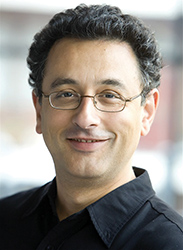
Schumann plays tricks with the rhythms and keeps pianist, conductor and orchestra on their toes,” explains pianist Fali Pavri in an email to Parsiana before his performance of the concerto with the Symphony Orchestra of India (SOI) conducted by Zane Dalal at the National Centre for the Performing Arts (NCPA) on February 12, 2016. The sought after pianist performed Schumann’s Träumerei as the encore. Giving several bows, the artiste made his way upstage elbowing in between the first violinists, much to the amusement of the audience and to the puzzlement of Dalal, who followed the pianist dutifully! Pavri even graciously acknowledged out of turn applause between movements.
"I am fortunate to have played with so many eminent musicians and ensembles in concert halls around the world and I will always be grateful to all the people who helped me along the way,” Pavri wrote. Currently on a teaching assignment as associate head of keyboard and professor of piano at the Royal Conservatoire of Scotland in Glasgow, the professional pianist is a soloist, chamber musician and teacher. He is accompanist to instrument and voice artists and travels the world with them.
"While still a student in London, I auditioned for (the renowned Russian cellist) Mstislav Rostropovich and consequently toured India as his pianist,” narrates Pavri, who was trained at the Moscow Conservatory for five of the seven years in Moscow which he calls as "a truly inspirational environment to study in.”
Now in his mid-fifties Pavri brims about "Playing with Rostropovich was a life changing experience for me. He was such a larger-than-life personality with boundless energy and enthusiasm. He kind of swept you away in his tsunami of extraordinary musical genius, combined with the ability to relate to and communicate joyfully with people of any background. He would say to me that one of his mottos in life was to do or see or experience or learn something new and life affirming every single day. That is something I have tried to emulate in my own life.”
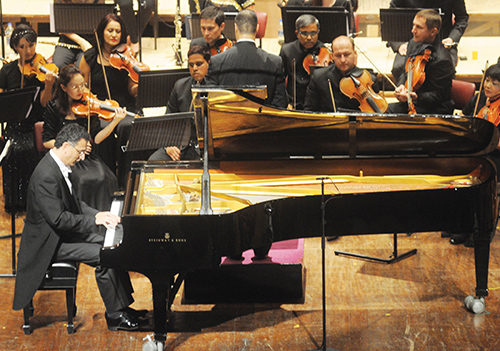
Top: Fali Pavri; Performing with the Symphony Orchestra of India
Pavri keyed his way to the Royal Academy of Music, London from Moscow. "A committed and sought after teacher with many prize-winning students, Fali Pavri is on the Piano Faculty at the Royal Scottish Academy of Music and Drama and is also much in demand as an adjudicator and examiner. He has given master classes in many countries around the world including recently in Estonia, Finland, Cyprus, India and South Africa…” the cadenzasummerschool website states of him.
The music scene in his birthplace Bombay today is a far cry from the days when Khushroo Suntook, chairman of NCPA which supports the SOI, travelled regularly to a communist Moscow, on work. The pianist reminisces about the excitement he felt on receiving much awaited "luxury supplies” of soap, toilet paper, tea and craved for food on each visit, when Suntook indulged the young student. Despite the deprivation of yearned for comforts, Pavri acknowledges the upside of the Russian capital, which offered students the ability to listen to and attend performances and workshops by piano stalwarts such as Sviatoslav Richter and Emil Gilels, who lived and performed there. These masters also shaped him. As Michael Tumelty of The Herald, Glasgow says, "Pavri, a pianist who understands the soul, the secret and the balance of good chamber music performance.”
The performer’s Russian teacher Victor Merzhanov taught pianoforte for 65 years at the Moscow Conservatory. His name is etched on its marble wall along with greats such as composers Alexander Scriabin and Sergei Rachmaninoff. Merzhanov achieved international recognition as a pianist in 1945 when he won the first prize (shared with Richter) at a national Russian competition.
Setting off on his career, the first ever piano concerto Pavri performed "with a real ‘live’ orchestra was Beethoven’s 3rd Piano Concerto (in C minor, Opus 37) with the Bombay Philharmonia (now the Bombay Chamber Orchestra) conducted by Charles Darden in the Tata Theatre in 1980… I can still remember the excitement I felt to be performing this great piece in my hometown.” He also participated in Bombay’s music festivals of Sangat and the Mehli Mehta Music Foundation. Pavri acknowledges the strides western classical music has made in Bombay with its own international orchestra since his departure almost four decades ago.
Première performance
As a Bombayite, the young lad recollects afternoons sitting with his physician father Soli at home at lunchtime when the doctor "invariably put on a record of classical music. I loved sitting next to him on the sofa luxuriating in the glorious sounds of Beethoven, Brahms, Schubert and Mahler. His love of music couldn’t but rub off on me.” A late entrant to music, Fali learnt the piano at age 11 with Shanti Seldon and continued to do so whilst studying at St Mary’s High School and subsequently at St Xavier’s College. Throughout his educational career, he considered his music lessons "the highlight of my week.”
His website
www.falipavri.com scores the several artists he has played with, amongst whom are John Mayer, the Anglo-Indian from Calcutta who struck a chord with Pavri, recording Prabhanda and Calcutta Nagar with cellist Timothy Gill. The British-India born Mayer was known primarily for Indo-jazz — fusion of jazz with Indian music. Mayer says on the website indojazz, "It isn’t a question of the music being jazz, or Indian, or classical; it is a thoroughly satisfying blend of ingredients into something genuinely new, original and forward looking.” Indian music instruments like sitar, tabla and tanpura were played with trumpet, piano, drums and bass guitar — a well-blended masala, if you will. Yehudi Menuhin, the indophile, is known to have performed Mayer’s violin sonata in 1955, Wikipedia informs us. In fact it was the late Mayer who introduced the Bachelor of Music course at Birmingham Conservatoire in 1997.
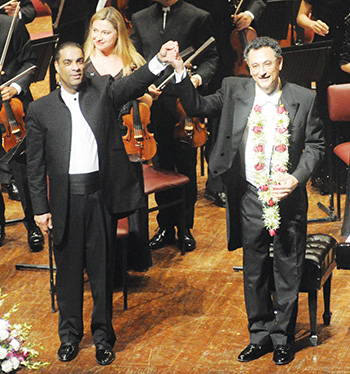
Pavri (right) with conductor Zane Dalal (left)
Making music has been the Pavri’s passion trying to reach the "right balance between teaching and performing.” Both are time consuming and the musician always seems short of time to devote hours of practice to maintain professional standards in playing. "When you add to that equation a busy family life with a musician wife, three young children, a border collie and a cat, life becomes a whole lot more complicated!” That is his current life. Wife Naomi Boole-Masterson is a cellist with the Scottish Ensemble and the couple perform in cello duos, trotting across the globe. Pavri amplifies his annotations with "…it is fair to say that our house is rather chaotic and it is a wonder that our three children have turned out to be such well-balanced and lovely kids.”
The eldest Amy played both the violin and the piano and seems set to excel in being a gymnast. Their second, Thomas, combines piano with tennis and the father claims "he plays the piano with extraordinary sensitivity.” Anjali played nondiscriminatory, learning the instruments of both parents — cello and piano. She is also into competitive swimming. Her all-time favorite meal is dhan-daar, the father writes in his email. Concert schedules of the musician parents are a test of juggling abilities when confronted with child-minding dilemmas. Pavri says it would help at such times to have family or domestic help, as is the norm, in India. His older sister Roshan lives in Bombay, whilst younger sibling Feroza inhabits Switzerland.
Listening to music is not the only use the family puts compact discs to. The Pavri kids learnt Ashem Vohu from a CD, much to his surprise. Enthused by tales of his childhood and beliefs, they went into overdrive. He says, "If I had to choose one religion that least caused strife and division and encouraged tolerance and enjoyment of all the good things in life in moderation, it would undoubtedly be Zoroastrianism.”
In Pavri’s words, "It takes lots of hard work and a good dose of luck to make a satisfying career in music. It is now my turn to nurture and guide the musical talent of the future.”