Set amid scenic surroundings, steeped in history and religion, modern Bhutan offers visitors a
taste of its unique cuisine, customs and culture
Dilnavaz E. Bhagwagar
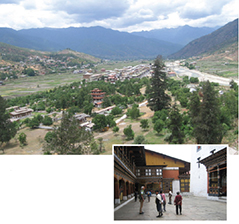
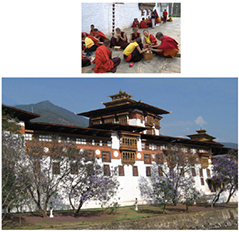
Ninety minutes flying time brings us from Calcutta to Paro, Bhutan’s only international airport. Druk Air is the only carrier permitted to land in Bhutan. The small but charming airport terminal, the crisp, cool weather and the gentle, smiling Bhutanese in traditional dresses make for a warm welcome to the Himalayan kingdom.
Our small group of four was out of the airport terminal with minimal time and formalities. We were met by Rinchen Dorji in his grey ‘gho’ (the traditional attire for men), black knee-high stockings and wide smile. For the next 11 days Dorji was our driver, guide and constant companion. He truly made Bhutan come alive for us. He was very knowledgeable, impressively articulate and had a great sense of humor.
On the drive from Paro to Thimpu, Dorji fills us in on facts ranging from the population of the country to the number of wives the king has. "Apples and oranges, potatoes and rice are the main cash crops,” we are informed. "But our biggest industry and export to India is hydroelectric power.” Sure enough, some time after our return to India, The Times of India report on the massive power failure in the northern and northeastern states of India on July 30, 2012 read, "Emergency hydel power brought in from Bhutan to electrify the Prime Minister’s residence, Delhi Metro and AIIMS (All India Institute of Medical Sciences.”
Less than a two-hour drive from Paro brings us to Thimpu and the charming Galinkha Hotel. Our rooms are large and well appointed with big windows opening out on to the Main Street below. After lunch we sit under an awning and watch the world go by. Thimpu is the modern face of the country. While school girls and boys, and persons In government service have to wear the traditional ‘gho’ for males and a ‘kiera and tago’ (long wrap-around skirt and long sleeved jacket) for females, others can be seen in trendy western wear. Of course, the ubiquitous cell phone is in everyone’s hand.
Pubs and karaoke bars are aplenty. Shops overflowing with Chinese merchandise compete with the handicrafts of Bhutan. Intricately woven fabrics, hand-painted tankhas and scrolls and jewellery made with turquoise, coral, jade and silver are the main handicrafts. In the bazars of Bhutan you cannot bargain like you do in India and China. In their own, gentle, smiling way they will tell you to "take-it-or-leave-it.”
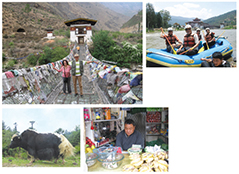
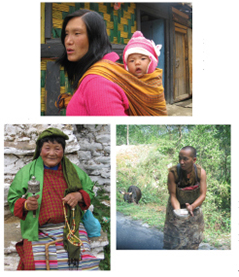
In the evening we drove around Thimpu to get a feel of the city and see some important sites. We visited the Memorial Chorten, built by Her Majesty the Queen in memory of her son K3 the third king of Bhutan. Because of their long names the kings are popularly known as K1, K2, K3 and so on. Devotees with their prayer wheels and prayer beads can be seen circumambulating around this stupa. Everyone walks in serenity and talks in whispers as the prayer wheels spread good vibes around the world.
A 176 ft tall statue of the Buddha set on a hilltop in Thimpu is our next stop. It is a truly spectacular sight! "The Buddha was made in China,” Dorji told us, "shipped in many parts to Calcutta and then sent overland to Bhutan.” Work at the site of the statue is still in progress, with dozens of Bihari laborers and other Indian and Bhutanese supervisors overseeing it. The serenely beautiful, gold-plated Buddha, seated in lotus pose, with a glittering diamond on the forehead to denote the third eye has — hold your breath — 25,000 smaller Buddhas inside the main body.
That night we dine at The Bhutan Kitchen, a typically Bhutanese eating place. Seating is on low tables and benches. Hostesses in traditional dress serve ara, a fiery local wine, while a lone musician plays a stringed instrument in the background. Rice, potatoes, mushrooms, yak cheese, meat and lots of chilies form the basis of a typical meal. Red, green, yellow chilies, cut in rings, slit lengthwise or ground to a paste are an indispensable part of the cuisine. Fiery chilies that are joined in the cooking pot by cheese, butter and salt make the perfect Ema Datshi, a thick, smooth paste that is the base for further embellishments. Rice is eaten in large quantities. Chapattis or bread are not part of a typical Bhutanese meal.
The next morning we press on to the Punakha valley. "The valley is warm and sub-tropical,” explained Dorji, "but to get there we have to drive up to the 3,140 m high Dochula Pass. On a clear day you can see forever, from there.” Unfortunately, clouds conceal the beauty of the mountains with a chador (sheet) of their own. "Wherever there is a high pass or a dangerous river crossing there is a stupa to pray at, for safe passage. Near the Dochula Pass is a site known as the ‘108 Stupa Stop,’” says our guide. We halt at a sloping hillside with the 108 stupas and send up our own prayer. Religiosity permeates every aspect of Bhutanese life, just as it does the soul and sinew of its people. They are gentle and compassionate towards all God’s creations.
Road widening work was going on in a big way, just beyond the Dochula Pass. The road hugs a bamboo and birch covered mountain on one side and looks down on a green valley floor hundreds of feet below on the other. Our PWD (Public Works Department) has much to learn from the systematic and orderly manner in which they work. Vehicular traffic is allowed to pass at certain pre-fixed times of the day only. No exception is made either for minister or monk. Honking or overtaking is not allowed so that when the traffic is resumed, it snakes silently and smoothly along its onward journey. Giant Tata excavators gouge out the mountainside to widen the road. Almost simultaneously the rubble is removed. "This is the National Highway that spans Bhutan from the west to the east. It is the artery of life for the country,” explains Dorji.
After negotiating the Dochula Pass the road drops down into a fertile valley, green with paddy fields. We stop for lunch near the Chimmi Lakhang temple. "Like the Indian Shiv linga the phallic symbol is revered here and childless couples come to pray for a child,” our guide informs us. At a gift shop nearby and at the Bhutanese lunch place overlooking the river, phalluses are displayed and sold, in sizes ranging from six inches to six feet. It was disconcerting, to say the least, to have lunch surrounded by this extraordinary art work.
By sundown we descend into the Punakha valley and head towards the Damchen Resort, prettily perched on the banks of the gurgling Punachu river. The location of the hotel is excellent but the service leaves a lot to be desired. The fast and free internet facility at this and all hotels we stay at is a plus.
The high point of our stay in Punakha is a two-hour white-water rafting adventure down the Mochu river. We almost didn’t do it. The average age of our foursome was 70+ and everyone warned us that at best we would be battered by strong currents and bashed against black rocks. At worst our raft would overturn into the icy waters of the Mochu. But Dorji our guide allayed our fears. "We will take the scenic route, not the adventure rapids. And I will be rowing a kayak alongside your raft. Worry-curry not.” So, with our wallets lighter by 2,000 gnultrums (one gnultrum is exactly the same value as one Indian rupee) each and "Dadar Ahura Mazda” on our lips we donned our life-jackets and helmets, picked up our oars and went through a three-minute drill on how to save our 70-year-old lives, in case… !
The chief oarsman and two helpers completed the seven person crew. Our tense faces and stiff limbs soon succumbed to the roar of the river, the thrill of the lurching raft and the sting of ice cold water. The young crewmen are avid Bollywood fans and knew all the latest Hindi filmi songs. We all sang and laughed together. The scenic rafting route took us past the King’s palace and the beautiful Punakha Dzong and finally deposited us right at our hotel, the Damchen Resort. The exhilarating two hours made for a morning to be remembered. It also made us feel 10 years younger!
Before sunset that evening we visited the Punakha Dzong which we had seen earlier in the day while rafting. This dzong was built by Zhabrung Namgayel, a monk in 1637 at the confluence of the Mochu and Fochu rivers. It is possible to visit large parts of the Punakha Dzong but a small room at the top of the tower is closed to all but the King because the remains of Namgayel are said to be kept here.
Dzongs (‘d’is silent) are an integral part of the history, religion and culture of Bhutan. Every district has its own dzong. "They were originally built as forts to counter foreign invasions,” Dorji explained. "Tibet invaded Bhutan eight times in the 1600s.” With their defense duties now being taken over by the army the dzongs are put to good, practical use. "Certain areas are open to the public, parts of a dzong are used as a monastery for monks and a major portion houses government offices and district courts.” The last were the most amazing. No shouting, no tea stalls, no litter. Work was conducted in a silent, streamlined manner with just a handful of security staff directing the tourist groups away from the office areas.
We visited the local weekly market in Punakha. It was very similar to markets in the smaller towns of India, vibrant with color and competition. Fruits and vegetables, chilies and cheap Chinese umbrellas and much more were sold here.
From Punakha we drive further northeast into Bhutan over the 3,420 m high Pelela Pass to enter the Trongsa valley. The drive is through thick mountain forests with blooming rhododendrons in pink, red, white and yellow. After every few kilometers one can see foaming waterfalls and roaring rivers, all fed by the melting snows of the Himalayas.
We stop for the night at the Yangkhill Resort. Built on the mountainside, the resort has similar looking rooms at different heights. We were embarrassed and apologetic when we walked into someone else’s room after dinner. Less than half an hour later, another guest knocked on our door and was taken aback when someone other than his wife opened it!
It is almost mandatory to visit every dzong along the way but we tell our friend Dorji that a spectacular view of the Trongsa dzong set on a spur above the racing river, was all our legs could take the next morning. Dorji gave us a historic narration while driving past the dzong: "This 17th century temple fortress was the seat of the Wangchuk Dynasty. Even today every king has to come here in procession before being crowned.”
A couple of hours of driving takes us to Bhumthang, the furthest east we will go in Bhutan. Along the way we see the awesome, huge, hairy yaks. They are used as domestic animals but their size and the curl of their enormous horns warn you to keep your distance. You don’t want to mess with them!
Bhumthang is the home of the royal family and has beautiful natural scenery. We stay here at the Gonkhar Lodge, a family owned hotel. Its USP (unique selling proposition) is its very courteous and personalized service. Every night someone would come to our room and light a wood fire in a traditional fireplace. The food at Gonkhar Lodge was perfectly cooked and exquisitely served at a well set table. For dinner the first night we had a steaming mushroom soup, excellent cheese stuffed momos and fresh, tender asparagus sautéed in butter. There is no local dessert. To appease the sweet tooth of tourists they provide fruits like pears and apples which are canned in season and later served with cream.
From the Gonkhar Lodge we walk to the market and talk with the friendly locals. Children returning home from school gather around us to ask where we come from. At the mention of ‘India’ there are a volley of questions about Salman Khan and Shahrukh Khan. No one knows or is interested in what the capital city is or who the prime minister of India is! Most shops here and everywhere in Bhutan serve an interesting dual purpose. "Grocery and Bar,” "General Store and Bar,” "Laundry and Bar.” In spite of this we never encountered a drunken brawl or behavior suggesting inebriation.
The next day was an auspicious one for the Bhutanese. Prayers and ceremonies were performed all day at the beautiful Jambalakhang Temple. A steady stream of cars (mostly Marutis) and pedestrians were seen winding their way to the temple in unhurried grace. Once inside the temple courtyard, they would sit in silence turning their prayer beads till the monks finished a ceremony and came out to offer butter tea and puffed rice as prasad to the waiting devotees. We went in to pay our obeisance and listen to the chanting. It was a deeply moving and spiritual experience.
Monasteries and monks, prayer wheels and prayer beads and most beautiful of all, a gentleness of spirit and reverence for the environment, are part of the Bhutanese way of life.
Flying tiger
The seeds of Buddhism were sown in Bhutan way back in the 15th century by Guru Rimpoche. Legend has it he came from Tibet on a flying tiger which landed on a high mountain cliff in what is today the city of Paro. At the site of this landing is a most revered spot called the Tiger’s Nest Monastery.
As important and all pervading as the Buddhist religion is the love and respect the people of Bhutan have for the monarchy. Larger than life pictures of the present King Jigme Khesar Namgayal Wangchuk and his wife, the beautiful Jetsun Pema, adorn the façade of buildings. The Wangchuk dynasty spanned 101 peaceful years from 1907 to 2008. And then, without any demand or dissent the king handed over power to the people, making Bhutan a constitutional monarchy and the world’s youngest democracy.
Bhutan and its people sometimes come across as self-contradictory in principles. For example, they will eat meat, fish and fowl with relish but are reluctant to kill the same. They import the stuff from Bangladesh and India rather than butcher it themselves. Tobacco consumption is strictly frowned upon. Possessing tobacco without a permit can invoke a prison sentence, if caught. But doma or pan (betel leaves) as we know it is widely eaten by young and old, men and women as is evident from their red, pan-stained smiles. While there is much respect for women and seeming equality, men think nothing of having more than one wife. In theory a woman can also have more than one husband, but that rarely happens.
Our drive back from Bhumthang to Paro is via Phobjika. "Locals like to call it the Switzerland of Bhutan,” our guide Dorji tells us. It is very picturesque, with green, grassy pastures surrounded by frozen mountains. Herds of cows and yaks and a farming community growing mainly potatoes are scattered across the landscape. Like rural communities everywhere, the people are friendly.
Phobjika is the winter home of the endangered black-necked cranes. Hundreds of these birds fly here to escape the harsher Tibetan winter. We were there at the wrong time of the year to see the birds but were told that the arrival of the black-necked cranes spells festival time in Phobjika. Songs, skits and crane-dances are performed and ornithologists from around the world gather there to sight these rare and beautiful birds. The Royal Society for Protection of Nature (RSPN) has viewing points, telescopes and interesting information to educate tourists and locals about these cranes.
On the long drive back from Phobjika to Thimpu, we saw an amazing sight — a young Bhutanese monk with rags tied on his palms and knees, prostrating himself on the road and rising again with each step. "He is atoning for his sins and for the sins of the world,” Dorji said in response to our surprised query. We stopped the car while he spoke with the "repentant monk.” "He has traveled this way all the way from Paro and is on his way to Bhumtang. He has been on the road for two months already and it will be another two months before he reaches his avowed destination.” Before we could digest or respond to this information, the monk was on all fours once again, inching his way up the steep mountain road.
We reach Thimpu in the early afternoon. That same evening we are invited to high tea at the Indian Embassy in Bhutan. Ava Khullar’s husband Gopal is a good friend of Shubhdarshani Tripathi, the deputy chief of mission at the Indian Embassy. I expected to meet a plump, pompous, bespectacled woman, surrounded by fawning embassy staff. She is a slim, attractive woman, living in a big, beautiful home, surrounded by a garden with roses, the likes of which I have never seen before. She is charming, intelligent and exudes confidence. As the face of India in a foreign land, she does our country proud. She is a diplomat serving her second term in Bhutan. Earlier she was in France, Israel and Malaysia. An accomplished Odissi dancer, a great cook and a most gracious hostess, Tripathi told us, "The Indian government has played a big part in laying the infrastructure and guiding the young democracy.” She adds that "Bangladesh and India are the only two countries who have been allowed to establish their embassies in Bhutan.”
Pawan Kumar Verma, the erudite author and Indian Ambassador in Bhutan, was not in the country on that particular day. In his absence Tripathi was to meet with three delegations from India, after tea with us. The Indian Embassy grounds are huge and imposing. They house living quarters for 20 families, a temple, golf course, manicured lawns, gardens and office space.
June 1 is our last day in Thimpu. I am reading Kuensel (the local newspaper whose name means "information”) over coffee. One article makes me whip out my diary and jot down some details:
"In a move to remain carbon neutral the cabinet has decided to observe Tuesdays throughout the country as pedestrians day, starting June 5. On that day, every week, Bhutanese will walk for their health and to promote community vitality.” The article went on to say that from 8 a.m. to 6 p.m. the core area of the city would be a pedestrian zone. Only bicycles and service vehicles like ambulances, fire brigade and public buses would ply. We were not in Bhutan on June 5, but I have no doubt that the move was implemented and with success.
We pack our bags and drive back to Paro where we had landed 10 days earlier. Bhutan’s most famous site, the Taktsang Monastery, more popularly known as Tiger’s Nest, is located here. Clinging precariously on to the side of a mountain, the history, color and architecture of this monastery beckon strongly. But we cannot muster the prowess of a tiger, flying or otherwise. We decide on the next best thing, which is to make the one-and-half-hour climb up to a viewing point-cum-restaurant.
Having made this brave decision, we go to bed early so that we can drive to the base of Tiger’s Nest and start our climb by 8 a.m. But group proposes and God disposes. We woke up to grey skies and a steady drizzle. "Not advisable,” said Dorji. "The mountain road will be slushy and slippery.”
Disappointed, we do the next best thing, which is buy picture postcards of the famed monastery. Dorji drops us off at a touristy street, promising to meet us for lunch at a small Bhutanese restaurant. There are a lot of interesting and beautiful things to shop for. We pick up T-shirts with Bhutanese emblems, Chinese silks with a woven design and a turquoise and silver necklace. Solar powered prayer wheels in different sizes catch our fancy. Put where it can catch the sun, the prayer wheel rotates when sunlight hits it. We bought one of these. I am looking at it even as I write this.
That evening, our last in Bhutan, we met with the very fine and well spoken gentleman. Sonam Tobgay, owner of Lotus Adventures through whom we had made all our travel arrangements, to our complete satisfaction. Bhutan is an ideal getaway for Indian tourists. Indians do not need a visa for Bhutan. All payments can be made with the Indian rupee. There are direct flights from Delhi, Bombay and Calcutta to Bhutan. Most people speak English, many speak Hindi. Everyone is honest, gracious and friendly. It is value for money spent. The cost of a 11 day tour of Bhutan, starting from pick-up at Paro International Airport to being dropped back there, was Rs 44,000 per person. This included a comfortable car, a very good driver-cum-guide, hotels, all meals and entrance to every place. There were no hidden costs. Tips, liquor, shopping was, as always extra. The only optional activity was white water rafting for which we paid Rs 2,200 per person. The Calcutta-Paro-Calcutta airfare, booked two months in advance was Rs 11,500 per person.
The most unique thing we learnt about governance in Bhutan was a concept called GNH — Gross National Happiness. India and other countries around the world measure progress and prosperity by GDP — Gross Domestic Product. As did Bhutan till 1986. During the reign of K4, the monarch decided that all-round happiness of the people was more important than industrial output and wealth for a few. GNH is not a mere fanciful phrase for public consumption. It is a well researched concept. The population is given forms to grade public services, express their satisfaction or air their grievances, which are then addressed. This is possible because the total population of Bhutan is a mere 6,36,958. Good governance, socio-economic development at all levels, preservation of age old culture and traditions and conservation of the environment are the guiding criteria for arriving at the GNH.
Is it any wonder then that ‘Happiness’ is a place called Bhutan?
silver necklace. Solar powered prayer wheels in different sizes catch our fancy. Put where it can catch the sun, the prayer wheel rotates when sunlight hits it. We bought one of these. I am looking at it even as I write this.
That evening, our last in Bhutan, we met with the very fine and well spoken gentleman. Sonam Tobgay, owner of Lotus Adventures through whom we had made all our travel arrangements, to our complete satisfaction. Bhutan is an ideal getaway for Indian tourists. Indians do not need a visa for Bhutan. All payments can be made with the Indian rupee. There are direct flights from Delhi, Bombay and Calcutta to Bhutan. Most people speak English, many speak Hindi. Everyone is honest, gracious and friendly. It is value for money spent. The cost of a 11 day tour of Bhutan, starting from pick-up at Paro International Airport to being dropped back there, was Rs 44,000 per person. This included a comfortable car, a very good driver-cum-guide, hotels, all meals and entrance to every place. There were no hidden costs. Tips, liquor, shopping was, as always extra. The only optional activity was white water rafting for which we paid Rs 2,200 per person. The Calcutta-Paro-Calcutta airfare, booked two months in advance was Rs 11,500 per person.
The most unique thing we learnt about governance in Bhutan was a concept called GNH — Gross National Happiness. India and other countries around the world measure progress and prosperity by GDP — Gross Domestic Product. As did Bhutan till 1986. During the reign of K4, the monarch decided that all-round happiness of the people was more important than industrial output and wealth for a few. GNH is not a mere fanciful phrase for public consumption. It is a well researched concept. The population is given forms to grade public services, express their satisfaction or air their grievances, which are then addressed. This is possible because the total population of Bhutan is a mere 6,36,958. Good governance, socio-economic development at all levels, preservation of age old culture and traditions and conservation of the environment are the guiding criteria for arriving at the GNH.
Is it any wonder then that ‘Happiness’ is a place called Bhutan?