Ardaseer Wadia’s manifold contributions to science
were recognized with a blue plaque by English Heritage
Parinaz Gandhi
It was at the young age of 25 years that Ardaseer Cursetjee Wadia had designed and built the 60 ton Indus, the first ocean going steam ship in India, and introduced gas lighting to Bombay the following year. In recognition of these accomplishments, he became the first Indian to be elected Fellow of the Royal Society (FRS) in 1841. On the 180th anniversary of this distinction, Wadia’s one-time residence Lowjee House where he spent the last decade of his life in the United Kingdom was honored with a blue plaque by English Heritage London on May 19, 2021.
"A pioneering civil and naval engineer from the renowned Wadia family of Bombay shipbuilders, Ardaseer (1808-1877) was committed to the advancement of steam-powered navigation and to the progress of science in his country. He was at the forefront of introducing new inventions to Bombay including gaslight, photography, electroplating and the sewing machine… We are delighted to honor him with a blue plaque at the Richmond home where he settled in later life,” noted English Heritage blue plaques historian Rebecca Preston.
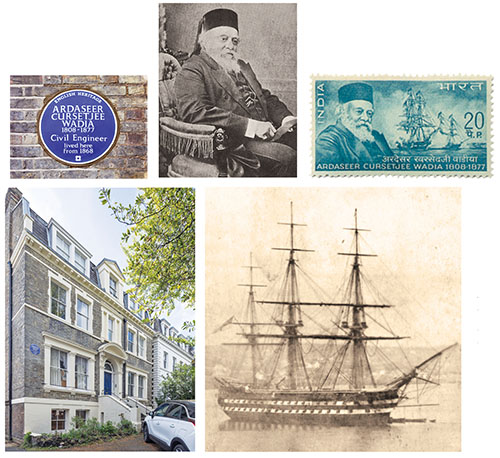
Clockwise from above r : steamship Indus Photo: Wikipedia;
Lowjee House and blue plaque honor Photos: Philip Whiteside;
Ardaseer Wadia Photo: Parsi Lustre on Indian Soil;
postal stamp released in 1969
"London’s blue plaques scheme celebrates the links between notable figures of the past and the buildings in which they lived and worked,” according to the website of English Heritage. Wadia is the second Parsi to be conferred this recognition, the first being music legend Freddie Mercury (Farrokh Bulsara) whose home in Feltham was conferred the blue plaque in 2016.
"The oldest scientific academy in continuous existence,” The Royal Society is "dedicated to promoting excellence in science for the benefit of humanity,” stated its website royalsociety.org. Tracing its origins to 1660, its Fellowship is made up of the most eminent scientists, engineers and technologists from the UK and the Commonwealth. Over the last four centuries 1,700 Fellows and Foreign Members, including around 75 Nobel Laureates have proudly announced their association with this institution.
"The Zoroastrian Trust Funds of Europe (ZTFE) is rejoicing” that their founder trustee Wadia received the honor, noted an email from president Malcolm Deboo who regretted that "due to the ongoing UK Government Covid-19 restrictions, sadly there was no unveiling ceremony or a public event.” Describing Wadia as "one of the most famous Indians in 19th century Britain,” Deboo mentioned that when the ZTFE was established in 1861, Wadia was the senior-most Zoroastrian in the UK. "During this period he was even more famous than Dadabhai Naoroji and Jamsetji Nussserwanji Tata. The name of Wadia FRS JP (Justice of Peace) always appears at the very top of all the early ZTFE documents from 1861 until his demise in 1877 while that of Naoroji is second.”
Wadia’s presence in the UK is recorded over three periods: between 1838-1841, 1851-1853 and from 1858 until his demise in 1877 at 69 years of age. Great (x2) grandson of East India Company (EIC)’s master shipbuilder Lowjee Nusserwanjee who was the founder of the famous Wadia shipbuilding dynasty, Ardaseer started working in the Bombay dockyards at the age of 14. Once he had grasped the theory and practice of naval architecture, he was more interested in pursuing the application of steam to maritime use which was then at the forefront of transportation technology.
Leaving behind his two young sons and two daughters in the care of his wife Awahbai, Ardaseer made his first trip to the UK in 1838 when he was sent by the EIC for further training at the dockyards at Woolwich, Chatham and Portsmouth. It was in 1841 that he was elected FRS. The same year he left for India after being successfully interviewed for the post of chief engineer and inspector of machinery at the Steam Factory of the Indian Navy in Bombay. In his new job where he continued for 16 years, Ardaseer reported to the commander-in-chief of the Indian Navy while under him worked one chief assistant, four European foremen, 100 European engineers and boiler makers, and 200 Indian artificers (skilled craftsmen). He was known to be the first Indian to be in charge of Europeans at the EIC.
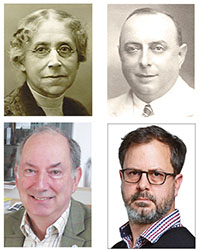
Clockwise from top l: Marian Barber Photo: A Gentle Lion;
John Anderson; Philip Whiteside Photo: news.sky.com;
Blair Southerden Image courtesy: Dr Helen Clifford;
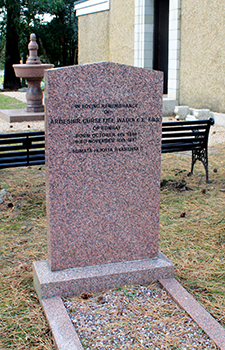
below: Wadia’s tombstone at the Zoroastrian
In 1851 he made his second trip to the UK and ventured further west to become the first known Zoroastrian to have visited the USA. Following his retirement, at the age of 50 he made his third sojourn to the UK where he stayed back with his British partner Marian Barber and their three children for the next 19 years until his demise in 1877.
Having been presented to Queen Victoria on several occasions during his stay in the UK and even invited to her wedding to Prince Albert, he had been called upon to give evidence on the "opium question” in the House of Commons. Ardaseer had headed the Zoroastrian delegation to Buckingham Palace in 1873 when Nasir al-Din Shah Qajar was visiting the UK. Leading members of the community carried a petition to the Shah to ameliorate the plight of their coreligionists in Iran who were reeling under the jizya tax.
It was Ardaseer’s descendant from his British family, Blair Southerden, who had in 2016 recommended to the English Heritage that his forebear be conferred the blue plaque. "Delighted” that his proposal was implemented, Southerden added, "As a fellow engineer I look up to him as an inspiring engineer…an innovator.” A former soldier in the British Armed Forces and a police inspector in the Kent Constabulary, Southerden changed careers to work in Information Technology and is a Fellow of the British Computer Society.
In his book A Gentle Lion and other ancestors Southerden has traced his family lineage (see "A tale of two families,” Parsiana, September 7, 2017). Culling her facts from this book, Mitra Sharafi, associate professor of law at the University of Wisconsin Law School in Madison referred to the dynamics between Ardaseer’s first and second families: "Harmonious relations between the two were obvious at multiple points in the families’ histories. For example, Gustasp (Ardaseer’s son by Marian) had a son named John Grenville Ardaseer. John changed his Parsi surname to Anderson, eliminating any remaining hints of his Parsi heritage. However, he then moved to India and became a business partner with the Wadias — from Ardaseer’s first family’s line. During the First World War, Southerden’s grandmother Beryl Ardaseer was left alone with her young children in England while her husband fought in Mesopotamia. Despite her husband’s modest income, the children were educated at boarding schools. By Southerden’s speculation, descendants of Ardaseer’s Parsi family (particularly Sir Cusrow and Sir Ness) may have helped fund their education.
"Most striking of all was a third instance of closeness: a marriage between the two lines. Ardaseer lived with Marian and their children in Lowjee House, Richmond. Through his first family in Bombay, he had a grandson named Rustomjee. At the age of 16, this grandson came for an extended stay with his grandfather’s second family in Richmond in order to study law at the Inns of Court in London. Rustomjee became a barrister, and was called to the Bar at Middle Temple. More unusually, he also married his grandfather’s daughter, Lowjee Annie… Rustomjee became the first Parsi member of the Indian Civil Service, and became an Acting Judge of the Allahabad High Court from 1906 until his retirement in 1911…
"Such close relationships between the Parsi patriarch’s marital and extramarital families suggested mutual acceptance. Perhaps Ardaseer’s status and wealth, and his families’ financial dependence upon him, meant that there was no space for resentment or hostility. Equally, it may have been that the racial dynamics of the day gave the second family an acceptability that it would not have enjoyed had Marian not been white.”
Yet another descendant Philip Whiteside who was surprised to learn of his Indian forebear wrote in a detailed article for sky.com on May 19, "He is an ancestor who, until 12 years ago, no one in my family — one we thought was entirely British — knew about… My mother who had been carrying out family research of the type made popular by the BBC show ‘Who Do You Think You Are?’ emailed me in 2009 and told me she had found an ancestor with an unusual name… listed on a marriage record as the father of my great-great-grandmother (Florence).” As Whiteside further acknowledged, "While it is difficult to accept there may have been racism in anyone’s family in the past, it undoubtedly existed widely at that time. But even if it was not buried because of racism, Ardaseer’s daughter Florence later suffered a mental illness that led to her being institutionalized in an asylum — something that could have been influenced by attitudes to people of dual heritage at the time… Besides the story of Ardaseer’s family being a fascinating insight into the past, his getting a blue plaque is doubly satisfying because it underlines the achievements of a man who has long been overlooked.”
Lowjee House where Ardaseer resided with his British family from 1868 had three reception rooms and seven bedrooms, while outside there was stabling for two horses, as well as a two-storey coach house, a conservatory and a large garden with a summer house and fountain. Fortunately the present owners, Richmond Housing Association, consented to the installation of the plaque. "At times, owners, for whatever reason, refuse consent as was the case for Dadabhai Naoroji a few years ago,” clarified Deboo in response to a query from Parsiana.
A conservative Parsi, on his first trip to the UK Ardaseer was accompanied by domestic help to ensure that he was only served food cooked by members of his own faith. Over the years he must have learnt to make adjustments when residing with his British family. As specified in his will, his last rites were performed according to Zoroastrian rituals and he was buried at the Zoroastrian cemetery in Brookwood. In 1969 the Indian Postal Service had honored him with a commemorative stamp.