"One big lesson Dadabhai Naoroji gave us is of nationalism, which says there is no Patel, Muslim, Parsi or Christian, only Indian,” according to industrialist Piruz Khambatta. He was speaking at a function organized by the Ahmedabad Parsi Panchayat (APP) on June 30, 2017 at the Ahmedabad Management Association hall to commemorate the 100th death anniversary of the political leader and thinker. A book Dadabhai Naoroji The Grand Old Man of India sponsored by Khambatta was released on the occasion. According to a note, accompanied by a video of the proceedings received by Parsiana from APP chairman Brig Jahangir Anklesaria (Retd), the two-hour program was attended by "several hundred.”
"The unmistakable stamp of what Dadabhai (Naoroji) did in just 15 months as Dewan of Baroda, before leaving in 1875, was to be felt over the next 75 years,” according to Jeetendrasingh Gaikwad, great-grandnephew of Maharaja Sayaji Rao Gaekwad III of Baroda who ruled that princely state from 1875 to 1939. Naoroji drafted "policies which the Baroda state picked up, from notes he left behind,” according to Jeetendrasingh. He also recalled that in 1868, Naoroji stood up for the Wodeyars of Mysore, resisting British attempts to annex that state to the British Empire. "A five-year-old boy was installed on the throne at the behest of Dadabhai and the state of Mysore was saved,” quoted Jeetendrasingh.
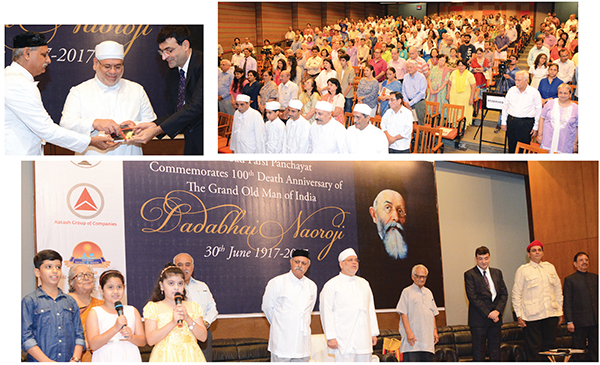
Clockwise from above: Brig Jahangir Anklesaria (Retd), Dastur Khurshed Dastoor, Piruz Khambatta,
releasing the commemorative volume; audience singing Chhaiye Hamé Jarthosti; Kersi Deboo,
Jeetendrasingh Gaekwad, Khambatta, Makrand Mehta, Dastoor, Anklesaria, Jinofer Bhujwala,
Dr Armaity Davar, children singing
Scholar and researcher Kersi Deboo reminded the audience that Naoroji was "the greatest” of navratnas (nine jewels) produced by the Parsi community. He was far ahead of the others as he was multifaceted and prominent in several spheres: "as teacher, social worker, journalist, politician and writer.” Deboo mentioned Mohandas Gandhi’s communication with Naoroji after the now well documented Pietermaritzburg incident where he was asked to disembark from a Whites-only train compartment.
Historian and research scholar Makrand Mehta called Naoroji "a Parsi, a Gujarati, an Indian and an internationalist — all these things.” Lauding his speech for being precise and "frugal in words,” the scholar said that like Sayaji Rao, he was a bridge between British imperialism and Indian subjects. The scholar stated that Naoroji’s greatest contribution was the thought that "what is morally wrong can never be religiously and politically right.”
"We should never mix religion and politics,” Udvada high priest and member of the National Commission for Minorities, Dastur Khurshed Dastoor reminded the audience. He noted Naoroji’s role in drawing up the boundaries of the five panthaks (Bhagaria, Sanjana, Udvada, etc).
The event was supported by a generous contribution by Jinofer Bhujwala of Atash Group. APP trustee Dr Armaity Davar proposed a vote of thanks.
Historian Dinyar Patel, who is working on an autobiography of Naoroji has a varying view and throws more light on the subject of Naoroji’s role in the panthaks: "By that point in time, in any case, I believe that the Sanjana and Bhagaria panthaks were really the only two that were fully functioning. In the village of Khergam in south Gujarat, Sanjana and Bhagaria priests were in dispute over who could perform rituals here. Naoroji was asked to arbitrate, and he decided in favor of the Bhagarias, saying that it lay within their jurisdiction. There is an old book in Gujarati on this case.”
Upon Parsiana’s request for details of Naoroji’s political reforms in Baroda as Dewan, Patel adds that "Naoroji’s chosen chief justice, Bal Mangesh Wagle, abolished nazarana (the practice of pledging gifts, within the judicial system). Naoroji, Wagle, and Hormusjee Ardeseer Wadya, Naoroji’s chosen chief magistrate, worked to draft new criminal, civil and penal codes.”
Quoting from Sir Rustom Masani’s biography of Naoroji, Patel states that Gandhi’s first letter to Naoroji is from July 5, 1894, a year after the Pietermaritzburg incident. In the letter, Gandhi briefly summarized his proposed work in South Africa and concluded, "You will, therefore, oblige me very greatly if you will kindly direct and guide me and make necessary suggestions which shall be received as from a father to his child.”