He joined the HMS Dufferin in 1935 because he felt "going to sea would be a rather good thing.” In an interview with Parsiana shortly after being named Chief of Naval Staff (CNS) (see "In the news,” Parsiana, December 1975) Adm Jal Cursetji, a soft-spoken individual with a ready smile, had termed his new office "an onerous responsibility” that he prayed he be "given strength to carry out to our best national and service interests.” On the occasion of his birth centenary in May 2019, numerous tributes were paid by colleagues and family.
"The primary role of the Navy is security and denying such security to any other Navy. Any nation can pose a threat as far as maritime interests are concerned. It all depends when your interests clash with that of others. The size and strength of your Navy has to be sufficient to fulfill the task assigned to it,” Cursetji had stated at a press conference on assuming office.
"The Indian Navy has been built up as a balanced force. It has to remain so; you can’t go for one type of vessel to the exclusion of the others. When you go into combat you’re pretty keyed up. There is nothing routine. Anything might happen. You don’t have much time to think of anything else. You just hope you will do well,” he had noted.
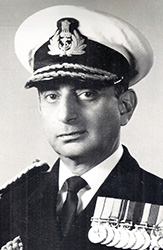
In 1937 he was selected for the Royal Indian Navy as a cadet and was sent to England for training. Commissioned in September 1940, Cursetji served on various naval ships during the last world war. In 1944, he was put in command of INS Bombay.
Speaking on Cursetji’s professional legacy at a function to commemorate the admiral’s 100th birth anniversary at Bombay’s INHS Asvini Auditorium on May 20, 2019, Cmde Srikant Kesnur, director of the Maritime Warfare Centre noted that Cursetji wrote a citation for every naval officer after the 1971 Indo-Pakistan War, "because he felt they deserved recognition, but never took any credit himself,” noted a report on the event in The Indian Express dated May 20. A write-up titled "About Admiral Jal Cursetji” prepared for the event noted that Cursetji’s "formidable team work” with Adm Sardarilal Nanda, then Chief of Staff "made a major contribution to the victory of the Indian Navy” in the 1971 war with Pakistan.
Rashida Cursetji Mendu and her sister Meher Cursetji Rafaat noted at the event that "though not overly religious, (their father) was a man who lived by his principles and conscience.” Meher sent a copy of their talk to Parsiana. After having served as the Indian defense attaché at Washington D.C. in the 1960s, on his return, Jal declared everything, including his bottle of aftershave to the customs officials at the airport, the sisters noted. Years later, when one of them was returning from overseas and a customs officer was ready to wave her through, Jal insisted that he check her bags. "She knows she’s not supposed to bring in more than the official allowance, so if she did, she can pay the duty,” he reportedly told the official.
"Father gave us a master class in learning to absorb facts, analyze them and project them,” noted Meher. "This… stands me in good stead today when dealing with government agencies or battling for civic issues,” she said. She narrated that when Jal retired from the Navy, he worked in the then fledgling field of environmental protection and heritage preservation. "I benefitted from his reflected light when I took my first steps in the field of urban conservation.”
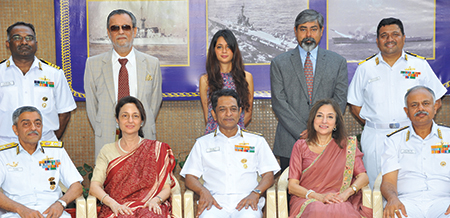
Top: Adm Jal Cursetji; above, from l, sitting: Vice Adm Vinay Badhwar, Meher Cursetji Rafaat,
Vice Adm Ajit Kumar, Rashida Cursetji Mendu, Vice Adm A. B. Singh; standing: Capt Doraibabu,
Darius Rafaat, Goolshireen Rafaat, Raghuveer Mendu, Cmde Srikant Kesnur
The Admiral was a prolific letter writer, noted the sisters who "feel fortunate to have a store of letters from him… he never used a printed or generic thank you letter and never let us do so either — even for our wedding gifts. To this day, I try to make sure my thank you notes live up to his high standards.” Jal’s erudition engendered a love of reading in both of them, Meher narrated. He passed away in 1991. "Perhaps the greatest lesson we learned from our father was that real wealth meant being happy with what you have,” they noted.