The Luminous Universe of Jehangir Sabavala
Geeta Doctor
The Crucible of Painting – The Art of Jehangir Sabavala by Ranjit Hoskote. Published in 2005 by Eminence Designs Private Limited, C/o G. S. Mhaskar Private Limited, 205-A. J. Shankarshet Marg, Opposite Gaiwadi, Girgaum, Bombay 400004. Pp: 224. Price: Rs 2,500.
It’s a magnificent summation of an extraordinary life. The cover painting itself is hypnotic. It is suggestive of the final movements of a performance of music, the sombre richness of a piece by Bach, perhaps, as well as the filigreed work of a goldsmith, the whole painting is held together by the faintest reverberations of white paint that pulse and glow against the enveloping dark. One is reminded quite paradoxically, since the figures in the painting are certainly more suggestive of nuns hurrying back to their duties after the evening prayers, or vespers, than of a flamboyant woman, of Cleopatra’s dying words, "The bright day is done, and we are for the dark.” And further the half murmured reflection as she asks to be dressed in the gorgeous emblems of an Empress of Egypt, "I have immortal longings in me.” Jehangir Sabavala’s paintings bring with them intimations of immortality, even when they are very carefully anchored in the here and now.
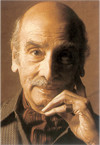
That of course is the haunting legacy of Sabavala. He reminds you of things you may never have experienced by drawing you into a world that is so exactly detailed and observed that you imagine that you have been there before. Yet of course, as this book reminds us, his journey has been such a strange and exotic one that very few persons might be able claim a kinship with it. He has most often chosen to be commemorated by poets. Ranjit Hoskote quotes Dilip Chitre, Adil Jussawala and Pria Devi to good effect in his text, while he himself has written a splendid volume called, Pilgrim, Exile, Sorceror – The Painterly Evolution of Jehangir Sabavala (1998) that he evokes in this volume also.
Hoskote belongs to the "Strum und Drang” school of writing. He never encounters a mountain that is not brooding, cannot contemplate a wood that is not Dantesque and when it comes to the paintings themselves Hoskote is beside himself. "These are a cartographer’s meditations: when we stand before these paintings, there is no sound louder than the pulse in the wrist, no ragged, unfinished element to blemish the eye with disproportion. After 1964, the music of Sabavala’s paintings becomes a subdued play of whisper and wingbeat, of haunting cry and rustling wind.” Do cartographers meditate? Don’t they just get on with their job, which is actually dry and pedantic? Maybe we should not grudge a poet his airborne sallies into the grand manner of Hopkinesque alliteration with a whisper and a wingbeat, but it can get a bit wearying.
(Right) An oil and canvas creation The Sorrowing Men (1974) by Sabavala (top)
Aside from this minor quibble, Hoskote is the perfect biographer since he has both the artist’s affection and his confidence. At the same time that we are told about the height of the brooding Matterhorn at Zermat, where the artist spent the most memorable years of his childhood in the still pristine environs of the Swiss Alps, Hoskote describes, for instance, the narcissus filled fragrance of the mountainside around Montreux. It’s extraordinary that Sabavala should recall such a detail, for there is just outside of Montreux, an annual festival of narcissus blooms. Every year, the hillsides around just one valley are filled with so many flowers that visitors are allowed to collect as many stems of narcissus as they can pluck and carry away in their arms. Later on, we are given glimpses of the Readymoney gardens in which the young Sabavala spent his holidays. It is as if the mixed borders of flowers with their heady scent of verbena, lavender and marjoram must have permeated some part of the artist’s being and made him the collector of the rare muted colors of garden, field and flower, the mauves and blues, yellows and greens that he so spontaneously creates on his canvasses.
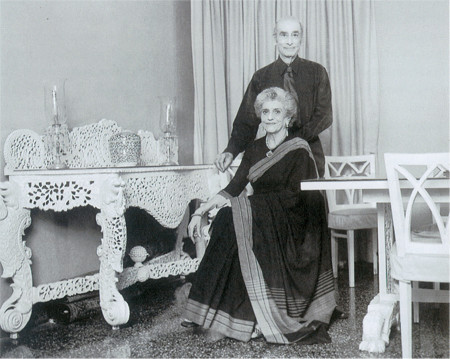
Shirin and Jehangir Sabavala at home, 2002. Photo: Dayanita Singh
Reading about the early Sabavala years one is reminded very acutely of the Cecil Beaton diaries, photographs, water-colors and gardening books where the golden youth of England spent the between the War years drinking pink lemonade under striped marquees playing croquet and tennis and elaborate games of charades and dressing up in fancy costumes. It is as if looking the part was as important as being the part. Hoskote’s heightened sensibility suits the Sabavala persona, or more accurately the different layers of his elegant way of life. It perfectly conveys the self-conscious intensity of the world inhabited by the artist, his immediate family and circle of friends. There are splendid photographs of both Jehangir and his stunningly beautiful wife Shirin that convey something of a way of life that was as gracious as it was refined.
Together they represent the confidence of the Parsi elite in its heyday. Like so many of their generation that had been sent to finishing schools and the best of educational establishments in the West, that in those days, automatically signified Europe, they combined a cosmopolitanism that is reflected in their confident gaze with the newly adopted richness of a young nation, in all its glowing self-affirmation. It could be that Hoskote underestimates the intellectual zest and fervor of the era. The set to which the Sabavalas belonged was exploring in the manner of the upper classes of their time, the most extraordinary mix of ideas from Theosophy, to those of Freud and Jung, Nudism and the experiments in free thought as represented by followers of Gurdieff and Ouspensky, the Moral Re-Armament movement, the architectural virtues of a Frank Lloyd Wright, the newly discovered vogue of cinema to the austerities of Gandhian thought and the daring attraction of Communism. Sabavala’s serene belief in his vocation stems from this milieu. He could withdraw into his cell as an anchorite, or pilgrim, as Hoskote so often describes him, because it was part of an enchanted circle, or garden. It explains what makes Sabavala’s work unique, despite all the vicissitudes of changing trends and fashion. He might be the last of his kind, an emperor of ice inhabiting a world of shifting color, but in that self-knowledge one may discern his strength.
Shirin wears her silk saris with pride, along with long dangling earrings or the splash of flowers tucked into her chignon. This was the mode adopted by actresses like Devika Rani and more discreetly by the chiffon clad Maharanis holding their diamond studded cigarette holders in the salons and race-courses of Paris. The cult of Orientalism was still very much in vogue and India represented the sensual and the feminine in all its suffocating splendor. This too is reflected in Sabavala’s work, the tension being equally divided by his innate love for the sensuous effects of color and thickly swirling textures and strict adherence to the inner architecture of line and form.
As Hoskote reminds us, part of Sabavala’s struggle as an artist has been to swim against the tide. It has been a continual process of learning and un-learning. When he was a student at Paris under the exacting eye of the artist and teacher Andre Lhote it was the singular rigor of the Cubist idiom that he struggled against before he could master it. By the time he had mastered it and learnt to sail into the fractured skies of his imagination, or more precisely in de-constructing the Asian landscape that he now confronted with his prismatic lens, he knew it was time to move on.
As Hoskote records, C. R. Mandy, the editor of the Illustrated Weekly wrote in a foreword to Sabavala’s exhibition in l958, "When I visited his first exhibition in Bombay held shortly after his return to India in 1951, I expected frankly to find the work of a gifted dilettante…I soon realized however, that Sabavala is indeed a dedicated painter, attending his studio punctiliously, as others attend their office desks, and constantly experimenting with new modes of expres-sion. His art has not remained static…There is nothing facile about his landscapes, they are deeply thought-out compositions which make a memorable impression on the viewer, as was evident when he showed his work at the International Biennale in Venice.”
Towards the mid-sixties, Sabavala had found the opening that he had been searching for in the example of Lyonel Fenninger. As he writes: "(In) Fenninger’s pure, precise and yet very delicate personal renderings of cloud and boat and sea, I discovered the joys of extending form into the beauty and clarity of light. I became interested in the source of light, its direction, its effect. Through these experiments, gradually my work changed.” There were to be other painterly heroes such as Turner and De Chirico from whose experiments with light, Sabavala profited.
As ever Sabavala is best understood in his own words. As he writes: "I discovered the suitability of landscape first, almost by wilful accident. For me, it was liberation, for the first time, from the various disciplines and schools of painting which was my equipment. I felt instantly at home with a scene that could be molded into whatever form that I wished to take. This eventually developed into my mountain/cloud/sea/dune forms. These became distinctly mine and not as depicted by anyone else. So that the idiom began to be personalized and now is exclusively so.”
Sabavala in Singapore with mother Bapsy (left) and friend Piroja Taleyarkhan in 1939
As Hoskote observes, in l966 Sabavala’s painted one of the most magnificent of his works that he called In the World’s Afterlight. Or as Hoskote writes, it is "a panoramic view of multiple horizons rising to accompany the sun as it vanishes into a great, golden twilight. The pilgrim figures gathered near a lake, perhaps to pray at dusk are the precursors of other such questing figures, whose advent would soon impart a distinctive mystical case to Sabavala’s paintings.”
It’s exactly 40 years now since that era. What is both astonishing and extraordinary is that Sabavala has managed to keep his vision exact and all but inexhaustible. The reason may be that having discovered his multiple horizons and walked on the shores of immortality Sabavala, the collector of the radiant moment, has understood a long time back that there is only one quest for him — the quest for truth that may also be described as beauty.