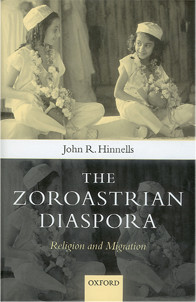
The Zoroastrian Diaspora: Religion and Migration by John R. Hinnells. Published in 2005 by Oxford University Press, Great Clarendon Street, Oxford OX2 6DP. Pp: xvii + 865. Price: Not mentioned.
Arnavaz S. Mama
The Zoroastrian Diaspora: Religion and Migration by John R. Hinnells. Published in 2005 by Oxford University Press, Great Clarendon Street, Oxford OX2 6DP. Pp: xvii + 865. Price: Not mentioned.
When Prof John Hinnells began his preparations in 1983 to deliver the prestigious Ratanbai Katrak Lectures in Oxford in 1985, he could hardly have anticipated that this hydra-headed topic would entail 250,000 miles of travel or that he would need to wade through 120,000 printout pages analyzing his international survey from 1,812 responses! Add to that 3,000 years of Zoroastrian history and one can condone the 22 odd years it took to get the results into the framework of this book. What he has produced is as much a history of Zoroastrian settlements as a documentation of the communities’ perceptions of the world and their place in it.
Hinnells: documenting Zoroastrians
In the process one learns that Zoroastrian diasporas began as far back as Achemenid times, with the spread of trade and culture along with the marching imperial armies, an instance of which was Anatolia, more familiar to us as Asia Minor. However it was the initial migration from Islamic Iran and the establishment of the Parsis on the west coast of India where Hinnells begins his story, and successive waves of out migration later as Parsi confidence, burgeoned by prosperity under British rule, sought an even wider canvas under the British flag. Participating in the sea trade with China led after a while to settlements from the mid 19th century onwards in Canton, Shanghai and Whampoa, and, eventually, Hong Kong. It was again by sea that Parsis went to Sind, establishing themselves in Karachi with agairies and dakhmas and hospitals; to East Africa — and Zanzibar, complete with the only agiary in the area — to supervise and facilitate the Indian labor that went to build the railways, providing professional services as administrators, engineers, doctors, bankers and the like.
In each case, what started out as short term service or trade concerns, developed into settlements with religious facilities where families established their own traditions, living within the community framework, with scant social intercourse with the Chinese, Sindhis, Africans or, for that matter, even with other expatriate Indians except, may be, cricket, as in Africa. As long as they lived under British rule, they felt secure in their loyalty to king and country. They felt no compulsion to study the religion. Ritual, not theology, was the focus, even for raising the younger generation [though in Karachi the teachings of Dastur (Dr) Maneck Dhalla so affected the community, writes Hinnells, that even those who later migrated to North America carried their religious devotion with them]. As for familiarizing the host communities with Zoroastrian concepts, the question did not arise. Their religious equation was with the priests and practices of the community in India, as Hinnells notes.
The end of World War II and the dissolution of the British empire appreciably changed the lives of Zoroastrians in Africa. Though there were 215 Parsis in Zanzibar in 1956 and Rustom Madon was nominated by the government to membership of the Legislative Council in 1957 and Rustom Sidhwa was the first elected Asian member of the Council, Pervez Talati, the first mayor of Zanzibar, and Keki Madon, the first speaker of the Legislative Council in 1961, "The Parsi story in Zanzibar came to a relatively quick and sad end,” writes Hinnells, "with a few returning to India and the rest moving to the UK.” Barring the descendants of the Darukhanawala family, "there are now effectively no Parsi residents in Zanzibar (following the revolution) which had been the hub of the Parsi East African network because of its temple and priest. In Kenya, the Parsi population is ageing and declining. As, so often in the Parsi universe, the community is deeply divided, not least over questions of intermarriage and because of personality clashes. But the religion is strong among most Parsis, and in its practices and beliefs is characteristically traditional or orthodox,” states Hinnells.
The story of the Karachi Parsis has moved "through different stages, from pioneering work in the growth of Karachi, to leadership roles in the early history of (Pakistan), to a concern at the potential threat of what is seen as the growing militancy of Islam…and increasing gang violence…Many of the younger generation who are able to travel to the West for education and employment, do so. The numbers are, therefore, consistently reduced: the young migrate, and the elders die…As numbers decline, so too do donations and subscriptions, and use of such facilities as the Dhalla Library diminishes. The demographic issues have an impact on the material and social structures of the Parsis in Karachi.”
The Hong Kong community is shifting from its business moorings into a more professional profile. Though a wealthy settlement, with a number of children under 12 years of age but few between 13–20, "the younger Zoroastrians do not meet socially very often. The new building has a room for children to play in while their parents are at ‘the club,’ but the club is for older people… There are no religious education classes.” Though "there was a strong and unified determination that Hong Kong would not become divided, as so many other Parsi communities have been…Few saw the prospect of a Parsi community beyond 50 years,” records Hinnells.
The oldest Parsi – nay Asian – settlement in the West is what began as a Zoroastrian Association in London when Dadabhai Naoroji was a member of the British Parliament in the late 1800s, now known as the Zoroastrian Trust Funds of Europe Inc. "Whereas the vast majority of other British South Asian migrants came as manual workers, the majority of primary British Zoroastrian migrants, both in the 19th and the 20th centuries came as educated professionals. There have been some merchants, for example that is how Naoroji and K. R. Cama first came to Britain, and it was the role that gave Sir Dhunjibhoy Bomanjee his fabulous wealth (as supplier to the British army in the Boer War). Whereas most early South Asian migrants lived in inner city areas seeking to save money to send back to India, Zoroastrians typically went straight to the leafy suburbs. The longer history of the Zoroastrian community means that they have a more diverse age range, with a greater proportion of elders, and of the second and third generation young… They have many facets to their sense of self-identity, but for most their Persian origins are of considerable importance… Although Zoroastrians typically do not want to be seen as Asian, the stark reality is that that is how most outsiders see them.” Speaking of the common self-perception of Parsis as being favored and respected by the British, Hinnells adds, "In Britain they commonly saw the significant distinctions to be those of class rather than race.”
Hinnells refers to isolated instances of Zoroastrians in France, noting, "it is difficult to speak of a community in Paris…There was commonly a sense of pride in being Parsi, but because their meetings are essentially ethnic socializing, they are not the sort of functions where Parsis meet Iranian Zoroastrians. Each group seems to know very little of the other.”
The same is also true of Germany where Iranian Zoroastrians live largely in and around Hamburg while Parsis are fairly scattered and there is a high proportion of intermarriage, notes Hinnells. Zoroastrians born there prayed occasionally, did not consider themselves German, describing themselves to Hinnells as Indian rather than Parsi.
Ervad Kersey Antia (left) and Ervad Noshir Hormuzdyar performing the navjote of Joseph Peterson in 1983
Though the number of Zoroastrians there is greater than in any other area apart from the home countries, the vastness of the North American continent has meant that groups settled at great distances from each other have developed diversely. There is also considerable difference in the perceptions of the Zoroastrians of Canada and of the US. They have been attracted to the latter in search of higher education, career prospects and the education of their progeny. But, unlike the official multiculturalism of Canada, US society makes "strong assimilation demands,” which have kindled the urge to create associations and, in turn the Federation of Zoroastrian Associations of North America, in an effort to preserve community identity by learning and teaching the principles of the faith so that the younger generation can respond with knowledge and pride to their questioning American peers.
The perception of America as "the melting pot” also fueled the effort to create community centers, termed Darbe Mehrs (interpreted as ‘doors of loves’) in deference to the generous Iranian philanthropist Arbab Rustam Guiv who financed a sizable portion of the cost, as well as the newsletters to help each community remain aware of program schedules as well as stay connected with other settlements in the country. To meet and mingle and to address fundamental issues, the North American communities have spared no effort to hold adult and youth congresses every alternate year. A crucial question is, how far can they adapt to American life while retaining the religion in terms that are meaningful to the young. Hinnells quotes the concern of Ervad Yezdi Antia of Toronto, enunciated at the 1985 North American Zoroastrian Congress in Los Angeles:
"Many among us believe that the practice of Zoroastrianism is riddled with rituals. Perhaps it was true in India, especially in respect to ceremonies for our departed. In the west, however, this is no longer the case. Rituals are the center of our social life here. Navjote, marriage, death and jashan ceremonies are occasions for the community to gather together from miles around, to affirm our faith, and give visible and tangible sense of identity to our children. In our main cities, we are scattered far and wide and we need more, not fewer, rituals for a purpose and an occasion to meet together.”
"It is widely accepted among American Zoroastrians that intermarriage is inevitable… ‘a natural consequence of being on this continent,’” Hinnells quotes Ervad (Dr) Jehan Bagli at a Toronto conference. Efforts to keep non-Zoroastrian spouses out of the atash dadgah at the Toronto muktads in 1984 "produced such intense debate in the community and so many concerns were raised about the effect this would have on families that in a (subsequent edition of their newsletter) the president Dhun Bhaya said that spouses and children of Zoroastrians should be admitted, otherwise they would be driven from the community, but that no other non-Zoroastrians should be admitted...The emphasis on the Zoroastrian identity being primarily religious raises for many the question of conversion. This has surfaced in other countries, but nowhere as acutely as in America,” comments Hinnells.
The author chronicles the furor in the Bombay community following the navjote of American engineer Joseph Peterson in New York in 1983. The controversy before and after the event continued in the Parsi Press as well as in the American newsletters. "The arguments were commonly personal, almost always vitriolic. The intensity of the comments from Bombay fuelled the debates within the North American community…One point behind all these documents is the belief that community and priestly directives in Bombay have religious authority over Zoroastrian practice overseas,” notes Hinnells. Though sometimes characterized as a "Parsi versus Iranian Zoroastrian debate,” because the Guiv Trusts sponsored the event and a majority of the pro-navjote lobby were Iranians, Hinnells states that of the four priests who officiated at the navjote, two were Parsis — Ervad Kersey Antia of Chicago and Ervad Noshir Hormuzdyar of New York, that World Bank executive Adi Davar had published a "controversial paper calling for the acceptance of converts,” that leading Bombay figures like The Bombay Samachar editor Jehan Daruwala, eminent diplomat and jurist Nani Palkhivala and noted solicitor Shiavax Vakil had supported the navjote and its strongest defendant had been Antia whose Argument for Acceptance earned him extra flak.
"Antia offered his resignation to his Chicago board at a meeting on February 13, 1983. It was rejected only by the casting vote of the chairman. Five members left the Association in protest,” records Hinnells. However, the Chicago Open Forum on Conversion, attended mostly by Parsis, voted 90 percent in favor of the acceptance of the navjote of spouse and children and 86 percent voted for the acceptance of anyone who came forward of their own volition and accepted the religion, says Hinnells, adding, "A substantial issue behind the debates is one of religious authority: do the religious leaders in the old country have authority to direct the religious beliefs and practices of diaspora communities?”
The question had never arisen in any other modern Zoroastrian diaspora. Even here it may have been the result of seeking directions which never came. Hinnells quotes a report from Bahram Faradieh to the Chicago AGM, June 11, 1978 after the Third World Zoroastrian Congress in Bombay: "Having witnessed in Bombay the inability of the Congress to resolve any vital issues, he stressed the fact that we were an autonomous independent group charged with the future of our children, and that we should mold our own future as we see fit and as dictated by circumstances and laws of this country.” "Many American Zoroastrians are convinced that they in the New World represent the future of the religion because in America there is a concentration of dynamic leaders,” notes Hinnells providing a series of quotes that register the feeling there that the American diaspora parallels the Zoroastrian experience in India in the early years after the migration.
An element that has dogged North American Zoroastrians has been the Parsi-Iranian divide — differences not only over language, food and festivals, the disparity of cultures acquired in Islamic Iran and Hindu India, but the diversity in the theology and practice of the faith. Nonetheless, in the records of the associations of California, Chicago, Vancouver, Toronto and Quebec, Hinnells has found that the Zoroastrians there "had pressed their respective governments to view sympathetically requests from their Iranian co-religionists for visas” after the fall of the Shah in Iran.
A specific North American dimension spearheaded by the Zoroastrian Association of Greater New York was the initiation of the "Good Life” Zoroastrian emblem in the Scouting movement to provide a religious education program for the young of the community. Sunday School and sleepovers in Chicago meant that learning the religion and socializing within the community became linked. Again in New York, Prof Kaikhosrov Irani and Lovji Cama organized adult classes, day schools and seminars to address the need that many Zoroastrians had confessed to Hinnells: their commitment and desire to learn about the religion "had increased after migration, partly to answer their children’s questions, partly to answer the questions of outsiders and partly because life in a new culture accentuated their own sense of distinctiveness.”
The yearning to learn led the associations to invite non-Zoroastrian scholars of the religion to speak to them, set up libraries, etc but the pattern of religious education varies depending on the size, resources and policy of each association. One consequence of the emphasis on religious education has been the articulation of "teachings which are meaningful in the New World, both so that they attract the young and also to avoid mockery or alienation from the wider American society,” shunning what might be branded racist or superstitious, such as saying prayers without understanding. Gavashni from Quebec and The Zoroastrian from California were two publications "concerned to present Zoroastrianism as unequivocally monotheistic” in the tradition of Dastur Dhalla whose "perspective on the religion seems to meet the intellectual and religious needs of many North American Zoroastrians at the turn of the millennium,” notes Hinnells. One result of the concern to present the religion in a good light to the public at large has been increasing involvement with interfaith activities.
The youngest diaspora is the one in Australia where well-educated, middle-class professionals feel comfortable with the wider society. "The Sydney population, the older of the two settlements, tended to have more young people, more singles and fewer extended families. The Sydney community saw itself as more united than the Melbourne group does, but the Melbourne group tended to be more traditional in religious terms,” writes Hinnells. Sydney has regular links with other Indian diaspora communities, uncommon elsewhere, notably for cricket and table-tennis. "The Indianness of the community is noteworthy,” comments the author. "Sydney is the center where intermarrieds have been most accepted and involved in the Association. Individuals not born Zoroastrians have served on the managing committee and been editor of the newsletter and an active priest is married to someone not born a Zoroastrian…The community as a whole did not want a religious flavor. It was decided after discussion that the president did not have to be a practicing Zoroastrian,” records Hinnells. Though Sunday School is a priority, religious beliefs are avoided in the managing committee to preclude disputes.
The emphasis in Melbourne on contributing to Australian multicultural society "is without parallel in any community studied,” writes Hinnells. "Their constitution defines Zoroastrian as ‘a person who has been admitted to the Zoroastrian faith by the performance of a navjote ceremony and has not thereafter renounced the same and/or declared his allegiance to any other religion.’ There is no reference to ancestry,” comments Hinnells.
Though Zoroastrians in both Sydney and Melbourne see themselves as staunchly Australian, Melbourne’s constitutional commitment to and role in Australia was greater than any that the author said he had studied. "In Sydney, in contrast, there was seen to be an unusual degree of Zoroastrian involvement with other émigrés from India and so the respondents from there identified themselves (more) with the old country.” Both have problems with the Parsi-Iranian divide, the emphasis on Gujarati jokes, cartoons and functions being more conspicuous in Melbourne. In both, the Indianness and the disputes are distancing the youth, while the emphasis on religious or secular culture varies from president to president and committee to committee.
The lurching search for a world body of Zoroastrians, the establishment of the World Zoroastrian Organisation, its work for the betterment of rural Zoroastrians in Gujarat and resettling of Iranian Zoroastrian refugees, the establishment of an annual lecture at the School of Oriental and African Studies (SOAS) in memory of the late Dastur (Dr) Sorab Kutar, the Gatha conferences it has held with the proceeds published, as well as the criticism it has roused partly because of its constitution and policies, partly because its paper work failed to keep abreast of events — Hinnells has recorded it all, though his time frame falls short of the near-achievement of the world body in June 2005 and the carping controversies from India that scuttled it.
"Religious communities are like chameleons; they change their ‘color’ in different environments…It is inevitable that Zoroastrianism will be seen differently in, say Los Angeles, a modern western city with many new religious movements and many Iranians, than in, say Mombasa or Hong Kong. On that axis, London would be at the midpoint. Plotting each city on the axis may be fraught with difficulties, but an axis exists,” writes Hinnells. But he emphasizes the relativity of such statements: "One person considered to be ‘orthodox’ may have been ‘liberal’ to someone else…In assessing the Houston figures, the respondents from there consistently showed themselves to be more traditional than the respondents from Chicago, even though more of them used the self-description of ‘liberal.’”
One-third of Hinnells’ respondents considered discrimination a problem in their new country of residence. The perception was shared not only by the Persian speakers and those educated in the old countries, but postgraduates in science who had reached the highest level of employment. The finding countered the general stereotype of those facing discrimination as being least educated and too community oriented to assimilate. "There is a strong feeling in many countries that to succeed you have to be seen to be twice as good as the local person. People whom I know well personally have had threatening phone calls and windows smashed; they include lawyers, accountants and in one case, someone active in mainstream party politics,” notes Hinnells.
A fine compendium of recent – and not so recent — history, what mars The Zoroastrian Diaspora are a number of errors, not just of spelling and proof reading, but of fact. For instance, in the context of the Parsi Punchayet Case of 1906, Hinnells consistently lists J. R. D. Tata among the plaintiffs whereas the person concerned was his father R. D. Tata. Referring to the split in the Federation of Parsi Zoroastrian Anjumans of India in 1978 when the Bombay Parsi Punchayet walked out of the body, Hinnells attributes it "in part, on the grounds that the Delhi Parsi Anjuman (DPA) allowed non-Zoroastrian spouses into their temple and into Anjuman membership.” (While the DPA admitted non-Zoroastrian spouses to membership of the Anjuman, they were never allowed the use of the agiary or the aramgah.) Speaking of the transfer of the Tavri fire to Bombay he notes "it was moved to Navsari to be housed until it was agreed to install it in the new building in Andheri.” (The Tavri fire had been resting in Navsari much before it was decided to move it to Bombay’s Godrej Baug off Napeansea Road, not Andheri.) Hinnells speaks of Neville Wadia as one "who had converted to Christianity,” whereas the man was born of both Anglican parents — his father, a Parsi, had converted to Christianity before Neville was born. Speaking of the controversy that dogged the Seventh World Zoroastrian Congress in Houston in 2000 regarding whether or not to allow Ali Jafarey of The Zarathushtrian Assembly to participate, Hinnells writes, "The compromise eventually reached was for Federation of Zoroastrian Associations of North America (FEZANA) to host a ‘debate’ during, but ‘apart’ from the congress, between Jafarey and the orthodox Khshnoomist Bombay teacher Adi Doctor.” (In fact, the debate was with another Khshnoomist speaker, solicitor K. N. Dastoor, a fact noted by Hinnells 152 pages earlier!) He notes categorically that in the legal dispute between the Athravan Educational Trust (AET) and the K. R. Cama Oriental Institute (KRCOI), "The court found in favor of AET.” (The KRCOI maintains that the matter is still under litigation.) Hinnells also states that the Bombay High Court in 1906 "ruled non-Zoroastrian spouses could not become Zoroastrians and only the offspring of a Parsi male could be seen as Zoroastrian.” With due respect to Prof Hinnells, what Justice Dinshah Daver said was "Even if an entire alien — a Juddin — is duly admitted into the Zoroastrian religion after satisfying all conditions and undergoing all necessary ceremonies, he or she would not, as a matter of right, be entitled to the use and benefits of the funds and institutions now under the defendants’ (Bombay Parsi Punchayet) management and control.”
Many such errors have crept into a publication which will be surely an important resource for future studies on the community. The fear is that thence the errors, if uncorrected in a future edition, will be compounded. Having been a staunch friend of the Parsis over a lifetime of research, such a fate would be sadly unbecoming Hinnells’ work.