Died: Dr Aspi Framroze Golwalla, 100, distinguished physician, chairman of the Pirojsha Godrej Foundation, erstwhile chairman of the Bombay Parsi Punchayet (BPP), the Parsi Medical Amateurs Association and trustee of innumerable community institutions; at The B. D. Petit Parsee General Hospital (PGH) in Bombay on August 29, 2020.
Looking forward to celebrating his 100th birthday, the strong-willed and cheerful Golwalla managed to cross that milestone eight days before his demise. In fact his birthday cake was carried to the Hospital by his son Dr Sharukh on August 21, for just two days prior a fall had necessitated his hospitalization. His roj birthday though had been celebrated at home in the company of his immediate family.
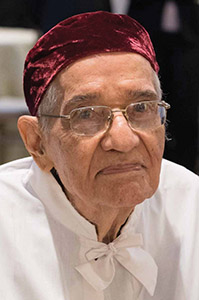
"He enjoyed being active, mentally and physically. He was fiercely independent right up to the very end. His passion was his medical books which he had authored or co-authored and which he spent hours laboring over and revising until a week before his demise,” recalled his granddaughter Zeena Golwalla. The workaholic had continued his private medical practice until he was 92 years old, sharing his clinic at Cambata Building (Eros Theatre) with his cardiologist son, Sharukh. Even thereafter, if the poor and the underprivileged approached him for assistance at his residence, he would treat them free of charge.
Practising as a physician at the K.E.M. (King Edward Memorial) Hospital, initially as an assistant to Dr Rustom Vakil with whom he had co-authored Physical Diagnosis — A Textbook of Symptoms and Signs, the popularity of this manual convinced him to fill the lacuna for such digests. Aspi’s Medicine for Students, now in its 25th edition and co-authored with Sharukh, continues to be regarded as the "Bible of medicine” by medical aspirants appearing for their theory and viva-voce examinations in India. His other books include Electrocardiography for Students and Practitioners, A Handbook of Emergencies, Practical Prescriber and ABC of Medicine. On retirement from K.E.M. Hospital, he was appointed Professor Emeritus of Medicine, a source of immense pride to the physician who enjoyed teaching. It heartened the family to hear prominent doctors acknowledge that Aspi’s tutorial lectures and medical textbooks helped them understand medicine.
"When I joined the board of trustees of Masina Hospital in 1978, Dr Golwalla was already a trustee with a high reputation in the medical profession and he was a towering personality,” recalled Burjor Antia, senior partner in the legal firm of Mulla & Mulla & Craigie Blunt & Caroe. "His method of working was really exemplary. He was punctual, meticulous and a great administrator looking after the development of the Hospital in all fields. He was a great disciplinarian (who expected honorary doctors to attend outpatient departments regularly and punctually)… At board meetings he would go strictly by the agenda and not allow any trustee to talk on any other issue,” observed Antia.
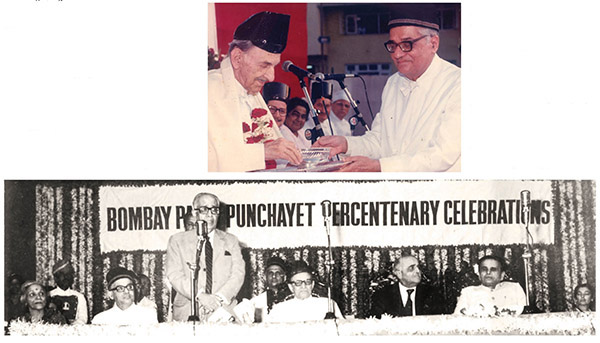
Top (r and top): Dr Aspi Golwalla felicitating J. R. D. Tata on his being conferred the Bharat Ratna Photo: Superstar Video Labs
above: at the BPP tercentenary event: Golwalla, then Vice President of India Justice Mohammad Hidayatullah and Boman
Boman-Behram (2nd, 3rd & 4th from l)
There were innumerable occasions when Antia, whose firm handled the legal matters for the BPP, was required to interact with Aspi. Appreciating Aspi’s rectitude, Antia stated, "He never instructed me to do anything contrary to the provisions of law or the opinions of senior counsel. He has never instructed us to take legal action against any person who has criticized the BPP in public. He never muzzled the freedom of speech of members of the community and he would always say that there are two sides to any problem… Today if Godrej Baug exists, it is because of Golwalla’s dynamic leadership and contact with the benevolent Godrej family.”
In a detailed article ("Genesis of Godrej Baug,” Parsiana, August 21, 2016) Aspi had written, "When I was elected trustee of the BPP in 1968, the main item on my agenda was housing. Though the BPP had ample lands, there was no separate fund earmarked for the construction of buildings.” Realizing that lands abutting Doongerwadi could be used for housing community members, he won the confidence of his co-trustees in 1976, used his contacts with the Godrej family (he was then trustee of the Pirojsha Godrej Foundation), along with other community stalwarts approached municipal and government authorities, including then Prime Minister of India Indira Gandhi for necessary sanctions, and was able to see his housing dream take shape from the early 1980s. As BPP chairman he had laid the foundation stone for the Godrej Baug agiary in 1988 that was finally inaugurated over a decade later.
Aspi’s association with the Punchayet had started in 1950 when he joined the medical panel of the Parsi Punchayet Health Unit and Cottage Hospital. Community historian Marzban Giara gave Aspi credit for "saving my life when I was admitted to the Gamadia Clinic at Tardeo in July 1957 when I was a student. He came at midnight to attend to me. I was unconscious.”
In an interview with Parsiana (see "The politics of healing,” March 1982) within three months of taking over as chairman, Aspi had stated, "The biggest need of the community is harmony; if we have harmony, we can achieve much more in the future.” Whilst adhering to rules and regulations, sitting across the table "to iron out our differences in a spirit of give-and-take, we might be able to revive the Federation (of the Parsi Zoroastrian Anjumans of India),” he had opined. The spat between the Delhi Parsi Anjuman and the BPP that had caused a split in the Federation in 1978 was resolved once he took over as chairman and the Federation started working harmoniously again with Aspi as ex officio president.
He believed the dual role of the Punchayet was to serve as the custodian of the funds and properties whilst looking after the welfare of the community, especially in Bombay. Among the changes he sought to introduce were to revive the prestige of the Punchayet, earn the confidence of the community by keeping them well informed through the publication of the BPP Quarterly Review and Statistical Outline, hold press conferences from time to time, form new action committees… "The intellectual, emotional and religious revival that has come about (in the community in India and overseas)… are the harbingers of a hopeful future,” he believed.
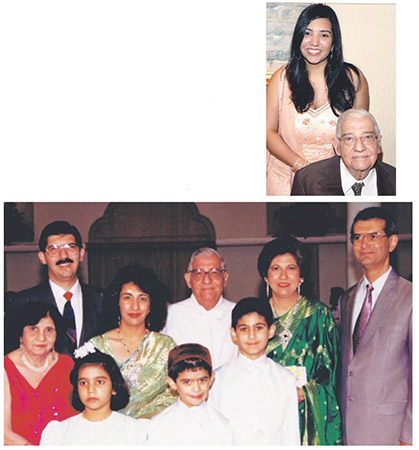
Above (from l) Golwalla family: Bhikhu, Dr Sharukh, Dina, Dr Aspi, Meher and Aspi Sattha
with Zeena, Zahan and Shahvir (in front); top: Zeena and Aspi
In favor of merging fire temples where few devotees remain, the trust is unable to finance the upkeep of the fire temple or give adequate remuneration to its priests, Aspi had candidly declared over four decades ago that "the number of fire temples in Bombay is too large… (see "Are there too many fire temples in Bombay?” Parsiana, April-May 1974).”
Ahead of the first adult franchise elections for BPP trustees when Parsiana had sought the views of erstwhile trustees on attributes to look out for in prospective candidates, Aspi had recommended individuals who do not "indulge in undue orthodoxy or religious fundamentalism, choose the middle path and move with the times, say a big ‘No’ to crazy and wasteful projects such as the vulture aviary at Doongerwadi (see "A good mix,” August 21, 2007).”
Notwithstanding the controversy created when he along with then BPP trustee Shiavax Vakil visited the insides of a dakhma in the early 1970s to check the conditions therein, around three decades later he along with Jamsheed Kanga and Homi Khusrokhan filed an Originating Summons in the Bombay High Court in January 2007. They sought to determine whether the bunglis at the Doongerwadi could be used for after death ceremonies by all Zoroastrians irrespective of the mode of disposal (see "Rewriting history,” Parsiana, February 21, 2007).
Born in Karachi, Aspi had lost his father when he was 20 days old and often recalled how his mother Meherbai single-handedly brought up six children. An outstanding student at the Bai Virbaiji Soparivala Parsi High School, he had completed his inter-science from the D. J. Sind College and was awarded the Coyaji Scholarship by the Bombay University. He then relocated to Bombay to pursue medicine at the Seth G. S. Medical College where he won several prizes for topping subjects like clinical medicine and infectious diseases. After qualifying as a doctor of medicine in 1949 he was appointed as tutor to the Grant Medical College and honorary assistant physician at the Goculdas Tejpal Hospital. It was in the same year that he married Bhikhu Sahiar whom he had met when living at a guesthouse in Marine Lines. After her demise 18 years ago, the family felt he had turned into a recluse.
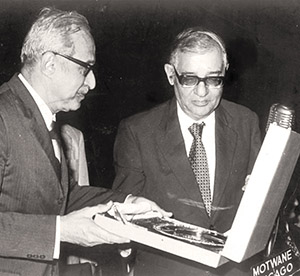
Golwalla (r) felicitating Justice Dinshaw Madon Photo: Rashid D. Bamanbehram
For several years he was examiner for the MD (Doctor of Medicine) courses conducted by different universities and he would frequently recount amusing anecdotes concerning naïve students. Over the years he was elected Fellow of the American College of Cardiology and invited to the Fellowship of American College of Chest Physicians. He was appointed medical advisor to the Atomic Energy Commission and honorary visiting specialist at the Tata Memorial Hospital.
"He rejuvenated The Parsee Medical Amateurs Association, together with Dr Jimmy Sidhva,” recalled Hector Mehta, joint honorary secretary of the PGH that was the chief recipient of the funds they raised when the medicos performed plays written by Dr Jehangir Wadia. "Ever smiling, genial and always ready to help the poor and the needy,” Mehta confirmed that besides treating many patients free of cost, he helped educate deserving young students pursue education with the assistance of several trusts with which he was connected.
An avid sports fan, he enjoyed following cricket and other games on television and being up-to-date on all news. Over the years Aspi had also served as trustee of the Banajee Trust, Sir Pheroze Sethna Memorial Fund, H. K. Kolah Trust, Zoroastrian Association and the Fort Gratuitous Dispensary for the dedicated doctor believed, "Today the gift of time is the biggest gift an able person can give to the community.”
The disciplined doctor is survived by his daughter Meher Aspi Sattha and son Sharukh.