Ancient texts do not support the tradition of
treating menstruating women as spiritually unclean
Dina G. McIntyre
The idea of whether or not menstruating women are spiritually unclean in our religion has been the subject of discussion in which historical facts are conspicuous by their absence. We have a lot of opinions, a lot of ancient sounding words thrown about (many of which are not Avestan) but few facts in support of this tradition. Yes, we have such a tradition in Zoroastrianism. But no one seems to have examined when and how this idea came into being in the long history of our religion.
Over the centuries, the underlying idea has resulted in many different practices in dealing with this phenomenon. Today, in orthodox and Ilm-e-Khshnoom circles, a menstruating woman cannot attend religious ceremonies (because she is a spiritual pollutant). In liberal circles, she may attend a ceremony so long as she does not touch anything of religious significance (because she is a spiritual pollutant) — she cannot go up to the afarganyu to add sandalwood and incense to the fire, or touch its instruments or the ashes, or do any one of the things others are encouraged to do — which naturally signals her condition to everyone present.
Many are embarrassed to publicly discuss this tradition (while still enforcing it). But we can no longer ignore this 10-ton elephant in the room. We cannot continue to teach this tradition to our children and enforce it — however quietly — without hurting them and ourselves, and failing to follow the path of truth. We need to look it in the eye, and decide. Are menstruating women a source of spiritual pollution? I cannot claim to have been instructed by invisible people on Mt Demavand. I can only tell you what our ancient texts say. I would like to show you — with the best available evidence — when this tradition arose, and on what it was based, so that each Zoroastrian community can make an informed decision on whether or not it wants to let this tradition go.
Our most ancient texts are the Avestan texts — the oldest being the Gathas and later the Yasna Haptanghaiti (both composed in Old Avestan), then the other Yasnas, the Visperad, Yashts, Nyaishes, Gahs and Afrigans [composed in Younger Avestan (YAv) — just as today’s English is different from older versions]. These YAv texts have been translated in Sacred Books of the East
(SBE) Vols 31 and 23, with the Avestan texts in Karl Friedrich Geldner’s Avesta. None of them teach that a menstruating woman is spiritually unclean, nor prescribe exclusionary rules to avoid her spiritual pollution.
So far as I am aware, the first mention of this idea occurs in the Vendidad (Videvdad), a text composed in what purports to be YAv (translated in SBE Vol 4). But scholars (who are linguists) have long since concluded that it was written after Avestan times, when our priests were no longer fluent in the Avestan language, because its Avestan is full of grammatical errors. Among the Avesta scholars are Robert Charles Zaehner, professor of Eastern religion at Oxford, who speaks of "the appalling grammatical confusion that characterizes that ... work,” (Dawn & Twilight of Zoroastrianism, pg 162) while academicians Helmut Humbach and Klaus Faiss mention in passing "...the well-known fact that the grammatical endings found in the Videvdad are notoriously doubtful...” (Zarathushtra & His Antagonists, pg 31).
Prof Almut Hintze, Zartoshty Brothers Professor of Zoroastrianism at of the School of Oriental and African Studies in London, thinks the Videvdad was composed in the post-Achemenian period.
I agree. The Achemenian kings would never have tolerated giving priests as much power to rule and punish, as they have in the Vendidad.
Ilm-e-Khshnoom claims the Avestan language was not a language for everyday life, but was created and used solely for rituals (and therefore could not have such mundane things as grammar). This is not true. Linguistic evidence has established beyond doubt that Avestan is in the Indo-European family of languages (would you believe, the English word "star” — in the sky — is Avestan star-), and Avestan is very similar to Vedic Sanskrit. One has only to study the texts to see that the language was for everyday use (and was also used for rituals). The texts describe many non-ritual things — the ringlets of a bludgeon-bearing warrior; the square earrings and fur clothing of a goddess, for example.
So where does the Vendidad fit (time wise), in the history of our religion? Zarathushtra’s date is not precisely known. Estimates range from the earliest, around 6480 BCE to the latest around 589 BCE. Some linguists and writers think he lived around 1000 BCE or 1700 BCE or earlier. From Zarathushtra’s date through the centuries of the YAv texts (which even then regarded him as very ancient) through the fall of the Achemenian Empire around 331 BCE, we have a period of several centuries. There is no textual or other evidence that the religion considered menstruating women as spiritual pollutants, or practiced resulting exclusionary traditions during all those many centuries.
Then how did this idea come into being? Well, in some YAv texts, we see the idea of cosmic dualism — two uncreated entities — an all good God, in conflict with an all evil devil (there is no devil in the Gathas, except for interpretations personal to the translator). The Pahlavi text Sikand Gumanig Vijar explains that if Ahura Mazda is all good (as He is in the Gathas), He cannot have created anything evil. Therefore (the ancients reasoned), there would have to be another creator of everything evil. And thus was born the idea of the devil — an all evil entity. In the Gathas, the only spiritual pollutants are things that are intrinsically evil, such as lies, cruelty, violence, anger, tyranny, bondage, murder, theft, harming, injuring, etc. In later Avestan texts, what is evil was extended to anything that was harmful to man (although not intrinsically bad) — wolves, disease, sickness, etc and these evil things were considered the creation of the bad entity — the devil.
At the time of the Vendidad, the cause of menses was not understood, but in their experience bleeding was caused by harming someone, and the devil was the source of all harm. So menstruation (which could not otherwise be explained) was thought to be caused by the devil (harming the woman). How do I know this? Because the Vendidad and ancient commentaries say so.
The following references to the Vendidad are from James Darmesteter’s translation (SBE Vol 4). Each chapter of the Vendidad was later called a Fargard. Each Fargard has numbered sections. These section numbers were inserted into the text by scholars. All the sections on menstruating women are from Fargard 16. All the sections on hair and nails are from Fargard 17. In Fargard 16, the question is asked, how much food should be brought to a menstruating woman (who is in isolation)? The answer is that she should not be fed too much, because any strength she might gain from the food would strengthen the devil (who was causing her to bleed). "How much food shall he bring to her? How much bread shall he bring? (Only) two danares of long bread, and one danare of milk pap, lest she should gather strength.” (section 7)
Darmester explains giving the Pahlavi commentary, "‘Soshyos says: For three nights cooked meat is not allowed to her, lest the issue shall grow stronger.’ As the fiend is in her, any strength she may gain accrues to Ahriman.”
There is a very lovely Avestan maxim repeated in YAv texts. It does not feature in SBE translations, but appears (in Avestan script), in identical form, in Geldner: aevo pantao yo ashahe vispe anyaesham apantam [There (is) one path, that of truth, all others (are) non-paths — my translation].
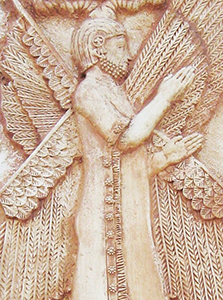
Relief of Cyrus the Great : Wikipedia
Under this teaching, a tradition is nothing — a non-path — if it is not in accord with truth. The idea that menstrual bleeding is caused by the devil is untruth. A non-path. Today, we know that the menses is just the lining of the uterus, which is enriched to nourish the fetus, and is sloughed off (as menstrual bleeding) if no fetus attaches to it. That is truth.
Many other reasons have been proposed to justify the exclusion of menstruating women (by people unaware of the original reason). One is that it allowed women to rest. Kindly, but not supported by any text. The ideas that the auras of menstruating women snatch power from a man or his aura (an Ilm-e-Khshnoomi thought), or that the touch of such a woman draws power from a man, or sours milk, or makes pickles turn out badly, are not found in any ancient Avestan text. These are all fear driven (or control driven) superstitions that have neither a factual, nor textual, basis.
The idea that menstrual bleeding is caused by the devil is the only textual basis for the exclusion of women during their menses. If, indeed, menstrual bleeding were caused by the devil, we should ask: Who vanquishes the devil every month like clockwork? Women do. So are women spiritually superior to men? Of course not. Spirituality has nothing to do with gender. In Avestan texts, men and women are treated as equals. According to the Aerpatastan and Nirangistan (believed to be part of the lost Avestan Husparam Nask), both men and women were priests.
Those ancients in the Vendidad were not afraid to use their minds to arrive at conclusions (although faulty), based on then available knowledge (although incorrect). Do we have their courage? If menses is not caused by the devil we should stop practicing any exclusionary traditions against such women. If you believe that menses is caused by the devil, then you should practice all of the Vendidad’s exclusionary mandates — anything else is hypocritical. I will summarize these mandates here (in addition to feeding such women only a little bread and milk) — all of which are ignored today. The Vendidad Fargard 16, mandates:
that menstruating women be kept in a separate building "...and they shall erect a building there, higher than the house by a half, or a third, or a fourth, or a fifth part, lest her look should fall upon the fire.” And that she should be kept "15 paces from the fire, 15 paces from the water, 15 paces from the consecrated bundles of baresma, three paces from the faithful.” (sections 2, 4)
that a person bringing her food should keep his distance: "Three paces from her shall he stay, who brings food to a woman who has an issue of blood, either out of the ordinary course or at the usual period;” that her food should be brought "in vessels of brass, or of lead, or of any common metal.” (sections 5-6)
that "if a child has just touched her, they shall first wash his hands and then his body” (sections 7) including a "child whom she suckles” (footnote 5);
and that after her "infirmity” is over, she must undergo a purification ritual in which three holes are dug, and she is washed by gomez in two holes, and by water in the third (sections 8-12).
No Zoroastrian community today — not even Ilm-e-Khshnoom — follows any of these mandates. Yet the Vendidad is clear that it is not just such a woman who is spiritually impure, her spiritual pollution is infectious — to everything — it infects the space around her, what her glance falls upon, and any person or non-metal thing she touches. So if the Vendidad is true, then the whole Zoroastrian community today (in fact the whole world!) is spiritually polluted because at home and outside it, such women live, cook, eat, sleep, go to work, shop, look upon and touch people and do a myriad things — in total disregard of the Vendidad. Why? Because it is convenient. Yet such women are still excluded from touching religious things, or attending religious ceremonies. Why? Because that inconveniences no one else (except young girls and women).
The Vendidad classifies many things as spiritual pollutants — worse than menstruating women! — which today, we totally ignore. For example, hair and nails (once cut) were spiritual pollutants. The following references are to Fargard 17, Darmesteter translation. Allowing a person’s hair and nails to fall into the earth without protective rituals (the Vendidad says) produces daevas on earth, and causes corn in the fields, and "clothes in the wardrobe” to be eaten up by insects. To prevent such dire consequences, hair and nails were required to be buried in the earth at a depth of 10 fingers if the earth is hard, or 12 fingers if the earth is soft, while performing various ritual actions, recitals and dedications (sections 2-10). Those who did not, were sinners.
"All such sinners, embodiments of the druj (deceit, falsehood), are scorners of the law; all scorners of the law are rebels against the Lord; all rebels against the Lord are ungodly men; and any ungodly man shall pay for it with his life.” (sections 11)
Today, we do not regard hair and nails as sources of spiritual pollution. They are just material rubbish which we dispose of in the garbage without protective rituals. Yet in the Vendidad, hair and nails are a source of spiritual pollution worse than menstruating women in that such women must be kept only 15 paces away from sacred things, whereas, "whenever ... thou shalt comb thy hair, or shave it off, or pare off thy nails thou shalt take them away 20 paces from the fire, 30 paces from the water, 50 paces from the consecrated bundles of baresma...” (sections 4)
Why do we still believe that menstruating girls and women are spiritual pollutants, when we have stopped believing that hair and nails are spiritual pollutants? Could it be that if everyone menstruated, the Vendidad’s ideas would have long since gone the way of hair and nails?
Menstruation is part of the process that generates the miracle of new life. If we believe in God, then we believe that the process which creates new life was designed (or set in motion) by Him. Can anything He designs (or sets in motion) be a spiritual pollution? To see any material thing as a source of spiritual pollution is a contradiction in terms — an oxymoron. So the choice that confronts us is this: Do we wish to be the prisoners of a tradition unsupported by any evidence during the first several centuries of our religion’s existence, a tradition which first appeared after the fall of the Achemenian empire, which is demeaning and hurtful to young girls and women, which has no basis in truth? If we keep this tradition will we keep our millennials? Can any community so humiliate young girls and women without humiliating itself?