The next generations have revamped the
iconic 107-year-old establishment
Berjis Desai
From a single can of milk to an iconic brand. Four generations of unbroken Parsi entrepreneurship over 107 years. A fanatical obsession with purity of products. Unbelievable brand recall despite near zero advertising. Like Tata and Godrej and Adi Marzban and Jam-e-Jamshed and Tanaz Godiwalla and the Union Press, Parsi Dairy Farm (PDF) is a household name not only in the community but also in Bombay. Now shaking off its understated low profile image and flexing its muscle by going corporate, digital and aggressive on a hitherto unprecedented scale; only after successfully staving off many an existential threat.
As the foundation stone of the Indo Saracenic styled Gateway of India was being laid on March 31, 1911, Nariman, a bright lad of 11 studying at St Xavier’s School, unexpectedly and suddenly lost his father Ardeshir. Plunged overnight into abject poverty, his mother Coovarbai expressed her inability to pay his fees, told him to drop out of school and work. But fate had other plans. Nariman’s Jesuit principal permitted him to sell pencils and rubbers (as erasers were then called) to his fellow students. This first foray into entrepreneurship enabled Nariman to pay his fees and continue his studies. Adulthood comes early to orphans.
When World War I began in 1914 Nariman diversified into supplying homemade lemonade to the British Army canteen in Colaba. The little businessman instinctively aroused trust in the shopkeepers on Princess Street; they would gladly entrust the gulla (cash till) to him during lunch break. A rapid learner blessed with astounding emotional intelligence, Nariman soon learnt the ropes of how to deal with customers and suppliers.
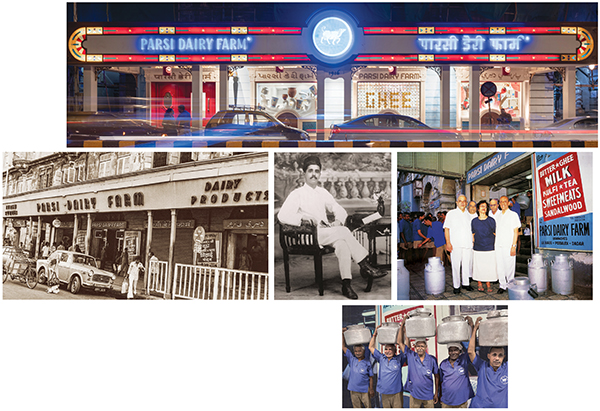
Top: Refurbished shop exterior;
2nd row (l to r): old facade; founder Ardeshir Nariman; Rusi, Naval,
Jeroo, Merwan and Dinshaw Nariman;
above: workers ready to deliver milk
In 1916, as soon as he turned 18, Nariman established PDF in a shop on Princess Street between two atash behrams in the Dhobi Talao area. Today, over a century later, the establishment looks like a set from Mary Poppins with its stained glass windows and walls displaying golden hued glass jars of cow ghee, automated toffee dispensers and a cart vending kulfi bars, ensconced in dark chocolate. A few weeks ago, Nariman’s octogenarian unmarried daughter Jeroo, all decked up for the occasion and seated in her wheelchair, smilingly cut the ribbon to inaugurate the reincarnated shop, as Nariman’s fifth generation cheered in glee.
Nariman’s four sons, Dinshaw, Merwan, Naval and Rusi, and Jeroo were inseparable in both business and family life (having dinner at a restaurant or club almost every single night after closing the shop) as PDF grew exponentially to become a major supplier of milk to the elite of Bombay. Blue shirted employees, mainly from Uttar Pradesh and colloquially called "bhaiyas,” were ubiquitous on a typical Bombay morning, carrying the cans on their heads ringing doorbells really early as bleary eyed housewives placed stainless steel or aluminum vessels underneath the spigot of the can to collect rich, frothy, thick, creamy milk (skimmed was a dirty word then) in exchange for a PDF coupon. One had to queue up at the shop to purchase the coupon booklet and the waiting list for new customers was longer than the housing allotment list of the much derided Bombay Parsi Punchayet. This writer was treated like Oliver Twist when he asked a burly, red-necked manager, whose belly was larger than a milk can, to enroll him as a customer.
Sugar was soon added to milk. In his 20s, the intrepid Nariman started manufacturing Indian sweets or mithai. Suterfeni (in bastardised Parsi Gujarati, sutarfaree), a desi version of white candy floss decorated with pistachios, almonds and the more humble dry fruit charoli as chironji was better known, melted in the mouth after making the tongue experience multiple orgasms; some ate it dipped in warm milk. The cone shaped agharni no larvo (dubbed "pregnancy balls” by Marzban) and laden with dry fruits was distributed at baby showers. Eating its tip was reportedly more effective than in vitro fertilization for wannabe mothers. Silken milk cakes and super sticky halwa, burnt milk mawa turned into rotund peda (pronounced pendo by Parsis) or the realistic looking mawa fish which diehard vegetarians won’t have on their plates, or the celestial kulfi with a secret recipe preserved for generations zealously like the one for Coca Cola. Cholesterol and broccoli were unknown then. Sugar was celebrated, not tested.
Displaying foresight, in 1968 land was purchased on the Bombay Ahmedabad Highway to house stables for buffaloes at their dairy at Varwada near Udvada. Some European friends gifted PDF Friesian cows in the early 1970s. They were flown to Bombay by airplane and welcomed by Nariman’s daughter-in-law at the Santacruz Airport before being transported to the state-of-the-art Varwada farm. The event was filmed by the fledgling Doordarshan.
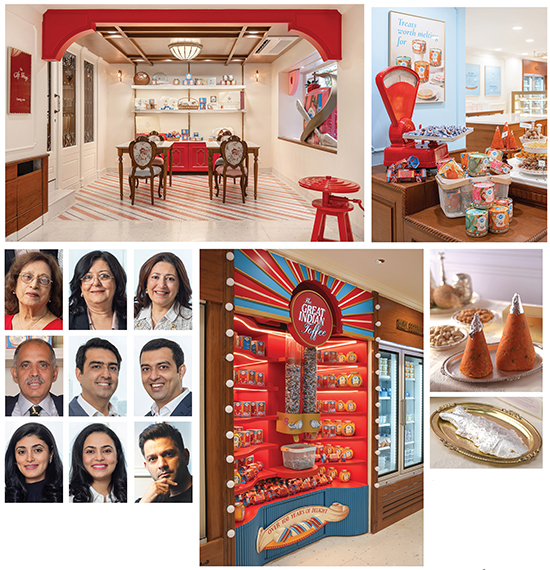
Top and above right: Products displayed at the newly renovated shop;
above: family members (l to r, 1st row): Jeroo Nariman, Shernaz Irani, Meheru Patel;
(2nd row): Khushru Patel, Sarfaraz and Bakhtyar Irani;
(3rd row): Zeenia Patel, Parvana and Shahen Mistry
Clockwise from top: Dairyland Parlour (new and old);
stables at Dairyland; Ardeshir Nariman (in pheta) at work
A few years later the family started a vegetarian restaurant, Dairyland Parlour, at the farm situated minutes away from the Maharashtra Gujarat border, which became, and still remains, a super hit. The area spawned numerous beer bars and pubs to quench the thirst of prohibition affected Gujaratis. Nariman had, however, decreed that the family would never sell alcohol with the memorable sentence "Jyaan doodh véchaay, tyaan daru nahin véchaay (alcohol should never be sold where milk is sold). The family religiously follows this diktat of the founder and does not sell alcohol. Everyone in the family is a teetotaller. They won’t even flambé their gulab jamuns with Old Monk rum!
Jain monks, who won’t use transport but choose to walk barefoot on the highways and are known to be extremely fastidious vegetarians, confidently stop to eat at Dairyland. Even the famous Parsi egg dishes have been banished from the vicinity of the restaurant which has now expanded into a fun place with water bodies, exotic birds and horses being trained for endurance rides. After the repast, travellers refresh themselves with thick lassi and dry fruit masala milk. Recently PDF has started retailing their home crafted chai and milk masala with crushed almonds. White butter, masala paneer infused with fresh herbs, Bengali and dry fruit based sugarless sweets, yogurt and shrikhand with multiple flavors, all disappear from the shelves by early evening. Although the Varwada site has been expanded with new toffee and ghee making plants, the substantially increased production barely meets the demand.
The founder’s work ethos motivated his employees to add to the owner’s sweat and toil. From dawn till midnight Nariman worked relentlessly, seven days a week, 365 days a year, barring an uncharacteristic passion to visit the Mahalaxmi racecourse every Sunday afternoon. A conservative man, he gambled for the rush of adrenaline and not to make money (which not even God can make at this racecourse). His only other indulgence, when he became wealthy, was to buy cars. He had a penchant for bidding at auctions for antique furniture and all his life used his favorite chair which has been restored and today occupies pride of place in the recently renovated premises.
Bakhtyar Irani, Nariman’s great-grandson and managing director of the company has, at 41, already put in an unbelievable 23 years of service with PDF. He proudly recounts the story of a nonagenarian lady who visited the shop regularly and prayed fervently in front of Nariman’s photograph. When asked why she did so, with tears in her eyes she recounted that her father passed away when she was six and when her mother came to inform the shop that they would no longer be able to afford the milk, Nariman continued to supply it free to the family until the children grew up. Similarly, on festival days he would distribute free sweets to every Parsi family in Udvada. Many such stories about Nariman’s milk of human compassion have protected the family during hard times, believes Bakhtyar’s mother Shernaz Irani, co-owner of PDF along with her sister Meheru Patel, who is in charge of the Varwada dairy plant and restaurant.
Meheru’s daughter Parvana Mistry, a Cordon bleu chef, juggles hats as a mother of two young children and manufacturer of PDF’s delicacies. Parvana’s passion for purity is unfailing. Universal, not random, testing of every drop of milk in a state of the art laboratory and electronic surveillance of the shelf life of each product is standard operating procedure. Introducing new items is Parvana’s hobby — mini kulfi on a stick dipped in dark chocolate to transform the traditional malai pistachio version into a chocobar; mouth-watering kopra paak (coconut fudge) with a raspberry bindu (dot) in the center; the great Indian toffee which makes adults salivate even more than the kids; the A2 cow ghee from Gir cows untouched from udder to the attractive new glass jars made by Piramal Glass (now PGP Glass) especially for PDF that tilt like the Leaning Tower of Pisa — the list becomes longer every week.
In its latest issue, Architectural Digest features the restored shop and extols the creative work of architect Shahen Mistry who designs all PDF outlets in the city. Shahen is married to Parvana. All the new project sites and plants of PDF have been constructed by Khushru Patel, winner of multiple national awards for printing under the name JAK Printers. Khushru is the chairman of the board of directors of PDF and happens to be Meheru’s husband of 40 years. At the next annual general meeting in November, four new directors — Meheru, Shernaz, Parvana and Zeenia Patel will be inducted.
Parvana’s elder sister, Zeenia, an award winning woman entrepreneur, divides her time between her father’s printing business and changing the look and feel of her mother’s dairy business. Her new packaging for PDF’s products has stumped seasoned designers and brand equity experts. Did someone say Parsi entrepreneurship is dead?
Shernaz’s younger son Sarfaraz, named after the Pakistani fast bowler by his cricket crazy father Kershasp (now deceased), is in charge of all important sales not only from the shops (two more outlets are opening soon at Borivali and Ghatkopar to titillate Gujarati taste buds) but also at supermarkets. Sarfaraz is super excited about the launch of PDF’s own online platform and app which will enable customers to order and pay online after examining the product in 3D; delivery will be almost within an hour.
As is the way of all flesh, the PDF journey has been far from smooth. Like every organization, country and family, this saga too has had its share of black swans and black sheep. Family unity of many years is often dissipated by greed or ego or both. PDF too had to endure some headline grabbing family litigation which pitched the entire family against one individual, embroiling his mother and sister as well. Veteran solicitor Burjor Antia, in his inimitable style, castigated the opposing Parsi solicitor for litigating against PDF: "Arré bawa (Oh Parsi), how can you litigate against those who khavraav doodh and malai (feed milk and cream) to our community?”
Those were the darkest days for the firm which teetered on the brink of disaster. But then the founder’s beneficence resulted in a miracle. Bombay High Court Justice Shahrukh Kathawala summoned all the lawyers involved to his chambers at midnight and managed to resolve all the disputes. Last year, the two other lady partners residing outside Bombay, and not involved in the management, chose to monetize their share and were bought out by Shernaz and Meheru.
The vision of the fourth generation, which works throughout the day on the shop floor, is fuelling the aspiration to create a fully integrated world class dairy with divisions making dairy products, confectionery and beverages, while adhering always to the PDF philosophy of no preservatives and no artificial colors irrespective of the scale of manufacture. In the last few months, the management is being rapidly professionalized. How the family works with the professionals will determine the trajectory of its onward journey. If their vision materializes, it will be beyond the wildest dreams of the founder who began his life’s work with that single can of milk.