Two panel discussions explored the mindset
required of entrepreneurs in a changing scenario
Parinaz Gandhi
"Your rigidity is your fragility and therefore unless you are agile, you will not be able to thrive,” reminded Dr Adil Malia when moderating the session on "‘Vigility,’ fragility and agility in volatile times” on the second day of the World Zarathushti Chamber of Commerce (WZCC) global conclave at Hotel Crowne Plaza in Poona from January 4 to 7, 2024.
Chief executive officer (CEO) of a boutique business management consultancy called The FiRM, Malia uses his four decades of corporate managerial experience to offer coaching to some of the well-recognized CEOs in India. He was joined on the panel by four others from USA, India and the UK who shared their knowledge and managerial experience. Edul Daver from USA was president of Alcan Metal Powders, a leading manufacturer of non-ferrous metal powders and initiator of ACuPowder International. Delna Avari, founder of a business consulting firm Delna Avari and Consultants with a presence in Bombay and London, offers business solutions to those in legacy businesses, young startups and those at inflection points in their leadership journeys. Dick Readymoney who worked for two decades in the field of sustainability, energy and water conservation in the Middle East has recently launched Right Solutions Hydroponic Farms and Consultants LLP to change the way agriculture can operate in India. Prof (Dr) Zubin Sethna is director at Regent’s University, London. A fully tenured professor of entrepreneurial marketing and consumer behavior, he is also an author of two textbooks on his areas of expertise and a founder of six successful businesses.
In the current scenario where markets are ambiguous, confusing and volatile, Malia recalled the advice given to little Alice in the popular book Alice in Wonderland where she is advised if you want to reach your destination, you have to run fast; and if you want to reach your destination before anyone else you have to run at double the pace.
Top from l : Behroze Daruwalla, Riah and Rati Forbes, Mahabanoo Mody-Kotwal, Lila Poonawalla;
above: Dr Adil Malia, Edul Daver, Delna Avari, Dick Readymoney,
Prof (Dr) Zubin Sethna Photos: J. Y. B. Photo & Video
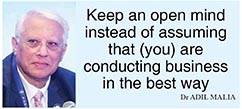
He further advised business leaders to look out for "environmental signals for they don’t come on placards. Your unique ability to foresee the change and predict (a likely outcome)” could tide you through any "black swan event.” A term repeatedly used by the speakers, Malia mentioned that it was coined by Nassim Nicholas Taleb to refer to rare events that could not have been predicted. Covid though is not considered a black swan event for it could have been prevented by timely governmental action. Since success tends to create a complacency unless you come face to face with crisis, he urged entrepreneurs to keep an open mind instead of assuming that they are conducting business in the best way.
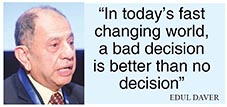
Daver recommended, "In today’s fast changing world, a bad decision is better than no decision. The fancy term for it is ‘Iterative deployment (fire and then aim).’ For this to work we need an open culture with no rules and an ability to thrive in organized chaos.” He felt leaders need to have an anti-fragile mindset, "be courageous and willing to make fast decisions with limited data which means an appetite for taking calculated risks. A ‘Do it now’ attitude means a tolerance for mistakes and taking rapid fire, corrective action to reach your goal.
"Vigilance means being ready proactively, with agility, nimbleness…” planning ahead for competition knowing that "growth is going to plateau and not last forever… But black swan events being unpredictable, they preclude contingency planning,” stated Daver.
Organizations today have to do "scenario planning, competitive benchmarking, customer planning, demand forecasting, big data analytics so it is extremely important that companies look at the world in the context of the entire supply chain,” stated Avari. "It’s not about surviving but thriving with an adaptive, growing mindset.” While geopolitical changes may affect your organization and your stage of business, knowledge of what is most relevant, what is likely to affect your business is crucial. Build tools within your system to be able to analyze clearly… Do your environmental scanning,” she advised.
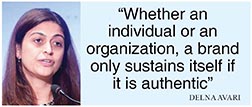
Profits, though important, should not come at the cost of stakeholders. "Whether an individual or an organization, a brand only sustains itself if it is authentic. Your authenticity is your stamp of success. Your core value system that adds to an organization, actually differentiates you. Anyone who does not have a strong core in life will struggle,” she observed.
Knowing that resources like water and energy will be under great stress in the coming years Readymoney recommended: "Be open to adapting, try and improve on what is right.” Every country must aim to become self-dependent and if a resource is not available in a country, "try and develop it.” A proponent of protected farming (cultivation undertaken on small plots in water-deficient areas where traditional agriculture is not viable), he mentioned how soilless farming saves water by 90-95%. To grow radish in stone, they use nutrients and are not dependent on soil.
Regretting that most newcomers are "YouTube graduates, not aware of how to take correct steps,” he felt an eye on the market and planning would help agriculturists succeed. He mentioned how his organization is focusing on research, substituting plastic and steel with bamboo. To grow saffron throughout the year they are doing tissue culture research. When it was suggested that he try getting water from air, Readymoney stated that it is not possible in areas like Rajasthan where humidity is not high. The reason why hydroponic projects are not successful in certain regions is because of inadequate planning or going in for "too much automation instead of using human power.”
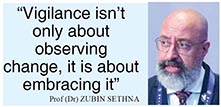
According to Sethna, "Vigilance isn’t only about observing change, it is about embracing it, leveraging technology, harnessing innovations… The ability to identify vulnerabilities, build resilience and adapt swiftly becomes imperative for survival… Fragility in the ecosystem requires resilience to face uncertainties and develops agility.” Those keen on vigilance invest significantly in market research and analysis to try and stay ahead. Fragility refers to susceptibility to disruptions and uncertainties due to economic fluctuation or changes in trade regulations and supply chain, market accessibility, not invest in emerging technologies.
He cited examples of Monzo Bank and Starling Bank disrupting traditional banking by offering mobile banking solutions with instant notification, user friendly interface and swiftly adapting to evolving needs of customers. For optimal vigility and agility, one should understand the PESTEL (political, economic, social, technological, environmental and legal) factors that can impact an organization.
Favoring fempreneurs
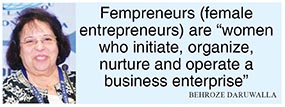
Yet another panel discussion included on the second day of the global conclave program on January 5, was the one hosted by the Women Entrepreneurs (WE) wing of WZCC. The subject, "Fempreneurs — their journey and challenges,” saw four spirited ladies engage with the moderator Behroze Daruwalla, WZCC global corporate secretary and president of the India Region who until last December headed WE. She described fempreneurs (female entrepreneurs) as "women who initiate, organize, nurture and operate a business enterprise” demonstrating their confidence, creativity and innovativeness. While desiring economic independence, a fempreneur creates employment opportunities for others. She has to be adaptable and flexible to changing circumstances and confidently take advantage of opportunities that come her way.
Joining Daruwalla in the discussion were Lila Poonawalla as also the mother-daughter team of Rati and Riah Forbes from Poona, and Mahabanoo Mody-Kotwal from Bombay. Poonawalla is the chairperson of the Lila Poonawalla Foundation and was the erstwhile chairman and managing director (CMD) of Alfa Laval India as also Tetra Pak India. Rati has been a director of the Forbes Marshall Group for over three decades and heads the Forbes Foundation. Stage actor Mody-Kotwal with over 60 credits to her name started her company Poor-Box Productions and also The Make-A-Difference Foundation to end violence against females. Riah oversees digital initiatives, startups and strategic investments at Forbes Marshall that provides innovative products and solutions to help businesses improve their process and energy efficiency. She also works with Indian nonprofits and social enterprises on challenges of leadership, organizational resilience and mental wellbeing.
Through the interaction the audience got an insight into the personal growth, meaningful activities and motivating factors that drove the panelists as also words of wisdom that could inspire others on their journey.
Referring to her sojourn from an apprentice to CMD, Poonawalla who was among the first female mechanical engineers in India recalled her job interview in 1967. Facing a panel of six men, none of them ascertained her expertise on the subject but one of them asked, "What will you do if a co-worker winks?” Her answer, she would reciprocate the wink and befriend him, got her the job! For three years she worked on the shop floor with male colleagues and celebrated every milestone by treating her colleagues to vada pav. Over the years, her colleagues and juniors have addressed her as "sister.” People matter more than machines, has been her credo.
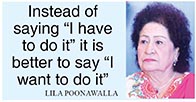
Accept every responsibility, she advised, referring to her stint as maintenance manager where she was responsible for the upkeep of the building, cleanliness of the toilets and the maintenance of the garden. Along the way she realized that instead of saying "I have to do it” it is better to say "I want to do it.” Likewise her stint in the USSR (now Russia) in -15ºC weather saw her winning hearts and business for the company. A great believer in role play, she emphasized that putting oneself in another’s shoes helped her solve labor problems as also enjoy a rapport with her mother-in-law.
Willing to change for the better, she advised, "make plans, not Excel sheets.” Through her Lila Poonawalla Foundation where16,000 girls have been provided skills she has experienced "the joy of giving.” Always willing to "sacrifice, compromise, help others,” for the self-motivated Poonawalla, "The best helping hand is at the end of your arm.”
Rati appreciated "the bedrock of values I was brought up with that created an interest to give back to society.” Her father Cooverji Bhabha served as chairman of the Central Bank of India and interim finance minister selected by Lord Mountbatten and Jawaharlal Nehru. Mother Amy, despite being a popular pediatrician at the Breach Candy Hospital, rendered honorary service at a small clinic at Fort. "Both my parents spent appreciable time to give back to the community and to the less privileged.” From her mother she learnt "the importance of being grounded, passionate about a career, maintaining a work-life balance, the importance of a nurturing and caring relationship.” She appreciated growing up in a joint family, at the Bhabha home where she learnt adaptability and tolerance, and considered herself "fortunate to be married into a family with an extremely supportive husband.” (Farhad was seated in the audience while his wife and daughter were on the dais.)
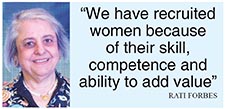
At Forbes Marshall, 20% of their work force is women as compared to the seven/eight percent norm in engineering companies in India. "We have recruited women because of their skill, competence and ability to add value. We offer a genuine level playing field and don’t give too many added benefits to a woman as it falsely conveys a weakness and vulnerability,” said Rati. They do however have mentorship schemes to support women to rise to the next level. She has noticed that "women come with a lot of baggage, with a mindset that they have to be the perfect wife, mother, daughter... fearing that what is acceptable in a man is not in a woman.” She referred to the importance of a role model in a woman’s life, citing a Harvard study that found adolescent girls go to college in rural and semi urban areas if they have a role model.
Her involvement with Forbes Foundation has enabled her to "meet people from all walks of life including a rag picker that gave me a new life perspective,” said Rati. Among the other lessons she has learnt are prioritizing time and developing empathy and compassion, having specially done a course with a Tibetan scholar on the subject. The importance of "collaboration instead of working in silos” was experienced when Forbes formalized efforts under Social Compact to assist migrant workers. Fifteen other companies have now joined them in this endeavor.
Like her mother, Riah too felt "very privileged,” having experienced the "intersection of two families with strong values.” As a child, birthdays were not only a time for celebration but also to reach out to those who were disadvantaged. Working with leaders of nonprofit organizations at the grassroots level she is concerned about making the "social sector more resilient,” seeing how the incredibly high levels of stress and burnout can impact the mental health and well-being of people working there. "What they do is heroic, energizing and humbling,” she declared.
Until the pandemic when Riah was in San Francisco, she had no intention of joining Forbes Marshall. With India facing one of the most stringent lockdowns, their manufacturing facility was closed for the first time since the strikes in the 1970s. "It seemed like a crisis. A time of great uncertainty. When my father and uncle initiated the daily morning 9 a.m. catch-up call, I started joining the call and sort of slipped into it. Things were chaotic. I felt like there was an opportunity for me to help.” Currently ensconced in the legacy business, she is learning to "navigate the balance to both steward and preserve the legacy and move in the direction which I think is important.”
Working with employees much older than her she realizes she "can’t waltz in and expect to be shown respect. You have to show how to add value, be empathetic, take people along with you.” Noticing the drop off of women at higher levels in their organization, she would like to offer affirmative action and support different kinds of diversity, not only gender but geographic and skill. Urging women to find a mentor and be a mentor, she believes, "Every person you meet in your life knows something you don’t.”
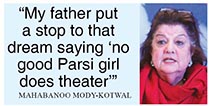
"If there is an entrepreneur’s hell I may have hit the jackpot having chosen to start a business in the arts, that too in the dying form of theater arts. Add to that I am a woman and my company has been devoted almost solely to bringing women’s stories to the stage,” remarked Mody-Kotwal. Although selected to study acting in New York on a full scholarship when she was only 17, "my father put a stop to that dream saying ‘no good Parsi girl does theater.’” She was only able to pursue her passion at the age of 44, being first cast in a play by her son and then by other directors in India and abroad.

After her six-month stint in London she realized that she would need to produce plays herself for the work she believed in and thus she started Poor-Box Productions. "Getting sponsorship for theater, arts, is very difficult. Going around with a begging bowl is not easy. What we need in the corporate world is a greater appreciation of the arts and how they lead to a more developed, democratic and intelligent society. We need more corporates to step forward and support projects to end violence against women.” She regretted that she had received limited support from Zoroastrian media houses in terms of funding or coverage during the 22 years she staged Vagina Monologues. "The worst thing in India is censorship,” commented Mody-Kotwal.
"Vagina Monologues put me on the path to fighting violence against women.” To raise funds for this cause she started The Make-A-Difference Foundation. She shared some statistics: There is one nongovernmental organization for 400 people in India and one policeman for 726 people in India. One out of three women in the world undergoes some form of violence in her lifetime (does not include unreported cases and those suffering mental/verbal abuse). In India, it is one of two. During the pandemic, violence was on the rise because the women were housebound with the abusers and violators. Data says 96% of rapists and abusers are men known to the women, she revealed. "Gender based violence destabilizes society,” asserted Mody-Kotwal, insisting "there should be zero tolerance towards it.”
Guided by ethics and empathy and determined to leave the world a better place, she further urged WZCC delegates, "Profits cannot come at the cost of dignity, equality or unfair treatment of even one solitary individual. Help everyone grow and progress professionally, mentally and financially. Allowing a select few to grow is the worst form of leadership and the worst kind of cowardice…” She advised indulgent mothers to refrain from using popular endearments like "mitho rajo, maro dikro (sweet prince, my son)” that overplay the importance of a male child. In our community women should claim full equality regardless of who we marry and who fathers our children. Terms like parjat (outcaste), dubro (dark skinned half caste), musallo (Muslim), kaariyo (blackie) need to be totally verboten. Abandon worship of white (as also)... warped and unscientific notions of purity or some ludicrous notions of us as a pure race.”
The final instalment of the global conclave report will be carried in a forthcoming issue of Parsiana.