Bombay Parsi Punchayet trustee Kersi Randeria provides an
insight into the workings of the secretive trust
The trustees must find innovative ways of raising money,” says Bombay Parsi Punchayet (BPP) trustee Kersi Randeria in a freewheeling, two-hour interview on January 21 this year with Parsiana that covered the issues of housing, finance, electoral reforms and upkeep of assets. The industrial entrepreneur and self-made millionaire voiced his anger at the BPP’s policy to auction flats to raise money. The highest bidders are assigned the flats on a leave and license basis. "Even a watchman can sell the flats,” you do not need elected trustees to do that. By transferring flats to the highest bidder the BPP was "not working as a trust but as a landlord...a trustee is only a custodian” of the property, "not the donor....if I’m a custodian, I have to maintain it.”
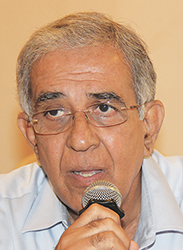
Both the Parsi Times weekly which he owns and the Jam-e-Jamshed weekly which is managed by him publish his opposition to the policy below each advertisement released by the BPP for auction of flats: "BPP trustee Kersi Randeria has dissented against this proposed auction and his dissent has been duly recorded in the minutes of the meeting of the board of trustees.” Randeria who was elected a trustee in October 2015 states the auctions have largely failed to attract buyers, but more on account of a weakening demand than his objections. The exception to the lackluster response was the auction of a 900 sq ft carpet area flat at Cusrow Baug that stipulated a deposit of three crore rupees (USD 421,064) to qualify for bidding and finally was allotted on a leave and license basis for over Rs 4.8 crores (USD 673,703).
When four new trustees were elected in 2015 the board had decided to assign the flats only on need-based merit. But with negligible donations being received largely on account of the BPP’s dismal image and with no other major source of income in sight, the trust’s finances were claimed to be precarious. Salaries were delayed, payments withheld, monthly second and third child stipends kept pending as well as the subsidies to full-time, practicing mobeds. BPP chairman Yazdi Desai even wrote to the government citing the trust’s dire finances as a reason to withhold the statutory bonus payment to workers.
"Primarily our beneficiaries have to be poor and middle class,” states Randeria. "When we see someone in trouble, we step up to the plate.” In 60% plus of the appeals/applications received by the board for assistance, the trustees have been able to provide relief. "The board has shown a human side.” Around 160 to 180 flats have been allotted in the past four years. Houses have been allotted to newly married couples till 2017. "People don’t see us as an evil force,” he stated.
The majority of the trustees finally decided to once again auction flats, mainly in the better maintained Wadia baugs. The five baugs gifted to the BPP by the Wadia family fall within the ambit of the trust but by consensus are managed by the Wadia Committee (WC). The Wadia baugs have surplus income but "the funds are controlled by the WC,” notes Randeria. The WC reportedly stipulates the amount be used for the upkeep of those five baugs alone. This policy is followed more out of deference to the Wadia family and their largesse rather than by right, state some trustees. In recent times, the WC headed by Wadia scion Nusli Wadia has "loaned” money to the otherwise bankrupt BPP.
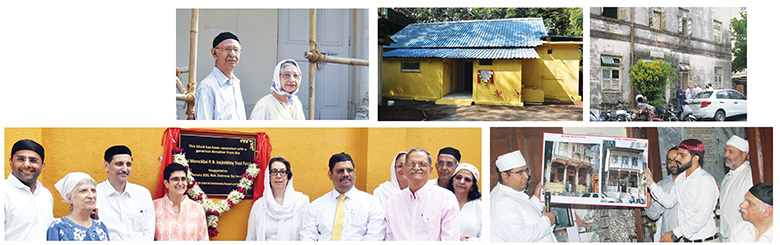
Top and above : Kersi Randeria; 1st row from l: Noshir and Katy Gotla; pallbearers’ toilet block
and Gamadia Boys’ Hostel before renovation; 2nd row: trustees, donors and volunteers at inauguration
of Doongerwadi toilet block; Godavara Agiary’ s renovation Photo: Dolly Divecha
One reason for the discrepancy in maintenance and income between the Wadia and BPP managed baugs is that the Wadia baugs have been raising their rents/service charges intermittently and are self-sufficient, states Randeria. As versus an average cost of around Rs 1,100 (USD 15.44) per flat two-and-a-half years ago, the recovery in the BPP baugs is Rs 750 (USD 10.52), thus adding to the financial burden and resulting in "a huge deficit in the baugs,” amounting to around 1.2 crore rupees (USD 168,207) annually. Today, with rising costs, the deficit would be greater.
The BPP has identified around 200 flats that are lying unoccupied against which "we could proceed legally” for eviction under the Rent Act laws. Some tenants keep their flats locked up because they reside elsewhere, often abroad, or have other residences. Notices have been issued to some and in a few cases suits have been filed, and not "only against bawajis,” Randeria qualifies. BPP trustee Xerxes Dastur has also been following up on the subject. Several matters have been settled. There are others, however, who not only willfully give up their flats but also make a donation to the BPP in gratitude for providing a home when they needed one.
Despite the financial shortfall, the monthly salaries of baugs’ custodians have been raised from Rs 15,000 (USD 210.5) to Rs 30,000 (USD 421), a more liveable salary, Randeria notes. He was also instrumental in settling a new wage agreement with the Mumbai Mazdoor Sabha union which represents the workers. The old agreement had expired two years earlier.
Realizing the need to upgrade several of the institutions run by the BPP, Randeria approached the community for funds. The first was the Boys’ Hostel at Gamadia Colony, for which Rs 65+ lakhs (USD 91,230) were raised from the public. The Godavara Agiary was next; of the Rs 35 lakhs (USD 49,060) or so required, BPP chairman Yazdi Desai and his wife Anahita contributed Rs 10 lakhs (USD 14,035). The visitors’ toilet blocks at Doongerwadi followed, with the Maneckbai P. B Jeejeebhoy Trust Fund footing the entire amount of Rs 16 lakhs (USD 22,456) for the block (see "A labor of love,” pg 37) Another Rs 6.12 lakhs (USD 8,702) was raised from various donors, small and large, for the pallbearers’ bathing and toilet block located closer to the dakhmas. Work on the Doongerwadi bunglis is progressing with funding from Noshir Gotla, a certified company secretary who worked with Bharat Petroleum Corporation Limited for over 40 years and unsuccessfully contested the BPP elections in 2011, and his wife Katy, both residents of Rustom Baug. Gotla has appointed a contractor and is paying him directly for the work. Donations are now being sourced for repairs to the dakhmas and Randeria reported that donors are coming forward.
But the balance sheets of the BPP published in the Parsi Junction brought out by the late Parvez Driver, a loyalist of the former BPP chairman Dinshaw Mehta, showed surplus income for the last two financial years. The BPP, unlike many large trusts and corporations, does not publish its accounts. It is only through leaks that the balance sheet is made public. Randeria questions the need to publicize the accounts but adds he "personally has zero problems publishing them.” Some of the others are obviously not so inclined.
"There are many good projects on the anvil...more than the earlier boards,” says Randeria. He is optimistic that bookings for flats in the ownership building at Godrej Baug could start sometime later this year. Construction of the building started around a decade or so ago.
The building has been acquired by the Bombay Municipal Corporation due to some disputes regarding payment of statutory dues under the Land Under Construction Act. But Randeria is hopeful of sorting out the problem. The plans for the proposed ownership and leave and license buildings at Bharucha Baug are ready. Around 40 flats will be sold at 60% plus of the prevailing market price and around 80 will be allotted on rent. Randeria says the project will be "self-financing.” The former BPP chairman Dinshaw Mehta is expected to oppose the sale of flats on ownership basis stating the land was donated for "poor and needy” Parsis.
Some tenants/occupants at the Bhabha Sanatorium at Bandra Sea Face have been "shifted out...and some have legal cases filed against them,” said Randeria. The possible sale of the residential sanatorium had been in the news a few months back. Randeria believes the BPP has several options. One is to sell the estate outright with or without encumbrances, second is for the BPP to develop the property themselves, the third is to find an outside developer who would develop one portion of the area commercially and keep the other for Parsis. The fourth is to repair the buildings and offer them on a leave and license basis to Parsis. But Randeria notes the BPP lacks the funds for such and expensive undertaking. According to one estimate, the property may fetch around Rs 700 crores (USD 98,044,030) if sold outright, Randeria stated.
But an advertisement by the trustees of the Bandra Parsi Convalescent Home inviting bidders for the property on Bandra Sea Face drew a poor response. The bids were below expectation and the proposal has been temporarily shelved. The real estate market in the country is generally in the doldrums. A public notice was issued in the Parsi Press this January-end by the BPP and the managing committee of the Parsi Lying-In Hospital inviting bids for the development of the former maternity hospital which closed its portals around 25 years ago. The responses are awaited.
On the contentious issue of electoral reforms that have been pending for at least the past four years, Randeria said he presented a draft proposal three years ago. The proposals included: reducing the trustees’ term from seven to five years, restricting the number of terms a trustee could serve to two, formulating a new merit rating scheme for allotment of housing (none is being observed at present, Randeria states), a code of conduct to be followed during trusteeship elections. Despite "pushing for the proposal several times,” the board has not acted on any reforms, laments Randeria. Recently BPP trustee Viraf Mehta too has been raising the issue. Randeria would like the code to include the election of chairman and the working relationship between trustees.
Randeria terms the contribution of BPP trustee Zarir Bhathena who has been absent from the board since December 10 last year on account of ill-health "a very valuable asset to the BPP.” A chartered accountant, Bhathena kept a close watch on the accounts, the tax deducted at source and other matters. "He speaks little but when he does he’s forceful.”
As regards the Federation of the Parsi Zoroastrian Anjumans of India from which Desai tried to oust five of his co-trustees, Randeria notes only around 50% of the members attend who represent about 30% of the regions. Major anjumans outside Gujarat and Bombay are conspicuously absent. He adds that even some of the delegates who attend do not live in the place they represent. "It’s a mockery of the word Federation. FEZANA (the Federation of Zoroastrian Associations of North America) is actually a federation.”
If the FPZAI manages "to monetize” the assets of defunct anjumans, "huge funds would come to the FPZAI.” But in the 35 years the defunct anjumans committee has been in existence, not a single property has been sold. Randeria prefers any funds accrued remain with the BPP. The FPZAI office bearers are all — barring one — Desai loyalists and are expected to do his bidding. The BPP staff functions more independently.
Randeria is disillusioned with the manner in which the Global Working Group (GWG), a Zoroastrian world body, formed the Global Council of Zoroastrians Trust (GCZT). The proposed trust deed had gone through 21 drafts. "Why were 21 drafts not shared” with us? Randeria questioned. He pointed out at the GWG meeting on January 7 this year that the latest draft was received less than a week prior and the trustees did not have the opportunity to discuss the proposal at their weekly Tuesday meetings. When he and his co-trustees voiced their concerns and inability to take an informed decision at the GWG meet, an exasperated Neville Shroff, non-executive chairman of the GWG and president of the Zoroastrian Charity Funds of Hongkong, Canton and Macao berated the trustees and Randeria in particular asking them to "put their money where their mouth is.”
Randeria claims Shroff "went beyond acceptable limits… The delay was entirely due to them, never the BPP.” The names of the GCZT founders and trustees was sprung upon the trustees in the GWG meeting itself. The founders are for life and would have veto powers over the trustees’ decisions. (Subsequently Parsiana was informed such veto powers were not included.) Viraf objected to a husband being a founder and his wife a trustee. They were assured their genuine misgivings could and would be rectified. The trustees finally agreed to the draft after pointing out their apprehensions.
But at the next meeting of the BPP trustees on January 14, the minutes of the meeting noted: "Mr Randeria recommended that BPP should not be a part of GCZT and if still the trustees agree, then he would disassociate himself and would not be a part of it.” Randeria alleged, "A small coterie is doing what they want to do...They are ramming things down our throats. This is not the way to form a body of this magnitude. Why didn’t they send the draft a month in advance?”
The BPP spends between around 36 crores (USD 5,044,981) annually on welfare schemes, salaries, etc to serve the community’s needs; but for the four or five crores (USD 560,252 to 700,315) the GCZT would spend, the BPP would function largely as a courier service to channel the funds from overseas to the community in India. The GCZT are in effect "bypassing the BPP.” There was no BPP trustee on the GCZT board. At least Desai "should have been on the board...They are keen to get rid of the BPP,” avers Randeria. He however said his involvement with the GWG would continue.
Whether the GCZT will be cosmopolitan or only for Parsi Zoroastrians also is not clear. If only for the community, donors would not be able to avail of income tax exemptions. If cosmopolitan, the FPZAI which is dominated by traditional, mostly all-male, south Gujarat anjuman trustees would not vote in favor of its acceptance. This may be one reason why the FPZAI meet scheduled for February 16 was put off. The ostensible reasons cited are ill-health of some office bearers or their family members, and some south Gujarat delegates attending marriage/navjote ceremonies. Hardly anyone from elsewhere attends.
Asked if the GWG tirade against the trustees was on account of the poor image the BPP has in the community, Randeria felt the approach was "to give a dog a bad name and hang it.” He felt much of the image had been dented by the past boards. "We lost whatever image we had 20 years ago.” He referred to four of the erstwhile trustees resigning in disgust at the alleged antics of a co-trustee, the reported instance of a trustee picking up a chair to assault another, the invectives used.
When questioned about the nasty emails being exchanged between some of the present trustees and the public efforts of Desai to divorce the BPP trustees from the FPZAI, Randeria admits the board needs "to pull up their socks.” He believes the leakage and publishing in the Parsi Press of email exchanges among the trustees "is not transparency. It is harming the trust intentionally.”
To deal with differing views, a "code of conduct” for the internal functioning of the trustees was proposed by him, "but ignored. It appeared on the agenda but then it was removed.” As it is the lengthy agendas are never completed despite the weekly meetings often proceeding beyond midnight. A Consultative Committee consisting of former trustees and prominent people involved with the community was formed at his behest "to give us some credibility, suggestions, guidance...Their scope is only consultative. We put forth our ideas and ask for inputs. The final authority is the BPP board.”