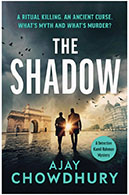
The Shadow by Ajay Chowdhury. Published in 2025 by Harvill Secker, an imprint of Vintage, Penguin Random House UK, One Embassy Gardens, 8 Viaduct Gardens, London SW11 7BW. Pp: 372. Price: £ 14.99, Rs 719.
Ajay Chowdhury, author of The Shadow, is quite the modern Renaissance man. He is not merely a writer of crime fiction and the inaugural winner of the Harvill Secker-Bloody Scotland crime fiction award, but is also the author of Ayesha and the Firefish, a children’s book, and artistic director of the Rented Space Theatre Company as well as a tech entrepreneur, to mention a few of the impressive activities. He has written a series of crime thrillers creating his own duo of detectives, Kamil Rahman, employed by Scotland Yard, assisted by Anjoli, a psychologist, who runs a prestigious restaurant, Tandoori Knights, in London’s Brick Lane.
The epigraph "old sins cast long shadows” from Agatha Christie’s Nemesis is very appropriate and we are plunged straight into the very heart of the book. It is Friday, August 15, 1947 and while India is in the process of being born, Xerxes Mehta becomes father to a baby boy. In this excitement, Xerxes hears trouble in the compound where some Muslims are seeking safety from a mob "brandishing tridents and swords… (with) flaming torches.” Mustafa, the Muslim watchman, pleads with Xerxes to grant the seekers sanctuary but he does not want to run the risk. The next morning, when Xerxes examines the devastation, he encounters Salim his long-time cook, who is Mustafa’s brother. Badly wounded and having lost his entire family in the mayhem, Salim curses Xerxes that he and all his descendants will die on reaching the age of 47.
Ajay Chowdhury: modern Renaissance man
The curse seems to have worked its way through two generations: both Xerxes and his son Cyrus die on their 47th birthday, and now it is the turn of Darius, Xerxes’s grandson who is about to reach the fateful age. Darius appeals to his old friend, Rahman, for help.
At about this time Peter Bell, a British citizen, an expert in underground boring who works for Darius, is grotesquely murdered in Bombay. Rahman is on the verge of resigning from the Metropolitan Police to start his own detective agency with Anjoli but decides to take up one last assignment as it serves a dual purpose. He will "shadow” the Bombay police on behalf of his employers while helping Darius with his problems.
Chowdhury keeps the reader in total suspense. Is there a connection between the murder of Darius’s employee Bell, who is working on the construction of the prestigious coastal road? Bell has been shot by 18 arrows; is the number 18 significant as it has several references in Hindu mythology? In which case, is Bell’s a ritual killing, a human sacrifice? The plot is convoluted and keeps the reader guessing, eager to turn the page to follow the several twists and turns, till the unexpected denouement is revealed.
The suspects are many, as well as the motives. To add to Rahman’s woes, Inspector Karve, the Indian police officer in charge of the case, is not merely unhelpful but is positively antagonistic. "Why will I let a Muslim from Scotland Yard shadow me?” Chowdhury peppers his novel with several red herrings to spice up the suspense. Bell was living at the Oberoi hotel. Someone seems to have searched his room, leaving it in a mess. Who did this and what was he/she looking for? How does one account for the fact that there is no blood at the spot where his body is found?
The tunnel of the coastal road passes under a temple located at Priyadarshini Park. Bell had initially wanted to demolish the temple but later agreed to relocate it at no cost to Swami Yogesh, the priest looking after it. Why does a Swami have "a pile of weapons in the corner — arrows, swords, maces, tridents, axes?”
There are three critical persons working for Darius: Niloufer Shroff, who is being being groomed to take over the company; the "ambitious” Ronnie Engineer, and Sunil Tandel, Bell’s assistant. Was Shroff having "a possible” affair with Bell? Engineer wanted the tunnel to bypass Swami Yogesh’s temple. When Bell disagreed, why did Engineer go out of his way to placate the priest? Who is this Felix referred to in an argument between Darius and Bell whom the latter wants killed? Why is everyone so evasive about Arpin Industries, the company controlling the construction site?
And where in all this does Faraz Davar fit in? He is Darius’s father-in-law, chairman of Mehta and Sons. His health is indifferent and the reader keeps hearing that his life hangs by a thread. But his Parsi genes seem very strong and he continues to live under the care and protection of his daughter Zara, Darius’s wife. What role do they play in this saga?
Chowdhury uses several locations in Bombay effectively, including Dharavi, to create a sense of menace and danger. The dual nature of the city — the rich and the poor, the progressive and the traditional — is sharply defined. The city comes alive with Chowdhury’s descriptions which are keen, perceptive and authentic. Parsi customs and traditions are woven naturally into the fabric of the novel. Most of the plethora of characters, certainly the main protagonists, are sensitively and realistically portrayed. The pair of detectives are a perfect balance and complement each other in the performance of their task. The emotional Anjoli brings much required humor to the book with her T-shirts displaying amusing slogans and her battles with the mercurial chef who runs the restaurant in her absence. The tension never flags as Chowdhury dextrously moves backward and forward in time in a natural and seamless manner, adding to the complexity of the plot.
The novel is a gripping and delightful read. The loose ends are all eventually tied up… and Chowdhury keeps the reader guessing who the perpetrator is till the very end. F. G.