During the five years she has been at the Aberdeen Royal Infirmary, Dr Jasmine Medhora, registrar in emergency medicine and critical care, has learnt "how raw trauma can be.” Receiving patients injured in the captivating yet unpredictable landscape of Scotland that is known for its inaccessible and logistically challenging geography, means her medical team has to brace itself to face the worst. Once members of the Scottish Trauma Network, a "super service” spread over the nation’s 30,000 sq miles, trace the location of the hapless victims and dispatch qualified crew by road or helicopter who can administer emergency help, patients are taken by air ambulance or by road to the nearest hospital.
"The clinicians that work up here are trained to manage that extra element of difficulty. They are up to that challenge,” Medhora noted in an interview with the Channel 4 documentary series "Rescue: Extreme Medics” that was launched on March 28, 2022. "Trauma remains the fourth leading cause of death in western countries and is the leading cause of death in people under 40. In Scotland, around 4,000 people are seriously injured each year and in the control center, specialist clinicians are monitoring almost 5,000 emergency calls a day working alongside the coastguards, Royal National Lifeboat Institution, fire and rescue service,” states the article and link to the documentary shared by Malcolm Deboo, president of the Zoroastrian Trust Funds of Europe, expressing pride in Medhora’s accomplishments.
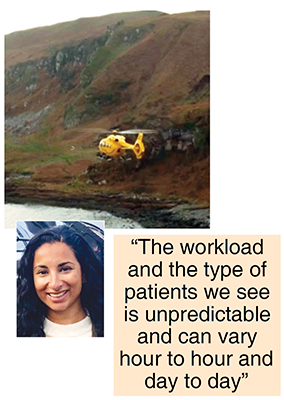
Jasmine Medhora trained in emergency medicine;
helicopter rescue by the Scottish Trauma Network
Featured in the nearly 45-minute first episode, Medhora and her team are seen tending to a 51-year-old cyclist who had a head-on collision with a digger bucket (a specialized container to lift bulk material) on a powerful loading machine that resulted in his throat being punctured by its serrated edge. To decide on the course of treatment, the team has to determine the extent of his injury as also contend with little known facts like whether the neck wounds have been in contact with potentially deadly bacteria.
"I think all fields of medicine are stressful in different ways,” stated 32-year-old Medhora in response to queries from Parsiana. As she further clarified, "The support system in emergency medicine and critical care is a strong team of doctors and nurses. We go through difficult situations together and are able to discuss things afterwards and reflect, which is very useful… The major challenge is that the workload and the type of patients we see is unpredictable and can vary hour to hour and day to day. This makes the specialties interesting but at times it can be difficult to manage lots of different patients with differing needs.”
An alumna of Watford Grammar Girls School, Medhora then pursued medicine at University College London Medical School. As a foundation year doctor working in emergency medicine at the Royal Free Hospital in London under some "excellent female registrars who were very inspiring,” she got interested in the field. "I then went on to work in emergency medicine in different areas of Scotland including the Shetland Islands, and this confirmed that I enjoyed the specialty so I applied for emergency medicine training in Aberdeen.”
Jasmine’s father Pilloo who is a retired British Airways engineer and mother Dinoo Medhora who ran her own aromatherapy business and used to volunteer for Age Concern continue to be active members in their local Zoroastrian community in Harrow. While earlier Jasmine was active as a Young Zoroastrian in her local group in Harrow, she is currently unable to involve herself with community programs due to work pressure. She believes though that "the essence of Zoroastrianism which is good words, good thoughts, good deeds is also the key to working in healthcare.” Her nature of work has made her understand "the comfort that prayers can bring to those who have a loved one in critical care.”