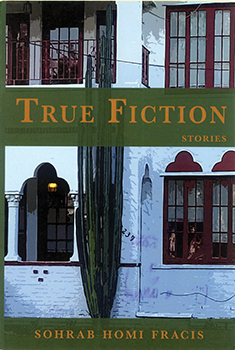
From the first sentence of this new collection, True Fiction, one is arrested by the confident voice and style of the narrator. The first few stories feel organic rather than plotted, and the anecdotal style of telling, the strong characterization and concrete details of time and place, feel more like a memoir than fiction, suggesting that the narrator may also be the author, and that this is a story based on real life characters and experiences. Sohrab Homi Fracis’s (pictured) first collection, Ticket to Minto: Stories of India and

America ("In search of home,” Books, Parsiana, August 21, 2018), was a finalist for the Flannery O’Connor Award for Short Fiction and was awarded the Iowa Short Fiction Award, described by the New York Times Book Review as "among the most prestigious literary prizes America offers.” Born in Bombay, Fracis was educated at Campion School and IIT, Kharagpur, before winning a scholarship to the University of Delaware in the USA.
When a book is marketed as fiction, readers have no grounds to speculate about whether it is based on real events, but the title of the collection seems to invite such speculation, and the author confirms in his Afterword that, although fictionalized, some of the characters and events are indeed based on reality. This approach provides a layer of realism that adds to the feeling of truth.
In verbal storytelling, whereas a traditional story requires a certain level of performing skill or innovation to bring it to life, audiences approach a true story with a different expectation. Performance takes a back seat to sincerity, as every nuance of the teller’s expression while they recall the events tells us something about the emotional impact on them, which the mirror neurons in our brains allow us to recreate in our own experience. But to achieve that effect in a written story is an unusual skill and Fracis uses this ambiguity playfully to stretch our credulity while also anchoring us in reality through his commentary. By utilizing a layering, or weaving together, of multiple stories, he also creates a sense of lifelike complexity and depth.
The first story in the collection, "Open Mic,” brings to vivid life a music venue, under threat from gentrification, where an eclectic crowd of outsiders — "students, veterans, cyclists, bikers, cops, artists, cops who are artists, techies, stand-up comedians, techies who are stand-ups, even a resident magician” — meet to perform and hang out. The need for connection that binds this varied crowd together is strongly symbolized in the story of Henri, a seven-foot Rwandan, whose speech is "a fascinating jumble that I cannot recreate” and who will never talk about the unspeakable things he’s seen. When the venue finally closes it’s clear that what has been lost is irreplaceable, and yet Fracis manages to end the story on a poignant note, both for Henri, who finally masters clarity of speech, and by showing how the memories and music continue to live on, even if only on Facebook. As with some of the other stories in this collection, I found myself deeply emotionally invested in and moved by these characters.
The second story, "All Right Now, Cupid,” is constructed around questions taken from the real ‘OkCupid’ dating agency website, according to the author’s Afterword. The discursive nature of the answers given by the narrator relate a complete story about a couple he’s observing, while simultaneously revealing more about himself than if he had answered the questions in the usual way. Despite his self-confessed flaws and apparently irrelevant ramblings, this is a narrator who comes over as both authentically human and humane. It’s a clever way of underlining how much more we can learn by listening to people’s stories, and observing their attitude to other people, than through their assessment of themselves, as anyone who’s ever used an online dating site will know.
The third and title story, "True Fiction,” is the highlight of the collection. It’s an extraordinarily skillful weaving together of several stories: about the narrator’s own unsuccessful love life, the story of the last woman he dated and her small daughter who taught him an unforgettable lesson, and a friend who seems to hint at a terrible crime in his past that he has got away with but seems eager to confess. The story captures the sheer complexity of human relations, our capacity for empathy even with those we may have reason to judge or resent, and our common humanity.
"Steven” is a simpler story, exploring the dilemma of a man who, over an evening spent with his wife and children watching a ‘bachelor/bachelorette dating show,’ discovers that he is turning into a woman. Apart from a reference to the mysterious disappearance of an uncle, whom he intuits may have had the same problem, there is no attempt to explain this event, and yet the exploration of the fallout from it is so believably done that the reader cannot help participating imaginatively in his dilemma. They say that "seeing is believing” and when a writer has the talent to make us "see” (in the sense of experience) something so vividly, the reader cannot help suspending disbelief. Again the story seems a plea for understanding of and compassion for our differences.
The last three stories are more experimental and seem to have been included to fill out the collection as they fit the title less well, except in the sense of metaphorical rather than factual truth, which can be applied to all fiction. "The Straight” is an experimental analogy about mating and reproduction that Fracis describes as a "Calvino-esque alternate-world story” about shapes with names like Rsj, Wnf, and Mlp. "A Coming” is a fairy story with some interesting thoughts and metaphors about the nature of life on a more abstract scale, and the final story is a retelling of the ancient Persian epic, Sohrab and Rustam, inspired by the poem by Matthew Arnold. Although well-written, like all Fracis’s writing, this ancient epic also fails to fit the description of "true fiction” except in the sense of a legend possibly being based on some distant historical event. The epic voice fails to reduce that distance and does not seem to add much to an understanding of, or emotional engagement with, the story for this reader.
But despite this reservation, which may be put down to personal taste, this is a beautifully crafted, thought-provoking and moving collection, well worth reading for the first four stories alone.
UMI SINHA
Sinha is a writer, creative writing mentor and oral storyteller who has taught creative writing at Sussex and Brighton universities. Her novel Belonging has been published in the UK, Poland, Portugal and India.