A family home was co-opted as a
refuge for Poona’s stray dogs and cats
Delshad Karanjia
Padmini Stump had it all — a carefree childhood in Poona with her parents Gulshan and Jal Nigedar Irani and their pets; a promising modeling career and good looks that won her May Queen and Carnival Queen beauty titles year after year; a picture-perfect family life with her civil engineer husband Peter Stump, daughter Sandra and sons Steven and Shaun in Dubai — until tragedy struck on March 15, 2006, and her life was never the same again…
Born and brought up in Poona, Padmini was given her unusual (for a Zoroastrian) first name by none other than the legendary singer the late Lata Mangeshkar. In the 1940s, before she got married, Gulshan had acted in a few Hindi films under the screen name of Roop Kumari, and had developed a close friendship with Mangeshkar, who was given the honor of naming her friend’s baby. Padmini’s was a carefree childhood, growing up in Poona, where her father ran a billiards and rummy saloon called El Morocco, making frequent visits to Lonavla where her grandfather owned the popular National restaurant. Shortly after finishing schooling at Hutchings High School, Padmini married Peter, the half-Irish, half-German boy next door, and they moved to Dubai in 1977.
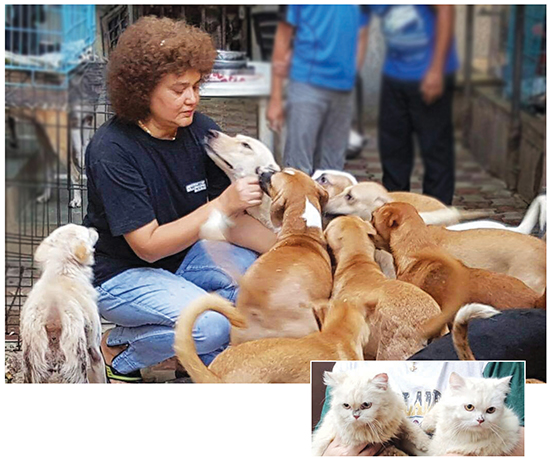
Padmini Stump with her stray canines and felines showered with care and compassion
Decades later, the ides of March dealt a cruel blow to the Stump family, when Steven, aged 28, died in a freak accident as he was returning home with a friend after a Bryan Adams concert. The entire family was devastated but Padmini went into a deep depression and could not bear to continue living in Dubai, where "everything reminded me of my boy.” She moved back to Poona, feeling that the joy had gone out of her life. Little did she know that she would soon launch a crusade that would bring purpose and hope back into hundreds of lives, including her own.
During a darshan with Dada Vaswani, a staunch promoter of vegetarianism and animal rights, the spiritual leader gently advised Padmini to "serve animals. They won’t be able to take away your pain, but they will help you heal.” Dada’s words were still ringing in her ears when, a few days later, Shaun brought home a tiny puppy that he had found on the road outside their bungalow. The playful little stray was immediately adopted and named Masti (mischief), and Mission Possible was launched, with the Stumps having no idea that the floodgates had been well and truly opened or that the family home would be co-opted as a refuge for Poona’s stray dogs and cats.
Padmini’s ancestral property on Shankar Sheth Road consists of a bungalow and a three-storey building, with eight flats which used to be rented out. The family now lives in the bungalow with several cats and dogs, and the building has been converted into an animal shelter that houses approximately 300 canines and felines. As Padmini’s reputation for caring for strays free of cost spread far and wide, people kept bringing in ailing or injured animals for her to look after. But her neighbors began to complain about the noise made by the dogs and the smell of their food.
"The main struggle is to get funding,” Padmini admits, "and the repeated objections and complaints from my neighbors don’t help.” So what is one to do? Poona’s burgeoning population of stray dogs, cats and pigs is a problem in most residential areas. Local newspapers carry regular reports of stray dogs being poisoned or beaten to death, puppies and kittens being drowned, and dogs being forcibly removed from residential areas and dumped in deserted spots miles away. Citizens’ complaints to the authorities about the growing nuisance caused by strays receives a standard reply: inability to deal with the problem due to staff shortage. If the greatness of a nation can be judged by the way its animals are treated, then India’s callous treatment of the vast majority of its animals does not bode well for its global image.
While protests and pressure from her neighbors continued, Padmini set up Mission Possible as an independent non-governmental organization (NGO) committed to making healthcare available for homeless dogs and cats in Poona. Noted oncologist and surgeon, Dr Ravindra Kasbekar, is the chairman of the NGO, with Padmini as its honorary secretary. The team of veterinarians who look after the animals includes Drs Avinash Rathod, Deepak Tulphula, Jeya Bharat and Uma Bharat.
Mission Possible’s website states: "We are a group of devoted animal lovers who have given our support, time, energy, love and finances for the cause of saving the lives of dogs and cats.” Many have been rescued from gutters and garbage dumps where they had been left to perish. The shelter takes in dogs and cats that have been severely injured in road accidents as well as pets that have been abandoned by their owners or breeders. Mission Possible also vaccinates, neuters, medicates and attempts to find homes and loving families to adopt the animals.
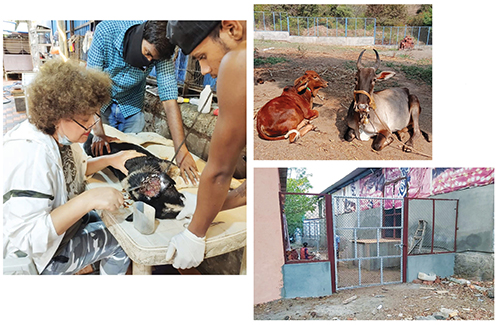
Padmini removing maggots from a canine; right: shelter and its inmates (top)
With more and more animals needing to be housed, Mission Possible needed to expand its operations, but where would the resources and funding come from? It may have been the blessings bestowed on Mission Possible by hundreds of speechless animals that helped things to fall into place, a step at a time.
One day, a gentleman named Amarsingh Jadhav Rao came to the Shankar Sheth Road shelter wanting to adopt a dog. While Padmini was sorting out the paperwork for the adoption, a few nagarsevaks (corporators) from the municipal corporation arrived to talk to Padmini about multiple complaints from her neighbors about the disturbance caused to them by the dogs’ barking. Trying to placate the nagarsevaks, Padmini reassured them that she was trying her best to find a site to relocate the strays, and would shift the animals as soon as she found a suitable location. After the corporators left, Jadhav Rao began questioning Padmini about her requirements for a second shelter. Padmini told him that she was looking for a plot of land outside the city where she could house a large number of dogs and cats. Jadhav Rao gave her two acres of land on his sprawling property in Jadhavwadi, Saswad, on a 10-year lease.
Nestled among acres of barren land, with no buildings within miles, Mission Possible’s Jadhavwadi shelter today houses approximately 1,000 dogs, 300 cats, a buffalo who was rescued from being slaughtered, and a few cows. There are also animals who cannot fend for themselves, such as newborn puppies, and old or handicapped dogs and cats. The two-acre shelter has tall, wired fences, 10 single-storey sheds with indoor kennels to house the animals and two large sheds for the caretakers, all set up thanks to donations from well-wishers. Water is supplied from a bore well, and the shelter has its own generator for electricity. There is also a small operating theater where vets can treat injured animals.
The dogs roam free on the grounds throughout the day. Currently, there are seven caretakers who live on site, some of them with their wives. Padmini points out that because of the remote location and paucity of funds, it is difficult to get staff. I asked Kanhaiya Divakar, one of the attendants, if he managed to sleep at night given the deafening ruckus that the dogs are capable of creating. He replied that the dogs get tired after running about outdoors all day and are usually quiet at night.
The expenditure of providing meals twice a day to the animals in both shelters besides feeding hundreds of stray dogs and cats on the roads, plus medication, surgery and veterinary bills and staff salaries comes to nearly eight lakh rupees (USD 10,672.32) each month. In the past, Padmini’s family used to fund the shelter, and the rent from her Shankar Sheth Road property would go towards the animals’ welfare, but now there is no rental income and her husband and children have their own commitments. Peter is a managing director for an interior fit-out services company in the United Arab Emirates, Sandra is a senior marketing director for a multinational information technology (IT) organization, and Shaun is a human resources management professional for a leading IT services company in Dubai.
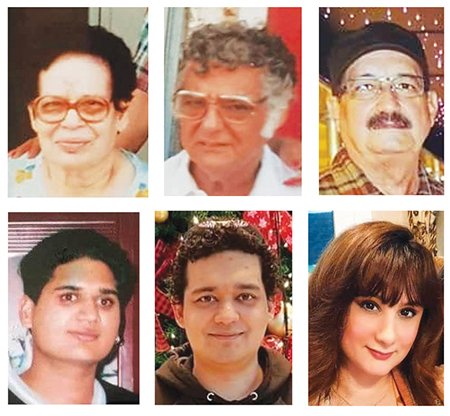
Clockwise from above l: Parents Gulshan and Jal Irani, husband Peter Stump,
children Sandra, Shaun and late Steven
Most of the funding thus comes from animal lovers. The greatest devotion is shown by Padmini, with commendable support from Kasbekar, the vets and staff. She drives the long distance to the Jadhavwadi shelter every day, provides first aid to any injured dog or cat, and even removes their maggots and ticks. "I believe that the seva (service) I do for these voiceless victims comes naturally to me thanks to my Zoroastrian genes. I have always been proud of being a Zarthoshti. We may be a small community but our hearts are large and we are respected for the light, honesty and goodness we carry with us wherever we are in the world. The traditions and values that are instilled in us will live on until the end of time. I’m extremely proud of my heritage.”
At great personal cost, Padmini has triumphed over her devastating tragedy and by selflessly helping the helpless, she has built a legacy of which Steven and her family can be proud. "Our goal is to reach out further and do everything we can for these helpless creatures,” she says. "Over the years, we have rescued hundreds of animals in trouble. We have never turned our back on them and we hope to be able to do more. We can only do it with your help and support. Please help us to help them.”
Donations to Mission Possible may be sent to: Dr Ravindra B. Kasbekar, Google Pay number: 9822037393, bank details: Mission Possible, Canara Bank, Deccan Gymkhana Branch, J. M. Road, Poona 411004, a/c no: 0382101068164, IFSC no: CNRB0000382