They came in all shapes and sizes. Dramatically different personalities. Scholarly, learned, pious, psychic, businesslike, funny, lewd, crude, poor, smart, shrewd. No single calling or profession could have produced such variety. In the last 60 years, they impressed, mesmerized, soothed, inspired, infuriated, irritated, disgusted. Most were excellent human material. Only a few were unfit to be priests.
The nearest thing to seeing young Zarathushtra in his prime was Dastur (Dr) Firoze Kotwal. At the Vadi Daremeher in Dastur Vad, in 1966, we, the navar candidates were in awe of him. Tall, handsome, with his flowing jet black beard, he could have stepped out of a set of Ben Hur. He strode like a colossus in the corridors of the bustling agiary (where today not a soul stirs and the holy fire is in a locked room, and a Gujarati lad checks visitors’ pandemic mandated temperature at the entrance). Kotwal had not yet dazzled Oxford and Harvard with his academic brilliance. Once he spotted the son of a friend up to some mischief. In a swift movement, he took off and flung his joda (pointed toe footwear) at the boy. All of us stood chastised. Kotwal silently picked up his shoe and walked away. His adoptive parents were our close neighbors in Desai Vad; and our loving grandmother, who had sponsored the navar of her only grandchild, was capable of turning into Attila the Hun if she heard the slightest complaint about us. Hence, we avoided Kotwal as much as we could.
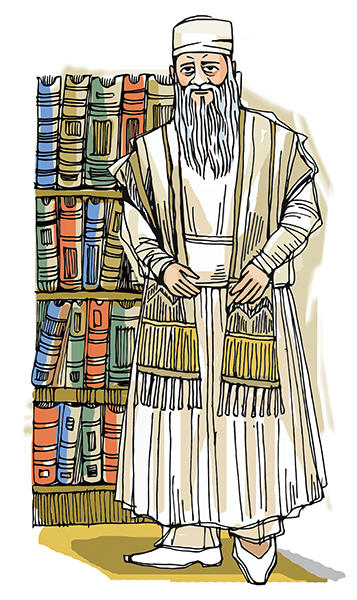
Illustration by Farzana Cooper
Kotwal is scripturally and ritualistically one of the most erudite priests that, forget Navsari, India has ever produced. In his later years he became unpopular with liberal sections due to certain provocative statements extricated from him by vested interests. All that is trivial when compared to what he has contributed to knowledge of the religion. We may have violently disagreed with him in the past but he remains, by miles, the numero uno of the Navsari priests we have known.
From the sublime to the ridiculous. On the very first day of our navar seclusion period, we were greeted by a dark complexioned, slightly obese priest popularly called Nariman Dagri, who told the confused boys that our father was to be routinely found lying on restaurant tables. Then he guffawed and explained that our father’s name being Minoo, it was the same as the "menu” on restaurant tables. He thought himself a great comedian. That afternoon, he invited the boys to a rocket launch. Lifting his sudreh he revealed the most hirsute stomach that our young eyes had seen. Upon this he placed his joda, inhaled deeply and exhaled forcefully to jettison the shoe upwards. In the process, he broke wind loudly. Thereafter, he made us learn what he termed a Sanskrit shloka: dhoom kari né padum jara bhi nahin gundhum; phoos kari né padum, atee gundhum (a loud fart is odorless but the silent one is smelly), which we stupidly narrated to our horrified grandmother. Dagri was a part-time caterer at weddings and invariably the food ran short. If he ran out of chicken, he would serve oily mutton cutlets, then half a cutlet, and finally a fried egg would be dumped on one’s patru. If anyone complained, he would call them, under his breath, a gluttonous MC. He too was mortally scared of Kotwal.
We also recollect an exceptionally short and elderly priest with a perpetual toothy smile who regaled the boys every night with a profane limerick half in Gujarati half in Hindi, which we can recollect verbatim 55 years later. The editors of this publication unfortunately won’t print it. The mobed used to recite a line, pause, and ask "Soo (what)?” Then the boys in chorus would have to repeat the line. Pleased with our learning, he would proceed further.
Then there was a jolly, garrulous priest who looked like the King of Spades and was nicknamed pittal no murgho (brass rooster) for his most sonorous voice which would reverberate across the fire temple and drown out the din of all other priests. He was a good and honest soul who died young.
The first death we witnessed was of our maternal grand uncle who desperately wanted a priest named Sohrab to do bhoin nu bhantar (praying before the corpse at night at home before the next morning’s paidust) when he passed away. Unfortunately, it was the turn of another priest to pray and our uncle’s family was disappointed at being unable to honor the last wish of the deceased. The other fellow prayed for an hour, had an attack of the loosies and Sohrab was summoned; he prayed all night as though he was pleading for the soul of the deceased with all his heart. Sohrab’s voice was so mellifluous that night that no eye remained dry.
The High Priest of Navsari, Dastur Meherji Meherjirana, was soft-spoken and humble. Often he would attend a tea club in the orchard of a missionary doctor whose little Baby Hindustan, on the return journey, would be packed to capacity with the doctor, his obese driver, Abdul (who drove with one hand and slapped pedestrians who came too close to the car, with his other) and older men. The High Priest had no hesitation in accompanying us, sometimes on a bicycle. No airs that he was the Vada Dastur. He may not have been as learned as his illustrious predecessors but he was an authentic priest. And he had a tough act to follow. His adoptive father was a titan amongst men, controversial, colorful, scholarly and a brilliant speaker. We had seen him only once at a family wedding looking resplendent in his simplicity, with his trademark picchori stylishly held in one hand, polished black shoes, goggles as shades were called, and a slightly bitter smile on a very intelligent face.
Navsari felt more comfortable with his son.
Berjis Desai, author of Oh! Those Parsis and The Bawaji, occasionally practices law.