The stateliness and stature is
back in the iconic Royal Opera House
Mehroo Kotval
"Opera House!” calls out the bus conductor of the BEST (Brihanmumbai Electric Supply and Transport Undertaking). Opera House is a landmark, a prominent postal address. It is now quite glibly the Royal Opera House (ROH), restored to its original splendor of 1916 in its initial Baroque style – ornate, heavily decorated, curving lines and gilt — the only surviving opera house in India, today. Back in commission as an opera house after 50 years, 23 years after the last screening of a film. The advent of home theaters, video cassette recorders and videos seem to have been ROH’s death knell then.
Ashish Doshi, honorary director, businessman and family friend of the royal house of Gondal, owners of ROH, gives a peep into the restoration saying they have "done the best in the realm of restrictions for this Herculean task. We have (acquired) the best seats, air-conditioning, used fire-resistant material, and have been as true to 1916 as possible… We want this to be for generations to come.” Doshi with a team of 20 plus personnel, informed Parsiana in a phone interview that bookings have started taking place from November 15, 2016. The premises can be hired for theater, film festivals, premières, concerts in both Indian and western genres as also for private events.
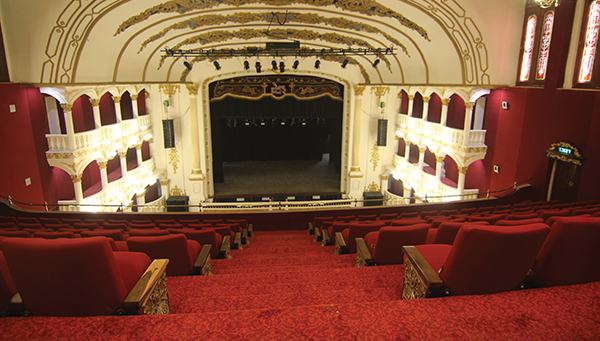
View of Royal Opera House from the first balcony Photo: Jasmine D. Driver
Maharaja Jyotendrasinh, Maharani Kumud Kumari Jadeja of Gondal; coat of arms
Seat signage Photo: Jasmine D. Driver
Interior of Royal Opera House
Eight-panelled dome Photos: Jasmine D. Driver
Asad Lalljee, the curator and chief executive officer of Essar Foundation’s Avid Learning, a public programing platform and cultural arm of the Essar Group who were the event managers, wants ROH to be a performing arts venue which can be given on rental, wants to run "workshops for the disenfranchised population too and do things for kids in various languages.” Lalljee adds that the Gondal royal family has been patrons of the arts and were keen to restore ROH, especially after the results they saw on restoring their palaces Naulakha in Gondal and Jayamahal in Bangalore. Jayamahal is now metamorphozed to the heritage Jayamahal Palace Hotel at 1, Palace Road, another eponymous address.
ROH is a privately held property and for nine years they pursued the paperwork for restoration with various authorities, stated Doshi. The actual restoration began seven years ago. He also notified us that ROH is still awaiting permission for a lift to negotiate the steep steps but has no clue when this will be passed by the Mumbai Heritage Conservation Committee — as well as all the other miscellaneous clearances required for the property. They also have plans afoot to have a tea kiosk on the second balcony, subject to permission being granted.
Restoring a royal heritage
Conservation architect Abha Narain Lambah, commissioned to restore ROH, was quoted by the NDTV website stating, "The interiors of the Baroque style were renovated and refurbished into a more modern, art déco style… a lot of the interior elements such as the multi-tier Baroque side balconies and the historic plaster ceilings were either concealed or removed altogether.” The renovated ROH has maintained the curvilinear, multi-tiered side balconies, Corinthian and fluted columns and gilded tracery to replicate the original look. The sources the restorers relied on included catalogs of opera houses around the world, old pictures and old films shot at the venue. Wikipedia website further informs us that ROH features a blend of European and Indian architectural styles.
Archival photos of Royal Opera House interior; the first balcony; Photos courtesy: Royal Opera House
King George V Photo: Wikipedia
The restored heritage building lit up at night
Built with exquisite Italian marble, ROH continues to house a pair of unique crystal chandeliers donated by the David Sassoon family from their mansion. At the main entrance to the auditorium, a dome is segmented into eight different panels as a tribute to poets, dramatists, novelists, literati and people from art and culture. The seating enabled a clear view of the stage and the acoustics were created by shaping the ceiling in a manner that permitted distinct audibility that allowed the audience seated in the gallery to hear every word or song from the stage. Both these facts are alas now compromised, as from the upper, second balcony, the bar supporting the floodlight obstructs full view of the stage as also the audibility is strained and impaired.
The first priority was structural restoration with roof repairs and water-proofing, Lambah expands in the NDTV website. She then had to concentrate on the basement and the balconies that were leaning out. She acknowledges the expertise of structural engineer Satish Dhupelia. The conservationist specially commends her team and their hard work. The acoustics were sounded by Rahul Jhaveri and Company. Richard Nowell, the British expert acoustician made recommendations to ROH to replicate the same quality of sound as is in the various theaters of the National Centre for the Performing Arts.
The grade one heritage building has retained two balconies with a total of 574 seats, boxes with personalized split air-conditioning, auditorium built in a horn shape to improve the acoustics. As a consequence of this shape the second balcony has a telescopic, depth vision where performers appear dimunitive. As done in other venues of music making, they will consider a shell for better sound and amplification. They have of course refurbished the tiny restrooms and are still working on the dressing rooms. Parking in the crowded city is an acknowledged hurdle and ROH is no exception.
Past glory revisited
The ROH opened 100 years ago on October 16, 1916. Lambah recounts, "There was a performance that was set up in honor of the visit of King George V to Bombay. Without the building being ready, they used a lot of drapes and temporary fabrics to actually put together the performance.” At the time, the inauguration of ROH (the word ‘Royal’ having been added as George V opened the venue), a magic show by American magician "Raymond” set the pace.
Maharaja Jyotendrasinh and Maharani Kumud Kumari Jadeja of Gondal, Gujarat are the actual ROH owners. The immediate former monarch Maharaja Vikramsinh, father of Jyotendrasinh, acquired ROH in 1952 for a 999-year lease, Doshi informs us.
The design for this iconic building was conceived in 1908 by Jehangir Framji Karaka, head of a firm of coal brokers and Maurice Bandmann, an American entertainer who made Calcutta his home, becoming owner of theaters, as per The Times of India of October 18, 2016. The impresario told The Straits Times of Singapore in an interview in 1911: "We have educated the natives into play going. They have become especially fond of Shakespeare… and Indians were willing to pay sometimes as much as Rs 50.” Adding, "The best native playgoers in India were the Parsis.”
The royal family of Gondal have supported education and healthcare, both of which have been free for their subjects under maharaja-rule. Similarly, general taxes levied by rulers were not exacted for over a century. Female education has been close to the heart of its royal family and the royal ladies from this house were among the first to abolish the purdah system, Wikipedia enlightens us. They further state that Bhagwatsinh, great-grandfather of the current ruler, has been the only maharaja to acquire a medical degree and other degrees.
Live performances still alive
The heritage building hosted the 18th Mumbai Academy of the Moving Image on October 20, 2016, the trust that organizes the Mumbai Film Festival, an annual international film festival in Bombay.
After the restoration, its first public performance was held on October 22, preceded by a private viewing the previous day on the 21st. The evening of the 22nd started with Indian born Patricia Rosario singing Sure on this Shining Night by Samuel Barber and lyrics by James Agee, accompanied by her pianist husband Mark Troop. In fact the evening was designated On this Island: A Shining night. In association with the music store Furtados, the soirée was produced by Parvesh Java who accompanied Kersi Gazdar in a Benjamin Britten song and clarinetist Nicholas Ellis in a Johannes Brahms sonata. Troop and Java also played Wolfgang Mozart’s sonata in B flat for four hands. The performance ended full circle with Paranjoti Academy Chorus (PAC) singing the same lyrics of Agee but in an arrangement by Morten Lauridsen. PAC also performed two movements from Johannes Brahms’ Requiem, one conducted by Coomi Wadia and one by Java. Java countered comments about performing a Requiem for an auspicious occasion, with the technical detail of Brahms’ Requiem being celebratory in spirit, written on the death of Brahms’ mother.
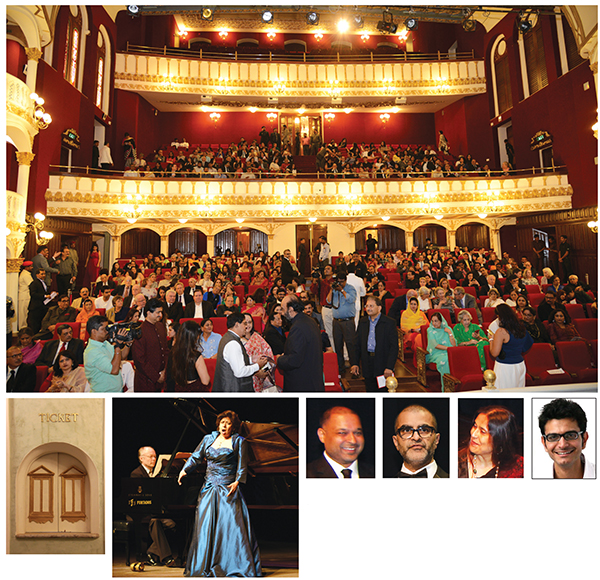
Top: View of the invited audience at the inauguration; Above l to r: the booking window;
Mark Troop and Patricia Rosario, Ashish Doshi, Asad Lalljee, Abha Narain Lambah, Parvesh Java
Of a total 12 pieces performed that evening, all six vocal pieces with piano accompaniment, were by composers of the 20th century so that the audience at the première, not conversant with western classical music, was estranged from the modern program. One movement of the oldie goldie Spring Sonata by Ludwig van Beethoven was played by violinist Eshvita Menezes with Java accompanying her. Some may also have been familiar with songster Franz Schubert’s lied Shepherd on the Rock performed by the Rosario-Troop duo and Ellis on the clarinet.
Rosario and Troop likewise opened the 21st première. That day’s gala was also by invitation only but was for family and friends of the royal family of Gondal. Rosario and Troop were the sole performers on the 21st and gave a 45-minute recital which included the well-known lied Gretchen am spinnrade by Schubert.
To find out more details, one may visit
www.royaloperahouse.in or contact them either on
info@royaloperahouse.in or on landline (022) 2369 0511.