Born and raised in Karachi, Niloufer Mavalvala (pictured) started to bake when she was eight years old and taught her first solo class at 17. She moved to Dubai soon after marriage where she organized cooking demonstrations. Six years later she moved to  Canada, where she supported fund-raisers for charities through cooking demonstrations.
Decades of passion and teaching cooking have prompted her to publish cookbooks, the first one in 2016, the second one awaited in mid-2019. Her earlier e-cookbooks continue to be available on Kindle via Amazon. This technological approach was with the thought of keeping her young friends involved, giving them easy and affordable access to her tried and tested recipes.
The recipies published here, with her kind permission, have been shared from her website Niloufer’s Kitchen at www.nilouferskitchen.com and her books The Art of Parsi Cooking: Reviving an Ancient Cuisine and the forthcoming The World of Parsi Cooking: Food Across Borders, both available on Amazon.
Potato flour (1 cup)
Red chilli powder (1 tsp)
Salt (½ tsp)
Prepare
Calamari tubes (6 — washed and evenly cut in rings)
Toss the cut calamari with
Salt (½ tsp)
Garam masala (½ tsp)
Cumin powder (1/4 tsp)
Nutmeg (scraped — a pinch)
Red chilli flakes (1 tsp)
Mix in
Coriander leaves (1 tbsp — finely chopped)
Lemon or lime (1 large — freshly juiced)
Cover, refrigerate and keep up to four hours. Bring to room temperature prior to frying.
To deep fry
Heat to a temperature of 180°C/350°F, three cups oil or test the oil by dropping a piece of bread; it should sizzle and come up if ready.
Working in six batches, toss each piece of calamari in the dry mix of potato flour and drop into the hot oil. Work quickly. With a slotted spoon remove the rings and place on absorbent kitchen paper. Repeat. Serve immediately with an assortment of dipping sauces.
Tips
Adjust the flame according to how quick you can work. If it takes you some time between the lots, lower the flame and then bring it up again. The calamari has to be cooked on a high flame to be crisp and not soggy. It takes just a minute for a batch.
There is a difference between squid and calamari. Calamari is the softer, easier to cook sea food. It is smaller and the fins go all the way down. Like every other seafood try to buy it fresh from your fishmonger and not the frozen ones available on shelves.
While potato flour is lighter and cooks more evenly, you may use gram flour/besan instead.
If using gram flour lower the flame after you reach the right temperature as it will take longer to cook through.
Top: Calamari pakoras; above: Tandoori chicken wings
All photos: Sheriar Hirjikaka
TANDOORI CHICKEN WINGS
Serves 8
Chicken wings (I kg)
Plain thick yogurt (1 cup)
Saffron (a pinch)
Garam masala (1 level tsp)
Red chilli powder (3 tsp)
Turmeric (1/4 tsp)
Cumin powder (1 tsp)
Lemon or lime (1 — juiced)
Oil (1 tbsp)
Garlic (4 cloves — minced)
Ginger (2 tbsp — ground)
Salt (½ tsp)
Sugar (a pinch)
Marinade wings with all the ingredients together. Bring to room temperature before cooking. Place the chicken wings on a baking sheet. Preheat the broiler to 375°F/ 200°C and cook for 12 to 15 minutes turning once, until golden brown.
Serve with lemon, freshly sliced onion and warm naan bread.
RATATOUILLE
Serves 8
Olive oil (1 tbsp)
Zucchini (1)
Red pepper (1)
Yellow pepper (1)
Eggplant/aubergine (1 small)
Salt (½ tsp)
Safflower oil (1 tbsp)
Golden onion (1 — large)
Tomatoes (2 cups — skinless chopped)
Brown sugar (1 tsp)
Salt (1 tsp)
Black peppercorn (freshly ground, to taste)
Water (1 cup)
Dried Herbes de Provence (1 tsp)
Goat cheese (½ cup — diced/crumbled)
Cut the vegetables into equal sized squares, toss them with olive oil, sprinkle with salt and roast in the oven until just soft. Do not overcook them.
In a pan heat a tbsp of oil and add one very finely chopped large onion. Saute until it is soft and turns a light color. Now add two cups of chopped tomatoes, brown sugar, salt and pepper, Herbs de Provence and water. Cook until it is thick and sticky.
Toss the roasted vegetables into this sauce. Cover and simmer for 10 minutes prior to serving.
To serve
Place the ratatouille in a large shallow bowl and crumble all the feta over it. Sprinkle with a choice of green herbs for color; watercress, mint, parsley, coriander all work well.
Top with puff pastry triangles.
Tips
Serve it in vol-au-vent cases. Ensure that most of the liquid has evaporated otherwise it will get soggy. Fill it just before you want to serve it and heat for three minutes before serving to melt the cheese.
Ratatouille (left) and Machhi no palao (right)
MACHHI NO PALAO
Serves 8
The fish gravy
Fish fillets (½ kg/1 lb)
Onions (3 — chopped)
Garlic (2 — tsp)
Salt (to taste — about 1-1½ tsp)
Cumin powder (1 tsp)
Green chillies (6 — finely chopped)
Curry leaves (8-10)
Tomatoes (2 medium — chopped)
Chilli powder (1 tsp)
Curry powder (1 tsp)
Turmeric powder (½ tsp)
Garam masala (1 tsp)
Saffron (½ tsp)
Lime (1 – juiced)
Corriander leaves (½ cup — chopped)
Water (1/4 cup)
Beat together
Yogurt (1 cup — at room temperature)
Sugar (a pinch)
Salt (a pinch)
In a pan heat a little oil and fry the onions till golden brown. Add garlic and stir a minute.
Now add to this the chopped tomatoes, chili, turmeric and curry powder and fry for five to seven minutes. Add this to the masala mix and let it cook simmering over a medium-low heat for 20-30 minutes till the whole mixture is well cooked, and almost dry. Initially cover the pan and after the time is done open the lid and dry off the masala stirring constantly over a higher heat. Now add the garam masala, saffron, lime juice, coriander and water making sure the gravy comes to a boil eventually.
Once it is ready to assemble, add the fish fillets and cook for just 7-10 minutes
The rice
Rice (700 g)
Bay leaf (1)
Cinnamon (2 thin sticks)
White cardamoms (6 whole — broken down)
Black or white cumin seeds (1 tbsp — whole) optional
In a pan of boiling water boil the rice, bay leaf, cinnamon, cardamoms and cumin seeds. Remove and strain all the water when the rice is just cooked, not overly done. Now assemble the fish gravy and top with rice. Make holes and drizzle over a little saffron water to help bring a little color to the white rice. Cover very tightly so no air escapes. Either simmer on gentle heat for 15-25 minutes or optionally in a preheated oven of 350°F/180°C degrees for 15-20 minutes. This ensures the flavor steams through and the rice cooks evenly.
Tips
It is best to use a firm fish like salmon or surmai. Making squares keeps the fish from breaking apart. When adding the yogurt temper the masala by adding a few tablespoons of the mix into the yogurt before adding it all in. It is best to allow the mixture to cool down slightly to avoid any of the yogurt from curdling. Use full fat yogurt and not skimmed.
Serve this with a raita or masala dal if you wish. Personally, it is perfect on its own.
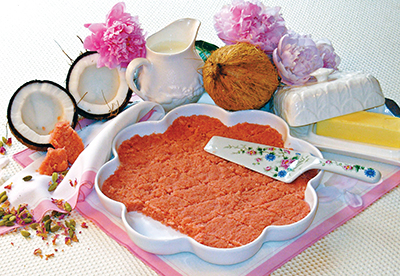 KOPRA PAK
Serves 8 (makes 1 kg/2 lb)
Whole milk (6 cups)
Sugar (1 cup)
Coconut (350 g/3/4 lb — freshly grated)
Salt (¼ tsp)
Salted butter (½ cup)
Vanilla (1 tsp)
Rose water (3 tbsp)
Cardamom (1 tsp)
A few drops of red food color, optional
In a pan heat the milk and sugar, stirring until dissolved. Bring to a rolling boil and continue to cook for 20 minutes. Add the grated coconut, salt and salted butter. Cook on a low heat until sticky and thick. This will take over an hour. To flavor add vanilla, rose water and cardamom powder.
Optionally, add a few drops of red food coloring to turn it pink in color. Cool in flat trays. Cut into pieces. This can be served warm or chilled.