A mother’s attempt to drop legends from a book on Zoroaster draws a protest
Aban Mukherji
Christopher Columbus could not have been more wonderstruck at sighting land than I was at the discovery of the dummy — intact with many of the original illustrations — of my mother Pareen Lalkaka’s book, Zarathushtra — The Golden Star. It was on a rainy day when looking at the numerous books housed in glass-doored cupboards that lined the dark passage of my flat, I came across this find. And as I gazed at the colorful illustrations the years receded and I was once again a teenager in the 1960s, enthusiastically following the progression of the book, accompanying my mother and artist P. B. Kavadi to the library of The K. R. Cama Oriental Institute to pore over books on Persian art so that a more authentic depiction of that remote age could be mirrored in the illustrations. [Some of the illustrations in my aunt Piloo Nanavutty’s Our Religion-Book I (1979) are inspired by Kavadi’s illustrations in Zarathushtra - The Golden Star (1965). Also, five of the illustrations from my mother’s book have been reproduced in Lorraine N. Moos’s My Simple book of Zoroastrianism (1996).]
I loved to watch each major episode of the Prophet’s life come alive in the clean simplicity of line and brightness of colors. Baby Zarathushtra being surrounded by a ring of fire, protected by the nurturing cow, looked after by the mother wolf, the failed attempt to murder the child, the miracle at King Vistaspa’s court — all stirred my imagination. The miraculous seemed to weave a ring round my childhood. My child’s mind clung to the "reality” of the supernatural world which I experienced all around me and which brought meaning and magic to my life. Looking back I feel that the myths surrounding the birth and infanthood of Zarathushtra bring out the "divinity” in nature and its many life forms as they come together in the act of nurturing to transform the world and lead it to the state of Frashokereti [the final renovation of the universe, when evil will cease to be and everything will be in perfect unity with God (Ahura Mazda)]. No rational explanation of the miracle of a mother’s love that cuts across species could enter a child’s heart as vividly as in the story of the cow and the she-wolf protecting baby Zarathushtra. Profound truths are imbibed with easy celerity through the introduction of the supernatural, and as the child matures, their symbolic nature becomes clear without it having to be spelt out.
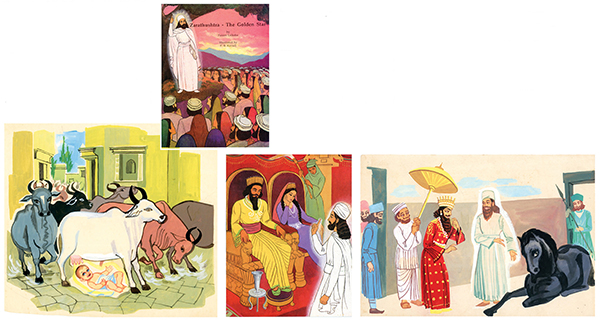
Cover of the book Zarathushtra - The Golden Star (top) and illustrations by P. B. Kavadi from the book (above)
I was quite thrilled to be living in a building which was supposed to be haunted, and be neighbor to a headless apparition in white who roamed the neighboring compound at night and could reportedly make one drop dead at the flick of her eyelids. Tom Thumbs lurked in the branches of peepal trees and fairies obligingly appeared as colorful dancing lights, the minute one’s eyes were half shut. The myths and legends of antiquity, the miracles surrounding great beings, the ghosts and jinns, elves and fairies that peopled my world were but "proofs” of a different reality that existed amicably side by side with rational thought.
Alas! In the middle of this work-in-progress, my mother abandoned her all-embracing attitude towards myths and miracles and came to the conclusion that it would do grave injustice to the message of Zarathushtra to include the myths surrounding his babyhood. I was aghast, upset and totally shattered at this decision. I was convinced it had something to do with her encounter with a group of Iranian intellectuals who had visited Bombay during the 1950s and ’60s. But my passionate pleadings to retain the stories fell on deaf ears. My mother explained how supernatural events woven into the lives of great men and women helped to distance the common man from the object of his admiration. It made him deaf to the message by transforming a human being into a "god” who could never be emulated, thus negating the very purpose of his/her manifestation on earth. I cried and begged my mother to retain the "offending” episodes, influenced not a little by the lovely illustrations. What would Christmas be without Santa? I pleaded. Didn’t he finally evolve into St Nicholas without any dilution of his message of love and service? What would Janmashtami be without the miraculous or the tale of Prince Siddhartha without a touch of the supernatural? But I was too young to effectively plead my case and rational thought prevailed over the magic of myths.
But not quite! I still saw fairies, conversed with elves, went in search of Tom Thumbs among the branches of fallen peepal trees and searched the dark, spiral staircase to the rear of my building for lurking ghosts. Needless to say, all I encountered was a ghostly white apparition with unblinking, beady eyes and a hooked nose perched as still as death on the wrought iron railing of the staircase. It was a barn owl! We stared at each other in silence for a long time.
I was convinced that my mother’s myth-busting attitude was responsible for transforming the magical into the world of mundane rationality.