Socialist governments created obstacles to the growth of the Tata group
Excerpts from Shashank Shah’s The Tata Group: From Torchbearers to Trailblazers. Reproduced with permission from Penguin Random House India.
Tata Steel embarked on a transformative journey around the time the Indian economy was liberalized. Right-sizing the labor force was a vital element of this exercise. After taking over as the chairman of Tata Steel in 1993, when Ratan Tata enquired about the size of the workforce, he was met with a stony silence. A few months later, the number 80,000 emerged. Dr Jamshed Irani recalled the reason for the massive labor force at Tata Steel. "The Tatas never gave any money for political causes and certainly nothing to politicians who wanted ‘bribes.’ I myself dealt with that. But we could give one thing which they wanted, and that was jobs.”
In the 1960s and 1970s, labor was cheap and to placate the powers-that-be the company willingly gave jobs. While the wages were low, that wasn’t much of a problem. "I remember J. R. D. Tata exploding one day in the 1980s when we mentioned that Tata Steel’s wage bill was Rs 100 crore. He said, ‘100 crore! What are you guys doing?’ Three years later the wage bill increased to Rs 200 crore,” reminisced Irani. As part of the Tata culture, the company gave more than what was recommended by national wage agreements. From a labor productivity standpoint, Tata Steel was producing 100 tons of steel per man-year, compared to 1,000 tons per man-year by some of the efficient producers in the USA. There were also a lot of redundancies. For example, Tata Steel had some 3,000 secretaries and office boys. The accounts department alone employed 32 drivers, security personnel and peons. All these were contributing factors to the rising wage bill. Given that the quantum of wages was non-negotiable, the size of the workforce had to be reduced to manage costs. For this a massive initiative was undertaken.
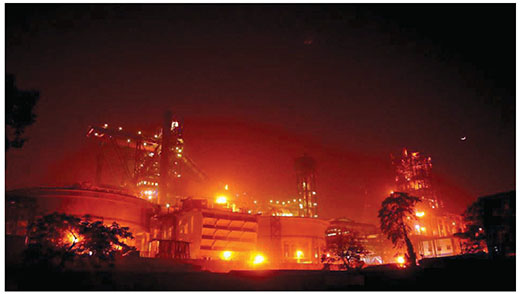
Tata Steel plant in Jamshedpur, at night Photo: Wikipedia
The Tata culture of not retrenching people and its agreements with the union limited any option of laying off workers en masse. Moreover, that wasn’t desirable due to the socioeconomic consequences for a workforce that did not have many employment opportunities in Jamshedpur outside the Tata plants. Interestingly, there was also a tradition at Tata Steel, once written into the agreement with the union, that every retiring worker (having completed 25 years of service) could nominate a person (daughter or son) to take over his job when he retired. While the one-for-one replacement clause built immense loyalty between the company and several generations of employees, it perpetually prevented the company from achieving any labor force reduction. At Tata Steel, it wasn’t just lifetime employment, it was eternal employment. In such a scenario, the company had to persuade its workforce to voluntarily separate. It proposed a very attractive package through its Early Separation Scheme (ESS) and convinced the union led by V. G. Gopal not to insist on the hereditary employment clause for the sake of the company’s survival. The union also realized that productivity was the key to the company’s survival.
Irani personally addressed several meetings to share his concerns about the dire state of affairs and the need to reconsider employment policies for existential reasons. He recalled one such meeting at the plant.
"After I explained my plan, one of the workers stood up and shouted, ‘We understand why you are doing it and how the company is gaining. But you are taking away the jobs of my children.’ Immediately, in an inspired moment, I shot back. ‘Look, if you don’t do it, your job and my job are at stake. So, forget your children, think about yourself.’ That was the turning point.”
The narrative was clear. The management was honest. The workers understood the enormity of the situation. To maintain credibility and convey through personal example, throughout his tenure as managing director, Irani never bought a car for himself. He used one from the cars available with the company. This gesture conveyed to the workers that his words and actions were in harmony.
Irani maintained absolute transparency with the union and workers. In his presentations with union leaders he shared details about the cost, sales, profits/losses, expense per employee, and potential expenses with the rising wage bill. He presented facts about competition and international benchmarks vis-à-vis the company’s performance. In conclusion, he would ask for suggestions on alternatives possible in the given situation. But there were none. Moreover, Tata Steel wasn’t taking advantage of the situation by proposing an apology for a separation scheme. Instead, ESS was so attractive that they had to curtail the exits by deciding who would leave and who would stay. They wanted to ensure that high performing candidates remained with the company. In effect, it wasn’t a voluntary retirement scheme, but a strategic separation scheme in which 40,000 workers were discharged in a single decade.
J. R. D. Tata
Purge the private sector?
J. R. D. lamented at the Tata Steel annual general meeting (AGM) in August 1972: "Deprived of the right to decide what and how much to produce, what prices to charge, how much to borrow, what shares to issue and at what price, what wages and bonus to pay, what executives to employ and what salaries to pay them and in some cases, what dividends to distribute, directors and top management from the chairman down have hardly any economic power in our country.”
There was a serious concern that government policies would soon lead to a total elimination of the private sector. The regulations at the inputs, combined with one of the most regressive tax systems that left hardly anything in the hands of entrepreneurs after delivering an efficient output, made an ideal recipe for disaster. In the early 1960s, individual income tax was increased by 450%. Added to that was a super-profits tax on 50% of the income remaining after the initial tax. By 1974, the highest rates of personal income tax had increased to a mind-boggling 97.5%, the highest in the world. On top of that, wealth tax had to be paid, thereby raising the taxation level to more than 100%.
The routine approach in such a situation would be to "manage” the tax system. Yet, the Tatas’ approach to taxation was different. One of India’s finest tax consultants, Dinesh Vyas, had observed that J. R. D. never debated "tax avoidance,” which was permissible, and "tax evasion,” which was illegal; his sole motto was "tax compliance.” On one occasion a senior executive of a Tata company tried to save on taxes. Before putting up the case, the chairman of that company took him to J. R. D. Vyas explained: "But sir, it is not illegal,” Softly, J. R. D. replied, "Not illegal, yes. But is it right?”
Dr Jamshed Irani: full transparency
Indira Gandhi: francophone
In the pre-Independence years, J. R. D. had mentioned to his economic adviser, Y. S. Pandit, that if there was nationalization of all industries post-independence, he was not going to evade it or take money out of his interests before nationalization. He was going to hand over all his businesses to the government intact. J. R. D.’s high level of personal integrity and the Tatas’ commitment to nation-building was apparent from this. Yet, the Tatas opposed such nationalization as was imposed without any compelling economic or social reasons. In an address to the Ahmedabad Management Association in January 1967, J. R. D. pleaded with politicians and bureaucrats to work with, and not against, business; and to shed their preconceptions that a "profit motive is dishonorable, that profit is synonymous with profiteering, that about three percent net is a fair return on risk capital, that the population problem will solve itself, that mechanization means unemployment, that it is more important to impoverish the rich man than to enrich the poor, that a welfare state can be built without first creating the means to pay for it, that nationalization creates additional wealth.
The inordinate delay in granting consents was the commanding bureaucratic tool. During the British Raj, permissions for a new business were given within roughly 40 days. For example, Dorabji Tata floated the Tata Construction Company on July 6, 1920 and it was registered on August 16. Even during the worst days post-Partition, the Government of India had given permission for starting Air India International within weeks. However, within a decade of independence, the process had become as slow as molasses in January. In those years, J. R. D. had asked Minister Jagjivan Ram: "Why is it that if the government could make an important decision on a big scheme like Air India in 10 days (in 1947), it now (1960s) takes many years to decide on smaller things?” Ram’s answer was, "In those days, we didn’t know any better.”
Despite the differences in opinion, Prime Minister Indira Gandhi and J. R. D. maintained a friendly equation. She once wrote to him after a meeting, "It was good to see you. Please do not hesitate to write or to come and see me when you want to convey any news — favorable or critical.” She also ensured that whenever a French dignitary or head of state was in Delhi, J. R. D. would be invited as both she and J. R. D. were francophones. However, procrastination over four specific applications by the Indira Gandhi-led Congress government hugely hurt the Tatas. These critical projects included the Associated Cement Companies’ (now known as ACC) plans for a million-ton cement plant; Tata Power’s need to generate 500 MW more electricity; Tata Steel’s urgent need to modernize its ageing plant; and Tata Motors’ plan to cut down lengthy waiting lists by increasing capacity from 36,000 to 56,000 vehicles. But the permissions wouldn’t come for years. Some did come, though 13 years later.