I was delighted to learn that some Zoroastrian Kurds were invited to the 11th World Zoroastrian Congress in Perth recently ("I will not budge,” Zoroastrians Abroad, Parsiana, June 21, 2018). Recent reports attributed to someone who visited the Kurds indicated that there are around 200,000 Zoroastrians there. If true, that would double the number of Zoroastrians in the world!
The excellent treatise Conversion in Zoroastrianism: The Truth behind the Trumpery by two eminent scholars, Prof Kaikhosrov D. Irani and Farrokh Vajifdar, 1996, clearly establishes, with several references to our scriptures, the acceptance of conversion in our religion, not forceful but voluntary. This is also backed by the Bombay High Court judgment of Justices Davar and Beaman. Why then are we so reluctant to accept those who wish to come into our faith? They will be Zoroastrians and not Parsi Zoroastrians and hence will not be eligible to take advantage of our assets.
Whilst Parsi Zoroastrians in India continue their relentless march towards extinction, there are many individuals, in different corners of the world, who are born into different religions and who, after studying different faiths, express a desire to be inducted into ours. Should we deny them this request?
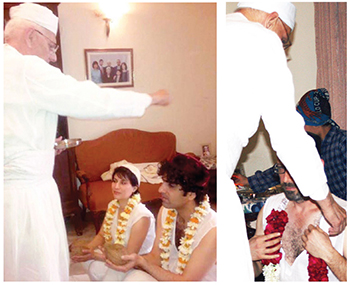
Yezad Kapadia performing the initiation of
(from l) Vista and Vanda, and George Popodupolus
George Popodupolus lives on the Greek island of Crete, along with his Muslim wife, Papatya, who is a Turkish national, and their two charming children. George was born into the Greek Orthodox Church. He studied several religions and came to the conclusion that Zoroastrianism is the most relevant one for the world of today. He expressed his desire to be inducted into our faith and wrote to several mobeds in America who were known to be sympathetic to his cause. Due to advanced age some found it difficult to comply with his request. For obvious reasons he was reluctant to go to Bombay.
When I read about his wish, I wrote to him that he could come to Delhi and we would see what we could do for him. Along with Papatya, he arrived early one morning at the gate of my residence. That very afternoon, in the presence of some of our friends, his wishes were fulfilled. He stayed for a couple of days before returning to Greece, carrying with him a bag full of literature on the religion purchased from the Parsiana Book Club.
Like George, after a lot of study, Gordon chose Zoroastrianism. One of his parents is French and agnostic, the other English and an atheist. He wanted to belong to a religion. He was inducted in Europe by an Iranian Zoroastrian priest, resident in Stockholm. Gordon is young and tours the world, teaching English. He is in close touch with the Zoroastrians of Iran. He spent a year in Delhi where he was a frequent visitor at our Anjuman, attending all the functions. He also gave a talk on his reasons for choosing Zoroastrianism to be his faith.
Vanda (from Vandidad) and Vista (from Avesta) are a young Iranian couple who spent a few years in Delhi whilst waiting for their request to migrate to America. Vista’s mother was a Zoroastrian but converted to Islam as she chose to marry a Muslim. However her deep feelings for the religion into which she was born were so intense, that she taught her daughter our prayers and urged her to get herself inducted into Zoroastrianism at the first possible opportunity. Vista also carried a copy of the Khordeh Avesta, in Farsi, with her to India. Her desire was conveyed to me. Her wishes were granted. The couple now live in California and are the proud parents of two delightful children. Vista has never forgotten the little kindness shown to her. She continues to be in touch with me, constantly updating me with photographs of her family!
Yet another person who wishes to be anonymous, who came from a region where at one time Zoroastrianism was the state religion, expressed a desire to get back to his roots. His wishes, too, were granted.
Our Parsi women married outside our faith are crying out aloud to have their children inducted as Zoroastrians. Does not our religion speak of gender equality? Why should we deny them this privilege? Our efforts should be directed towards preserving our Parsi traditions. At the same time we should aim to further the cause of our religion. YEZAD KAPADIA
Delhi
yezad.kapadia@gmail.com