Braving scorpions, nomads, soldiers and insurgents, Aspy Engineer flew over
north Africa before entering European airspace
Rusi Sorabji
Ninety-one years ago on March 21, Navroz day, Aspy Engineer, a young Parsi lad of 17 years, three months and six days, arrived in England from Karachi, flying his own plane, a tiny Gypsy Moth, accompanied by his friend Ram Nath Chawla. Engineer was to take part in the Aga Khan Race which offered a prize of pound sterling 500 to any Indian flying solo between England and India in the fastest time, provided the flight be completed within 30 days. This serialized account pertains only to how the two adventurous friends made it to England. Engineer then flew back to India solo to win the first prize. In the second instalment, the aviators had just left Egypt.
After our delayed takeoff from Cairo we cut across the Qattara depression landing in Salum (El Sollum) for the night where, to our disappointment, my flying companion Ram Nath Chawla and I were informed by the petrol agent that there were no hotels or any kind of caravanserai. However, the agent said he had some influence with the governor and might be able to persuade him to let us bed down in the Fort. That was an alternative to sleeping in the desert under the plane’s wings. It turned out to be the wrong choice. For the moment we lay down on the bare wooden beds, we were literally assailed by an army of very hungry bed bugs.
"We had no intention of taking along additional unwanted companions for the rest of our voyage, so we walked to the airstrip and the aircraft accompanied by the local gossip, our newfound guardian. This person informed us, in confidence, that the Fort accommodation provided to us had been a prison until recently, ready for ‘spring cleaning.’ We thought we’d be safer under the aircraft’s wings by covering ourselves with the new leather overcoats in the cold of the desert night, but just then our new guide and savior again confidentially whispered that our idea was, from his way of thinking, most imprudent. He was pleased to inform us of the presence of the most deadly poisonous of their species, the Salum scorpions.
"We did not tarry any longer for a goodbye or parting baksheesh (tip) to our friend but scampered into the cockpit. As he was leaving, our friend cautioned us once again to be careful as scorpions could smell and detect humans from afar and would have no difficulty climbing into our cockpit. So, digging a shallow trench in the sand around the wheels of the aircraft we poured into it some engine oil to thwart this. We awoke from our slumber nice and early but frozen.
"It was Chawla’s turn to fly and we had trouble starting the engine. It was my turn to swing the propeller. Our local friend from the previous night turned up mysteriously and offered a running commentary in pidgin English on the reasons for our predicament, ranging from the wrath of the Pharaohs to the ire of the sacred Salum scorpions. He mentioned all manner of causes except the correct one, i.e., the cold of the night. I had set the carburettor jet for hot weather operations during the day to a weak mixture which would give an extended range. I needed somebody to hold a wet petrol rag over the engine intake while I swung the propeller. I got our friend to do some useful work instead of merely gossiping and offering wrong advice.
"With more fuel in the cylinders we were soon on our way to Benghazi in Libya for an overnight halt during which we could clean ourselves up as well as the engine plugs and get some much needed rest. Next, we hopped briefly into Sirte on the way to Homs near Tripoli. Here we got lost in our search for Homs with maps that were obtained in Cairo and, as we were low on fuel, Chawla successfully attempted a forced landing in a flat sandy area from where a road led to some dwellings in the distance.
"Chawla went off in search of fuel while I took care of the engine. Hours passed and there was no sign of him. Just as it was getting dark, I noticed some stealthy movement on the horizon; a group of nomads was approaching the aircraft very cautiously. As the full moon rose higher in the sky the unfriendly nomads advanced closer to the plane. I tried to shout at them first in English and then in my broken French, but they showed no signs of friendliness and kept advancing. I rose in the cockpit and pointed my silvery torchlight at them. ‘The enemy’ withdrew in complete disorder. Just as they began to reassemble for an attack, the beams of a car’s headlights could be seen in the distance, coming towards them. Once again ‘the enemy’ withdrew in complete disorder and vanished over the horizon. I thought it was Chawla returning with some fuel, just in the nick of time, like it invariably happens in the movies, but no, in addition to Chawla there was an Italian officer and some soldiers.
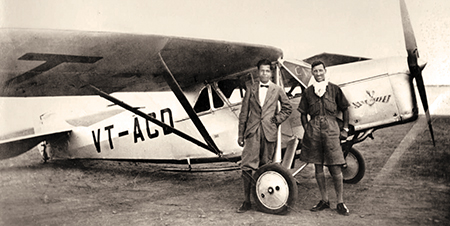
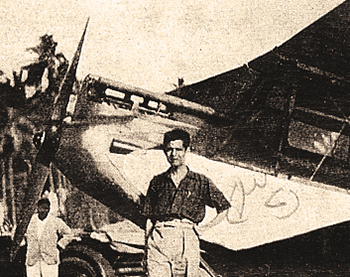
Top and above, l: Aspy Engineer with flying instructor William Jones (r)
"The Italians, from an adjoining military camp, were in search of troublesome locals and had offered Chawla a ride. After dropping Chawla off, the Italians went away in search of the nomads. On their return trip, the Italians left an armed guard for our aircraft and invited us to their fort 15 miles away for the night, offering room, rest and some camp food of cheese, condensed milk and black bread. We were the only ‘tourists’ to have been offered this great honor and were most grateful to them. After dinner they wanted us to play poker but we showed complete ignorance of the game and quickly retired for the night. Thanking and bidding farewell to the hosts the next morning, we flew into Homs which took only 15 minutes.
"Our next destination was Malta some 250 miles away. Homs, being then a part of Mussolini’s Italian Empire in Africa, caused a hitch. The authorities were checking on our suspicious entry and activities of the night before. Chawla had contacted the local authorities when he went to town, but I had had an encounter with the ‘insurgents.’ We were marched off to the police station. After the authorities contacted the Military Post where we had spent the night and we were certified as ‘friendly,’ we were declared free to leave.
"We headed northwards with all the flight and weather reports collected at the Homs port. As soon as we had crossed the blue Mediterranean, before one could say Jack Robinson, the sea turned gray with flecks of white everywhere. The plane was being tossed about like a leaf. Dark angry clouds had descended. Unknown to us we had entered an area which had been notified as having a severe storm. We were being pushed eastwards at a ground speed of hardly 60 mph. The rain pelted into our open cockpit and trickled down our necks. Despite the leather coats, we were pretty much frozen. Worried and exhausted I felt if we went any lower we’d hit the waves. No ships or land in sight. Now and then we could see a little ahead. Then, through a break in the clouds, land appeared. It was Malta! A look at the receding fuel gauge made us say a silent prayer.
"Strong winds blew the plane backwards on landing and I had to jump out to try and hold it back. Suddenly, 15 boys of the Royal Air Force (RAF) came running out and pushed the aircraft into the hangar. We thanked the RAF personnel most profusely; they had been most helpful and kind all the way. God being with us, we were destined to spend our first comfortable night in a good hotel. The next day we ate a hefty lunch and were lost to the world till it was dinner time. After a big breakfast on the third morning, while it was still raining hard, we approached Flight Control at 10 a.m. The duty officer had obtained the latest meteorological forecast indicating some improvement for the next 12 hours but it would be bad again the following day. He advised us to leave for Sicily at the soonest; the airfield at Catania was not too distant.
"The RAF mechanics had already serviced the dangerously stressed out plane and replaced or reset the sagging control wire. The refueling crew found the fuel tank bone dry. The kindly station Navigation Officer at the base provided a map up to Marseilles and worked out a course to Catania.”
To be continued