100 Legal Luminaries of India, no author stated. Publlished in 2016 by LexisNexis, 14th floor, Tower B, Building No. 10, DLF Cyber City, Phase - II, Gurgaon, 122002. Pp: 470. Price: Rs 5,995 (Hardback).
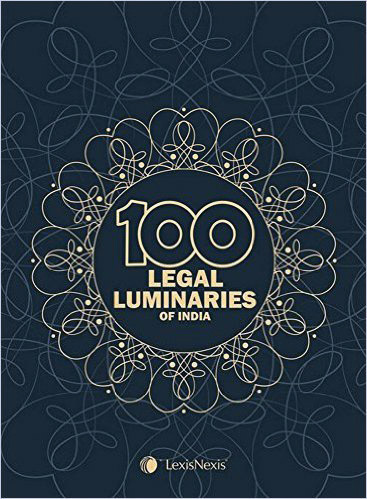
Even by the standards of vanity publication, this book will raise many eyebrows for its nakedly hagiographic tone and tenor. It purports to sketch the lives and achievements of 100 "illustrious legal minds in India” — men and women who, in the words of the blurb, "have contributed in (sic) every sphere of the society (sic).” These worthies, the blurb goes on, "(i)n their own ways…continue to bring about a just, peaceful, prosperous, happy and contented society.”
A flavor of the book’s approach can be had from the first of the 100 entries: it features an "eminent senior counsel” posing with his wife alongside his luxury car, with the car occupying nearly three-fourths of the double spread page. His eminence is described as "a thinker, a philosopher and a lawyer” who offers this pearl of wisdom: "Everybody should be allowed to pursue what they like — as long as they are doing it with dedication and devotion and not resorting to shortcuts for quick gains.”
Another luminary featured in the book offers the boast that he "was the most eligible bachelor” in his community before he got married at "the early age of 23.” The same lawyer became better known in 2012 for a less worthy reason, namely of being the chief protagonist in a video involving sexual activity of a rather lurid kind, but the book rather coyly avoids any mention of it.
It would be impossible, of course, for a book on Indian lawyers — leading or otherwise — to not include Parsis, and this book does not fail on that count. But readers of this journal are likely to be disappointed (assuming that they take this book seriously) that only four Parsi "luminaries” feature in it: Fali Nariman, Soli Sorabjee, Tehmtan Andhyarujina and Zia Mody. Mercifully, the write-ups on all four are relatively sober and free of the outlandish language used in most of the other entries. Even so, discerning readers will wonder why these four stalwarts agreed to lend their names — and thus a degree of respectability — to this rather dubious enterprise.
Modesty clearly is not a leitmotif of this work. Many of those featured are very willing to unburden themselves of their claims to greatness. Sample this statement from a "legend of the Indian legal firmament”: "The turning point for the Indian legal profession came in 1997 when I chaired the International Bar Association conference in New Delhi”; or this from another who is currently the Minister for Law and Justice in the Indian government: "I am (sic) a first class first till MA (sic).” Many of the entries refer liberally to fame by association: being the son of a former government minister, daughter of a former attorney-general, or even having a famous client ["(F)or over 20 years,” says one luminary, "Aamir Khan has been my client and I do all his legal work. Salman Khan is also my client” — the two Khans being well-known Bollywood stars, for those who may not be keen followers of the popular Press].
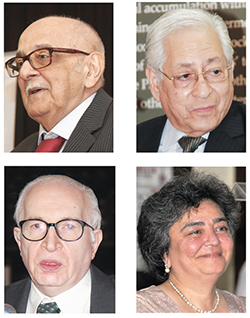
Clockwise from top left: Fali Nariman, Soli Sorabjee,
Zia Mody and Tehmtan Andhyarujina
Little expense has been spared by those behind this publication in indulging the luminaries with photographic props of their choice whether it involves them posing in a gym, on the golfing green, on a badminton court, with their dogs or their extended families, in front of favorite gods or god-men, before a home bar, leaning on a billiards table, clutching musical instruments or performing yoga. One worthy has even chosen to pose in front of a plaque testifying to the inauguration (by someone else) of a building, another against the backdrop of an industrial crane, and yet another in the act of chopping a vegetable! And as can be expected of a project of this kind, there are multiple images of those who "conceptualized and created” this tome.
We are told that the book even had a "mentor,” one of whose main claims to fame is as a leading light in an organization of local lawyers which has been at the forefront of the pushback against the opening up of the Indian legal profession to foreign lawyers and law firms in recent years. His visage, of course, adorns many of its pages (including as one of the 100 luminaries!). He is said to have "edited each and every word” of this bulky volume though it is not clear if his brief extended to checking grammar, syntax or even basic factual accuracy (his own, rather extensive, entry abounds with errors that would make a grammarian blanch).
Publications such as these raise many disturbing questions, not only about the state of legal professional ethics in India and the capacity of the regulatory authorities to deal with the extensive rot that has set in over the years, but also about the judgment of reputed publishers such as LexisNexis in the matter of lending their names to books such as this one. Unless the latter wake up to the reality of the serious harm that association with such questionable projects can cause, it will not be long before they see their reputations suffer irreparable damage.