A sepia-toned look at New Year celebrations in Agra
Rusi Sorabji
Prior to the Internet making the countdown to the biggest Zoroastrian festival, Nou Rooz, simple, it was quite different in the 1930s when our family went to Agra to celebrate Nou Rooz with our Irani maternal grandparents, aunts and uncles and had to await the arrival of a telegram from Iran to intimate us of the precise time and date of the occurrence of the equinox i.e. the exact moment when to greet the new day, Nou Rooz. The telegram also mentioned something that we never clearly understood, the name of the animal Jamshedi would be riding and the color associated with Nou Rooz.
Those few Nou Roozs that we spent in Agra were celebrated with a lot of ritual, unlike the ones we experienced during the rest of our lives, in Delhi, Bombay, Calcutta, Nagpur, Gwalior, Dubai, England, Germany, Canada or in USA.
My maternal grandfather was an Irani Zarathushti whose granddad, Bomas Khodadad Irani moved to India in 1859 because of religious persecution in Iran. The jolly old soul was a senior electrical engineer bestowed with a tremendous sense of humor like my father. My father was born a Kadmi Zoroastrian, but no sooner the religious man discovered the discrepancy in the Kadmi and Shahenshahi calendars generally followed by the community in India, both of which were not in harmony with nature because of miscalculations over nearly a millennia, he adopted the more accurate Fasli calendar — a calendar where the first month, Fravardin, commenced on March 21. Since my maternal grandmother was raised as a Shahenshahi and so too my mother, they followed the Shahenshahi prayers and the calendar. For them the calendar showed Nou Rooz falling in September. So here was a Zarathushti family harmoniously celebrating Nou Rooz with the Shahenshahis in September, with the Kadmis in August, and the real one at the time of the actual vernal equinox on or about March 21.
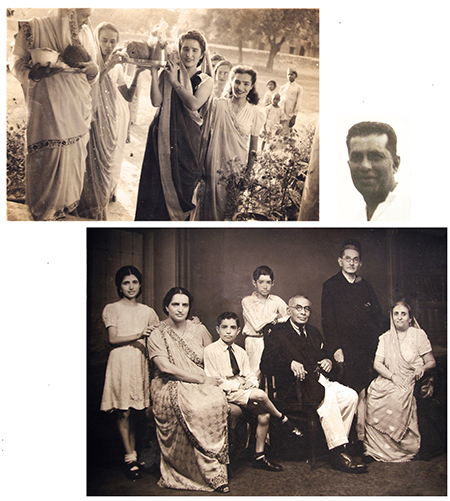
(Clockwise from top): Ladies of Agra at engagement ceremony; father Ruttonshaw;
Sorabji family with Rusi (4th from left), mother Kumi (2nd from left)
(Above, l): Early morning bicycle rides; morning picnic; Phus Walli Kothi, Agra
Grandmother (centre) with two successive generations circa 1950
During the 1930s-40s, in this Fasli Irani/Kadmi/ Shahenshahi Sorabji family of Delhi the excitement for Nou Rooz was usually ignited in us children with the start of the 15-day-long Christmas holidays at school. It was a fortnight of joyful excitement beginning with the pampering of loving grandparents; playing with aunts and uncles a year or two older; the prospect of receiving multiple gifts on Yalda, Christmas, New Year; and not forgetting rare Irani food, fruits and sweets. Yalda seemed to be the kick-off celebration to welcome Nou Rooz in three very fast disappearing months.
No sooner Sadeh (the midwinter festival) was over, preparations for spring cleaning had to be taken up on a priority basis. Advance notice, followed by reminders were given to the landlord of the building to get the annual white washing and painting of the house completed before the end of February. Indoors, furniture as also brass and silverware used in ceremonies had to be polished or refurbished, mattresses had to be reconditioned with the cotton wool fluffed out. Summer clothing was taken out of storage and given for washing. New clothes, hats, shoes and school bags had to be purchased. Orders were placed at stores in Bombay for timely delivery of new kustis for the family, sandalwood and frankincense, wicks for the divas, sweetmeats like suterfani, and snacks like wafers, batasas, nankhatai and mava-na-cakes.
The tempo built up into a frenzy as the Fasli muktad and Gatha days approached when prayers and religious ceremonies would be performed in remembrance of the departed souls and everyone partook of the chasni (consecrated food items) prepared by grandmother and the other ladies. As part of the religious drill, children had to memorize the names of the five Gatha days as also the names of the days and months as per the Zoroastrian calendar.
Post lunch saw more excitement during the Gatha days when children would be taken to the market for Nou Rooz presents even though there were only two toy shops in Agra Cantonment, Cheap John and another. Among our most treasured gifts from Grandpa before he left for Iran, never to return, were the Swiss wrist watches bought from Norman and Company owned by Nariman Mistry in the Saddar area. His daughter Dhun Khambatta is the last of the surviving Parsis from the 1930s. Yet another was The Navjote book of Prayers by grandfather’s cousin Dinshaw J. Irani.
The night of the Vahishtoist Gatha always found the ladies in a last minute rush to make sure things were in place on the Haft Seen table to celebrate the creation of life and the arrival of spring. A frame of Asho Zarathushtra with a bunch of tulips and fragrant hyacinths, the Khordeh Avesta, a divo in front of a mirror to reflect light, an afargan with some half burnt charcoal, sandalwood, frankincense, a bowl of water with a live or imitation gold fish to represent the animal world, a small plate with gold coins called "sick-kay” in Farsi were mandatory items on the table. The sick-kay were gold British sovereigns worth about Rs 21 at that time. These were given as presents to the elders in the family while the youngsters got toys.
There were additionally seven crystal bowls bearing symbolic items starting with ‘seen.’ The Haft items that started with the letter ‘s’ or Persian letter ‘seen’ were: apples, rose water in a silver sprinkler, green wheat sprouts, rock sugar (sakar) and candies, eggs with colorful designs, red wine or Scotch, malido (the ultimate sophistication of Parsi sweet dishes which was a near substitute for the Persian samanu, both made with wheat).
The original significance of the seven bowls was to represent the "seven eternal laws of nature” based on Zarathushtra’s teachings of Vohu-mana or Bahman (good mind), Asha-Vahishta or Ardibehesht (absolute truth), Kshathravairya or Shahrevar (good rules), Spenta Armaiti or Spandarmad (righteousness), Haurvatat or Khordad (perfection), Ameretat or Amardad (immortality) and Ahura Mazda (the creator).
Each year the senior ladies from the Irani family would decide on a theme for the arrangement of the Haft Seen table and for decorating almost every nook of the bungalow. All entrances to the bungalow bore colorful chalk designs, doorways had new colorful torans, some of which were made by mom and aunts during the year. All religious pictures had a garland. Photo frames of the dear departed arranged on a table were surrounded by fresh flowers. Other items on the table for guests to enjoy used to be fruits and nuts of seven kinds but a pomegranate was a must, with sev/ravo, gaz, bhakhras, batasas and little wine-cakes.
As the equinox hour, minute and second specified in the telegram approached, the entire family in their new dresses with a damp tilo on their forehead gathered around the table. With 10 seconds to go, all of us would commence the count down and bedlam broke loose as we all shouted "Nou Rooz.” Then started the greetings, the hugging and kissing, giving of gifts, prayers and the feasting. Before the feasting, but at the end of the prayer all of us from the eldest to the youngest, added a stick of sandalwood and a pinch of frankincense to the fire in the afargan while reciting an Ashem Vohu and fanning the fragrant smoke towards oneself.
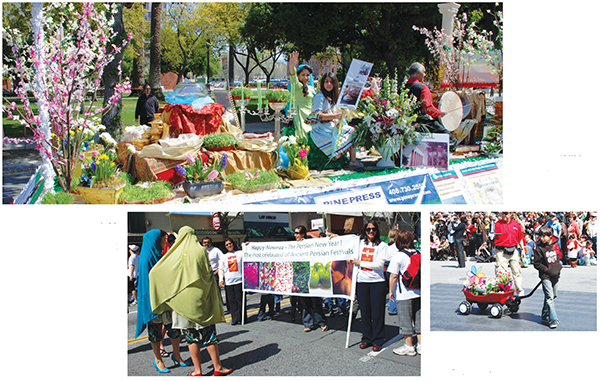
Nou Rooz Parade in San Jose: biggest Haft Seen table as a float and on a pushcart
Soon a stream of friends would arrive one after the other, bearing gifts and little boxes of sweets, sweetmeats or dry fruits. Agra then had a large Parsi population. It seemed like there were over a 100 visitors that day. The out of town tourists staying in the Parsi Dharamshala were special invitees to the festivities.
In the evening a procession of Parsis would head to the Agra Water Works on the banks of the river Jamuna by cars and horse drawn tongas for the community dinner to celebrate Nou Rooz with traditional ceremonial Parsi food by gas light under the stars.
Further festivities
Nou Rooz was followed by another 11 days of festivities including outings, movies, picnic, moon light visit to the Taj Mahal, a day’s visit to Fatehpur Sikri, the capital city that Emperor Akbar built, to Sikandra, Akbar’s tomb upon which once hung a gold chandelier donated by our ancestors Bomanji Khodadad Irani and the gold embroidered chador covering his grave donated by Khan Sahib Pestonji Batliwalla of Agra.
The sixth day after Nou Rooz was observed as Khordad Sal, the birthday of the Prophet. Another day of celebration, starting with a jashan performed by the elders by the river to teach us to venerate "nature in all its splendor.” Lunch was invariably dhan dar, gosht-no-patio, tamota-per-eeda, tareli machhi, and ravo, with some guests, and dinner was at some friend’s place.
Most of the outstation guests went back to their hometowns the day after Khordad Sal. The 11th day after Nou Rooz was always a picnic by the river Jamuna. The gold fish was released into the river and the flowers that had adorned the home were offered there as well. Next day, sadly it was our turn to return to Delhi, to school.
What we missed most was grandfather and his brothers reciting the Shahnameh during Yalda, Sadeh holidays and those boisterous count-down evenings to Nou Rooz. They would be reciting the Shahnameh from memory while sitting in a circle sipping Irani style tea in small two- inch glasses. After sundown the tea glasses were replaced by wine glasses. At times, while reciting, they would seem to go into some kind of a trance and a few moments later they’d be wiping tears that were rolling down their cheeks.
I often wonder now whether it was the wine sipping or the "sulemani” tea sipping during the Shahnameh recitals in the past that ultimately gave birth to the once very popular Irani tea restaurants all over the old Bombay province and in Iran once tea arrived there via the Silk Road.
These holidays enlightened us about our religion and added light, love and gratitude in our lives. Life moves on, but our shared rituals keep us connected.
Now a resident of California, probably the largest, most beautiful Haft Seen ‘table’ I have ever seen was the tableau that The Persian Zoroastrian Organization (PZO) of the Bay Area and other Iranians had organized a few years ago as part of the Navroz Parade in San Jose, California.
All the traditonal settings/items were there with the understandable exception of a glowing fire, picture of the Prophet, and a prayer book.
Instead of the open burning fire that is prohibited by law in public places in California, were two silver candelabras with four tall unlit candles each in front of the mirror. For reflection of light off the mirror, we had the largest heavenly source doing the job.
Colorful tulips and hyacinths were amongst the floral display. It is a little known fact that these beauties have their ethnic roots in ancient Persia. They were taken to Europe via the Silk Road via Turkey. Another item for the Haft Seen table with ethnic roots in ancient Persia is the apple "seeb.” Cherry and peach blossoms were spread on the rear end of the float. The prayer book was substituted by a book of poems by the famous poet Saadi.
The flower bedecked floats reminded the thousands of folks in vibrant dresses to greet one another on this only True Earth Day. I look forward to the day when all adherents of the Zarathushtrian faith come together aligning their calendars to bring in the Nou Rooz at the vernal equinox and remember their Prophet on his birthday six days later.