Doctor Steel: My Life and Times with THE TATAS by J. J. Irani. Published in 2023 by Penguin Random House India Pvt Ltd, 4th Floor, Capital Tower 1, Mehrauli Gurgaon Road, Gurgaon, 122002. Pp: 131. Price Rs 699.
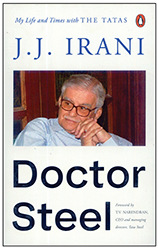
With a career at Tata Steel spanning over four decades this memoir of J. J. Irani, who deservingly earned the title of Doctor Steel, is bound to make interesting reading. The book Doctor Steel: My Life and Times with THE TATAS is a result of his conversations and interviews with N. K. Sharan, senior vice president, Tata Business Excellence Group, Tata Sons. As he justifiably mentions in his Introduction to the book, the talks "offer a rare insight into Dr Jamshed Irani’s life, as a person, as a CEO (chief executive officer), as a friend, as a technocrat and as a leader.”
Irani never set out to write his memoirs; he merely penned his thoughts on various matters as and how they occurred to him, not in chronological order. In fact, when his life was suddenly cut short by the pandemic, his wife Daisy (née Siganporia), found on his desk among his papers several points he had jotted down and which he planned to include. She said, "He wanted to write about his long association with Russi Mody, Ratan Tata and especially about family members to whom he was very close. However, we had no option but to go ahead with what he had already completed.”
The book has been divided into three parts, the first being his "formative years and journey to Tata Steel.” Irani came from Tata stock. His father Jiji worked for the Empress Mills in Nagpur which started its operations around 1877 when Queen Victoria became Empress of India. Jiji was supportive and affectionate but did not spare his son for any misdemeanor. Once, when Jamshed hit a friend on the legs with his prized cricket bat of which he was very proud, his father took him to the friend’s house and made him apologize for his unseemly behavior. He then made Jamshed offer the cricket bat to his friend as a token of reconciliation. Years later, Jamshed took his son Zubin to task and even "hit” him for angrily pushing his sister, causing her to fall and fracture her arm.
Jamshed reminisces about his first overseas trip after he had completed his matriculation examination. It was organized by the Young Men’s Christian Association (YMCA); the cost for the 100-week long trip was Rs 5,400 (USD 65) all inclusive. When he inadvertently forgot his camera on the train, he was full of appreciation for the Swiss who returned it. But he was peeved with the chief of the YMCA who had accompanied the group and kept "the young boys away from the nightclubs in Paris.”
After studying geology at Nagpur University, Irani received a scholarship from the J. N. Tata Endowment Fund and left for further studies at Sheffield University in the UK. So outstanding was his performance that when reports of the students who had been granted scholarships were sent to J. R. D. Tata, he wrote a remark against Irani’s name: "If ever this young man wishes to come back to India, he should first knock on the doors of the Tata Iron and Steel Company.” On returning, Jamshed did join Tata Steel. He was initially disappointed with his duties but thanks to JRD’s intervention was placed as an assistant to the general superintendent. Jamshed speaks of JRD with great affection, admiration and respect for his principles and concern for others. He narrates an incident when one night JRD endured the extreme cold of an air conditioned room but did not want to wake up a bearer who had been assigned to serve him.
On the personal front, things were progressing well and Jamshed married Daisy and started a family. He speaks of Daisy with great affection; she complemented him as he was reserved, rather withdrawn and generally lacking warmth in his communication with others. This was an area in which Daisy excelled; she helped him to become more approachable on account of her congeniality.
Dr Jamshed Irani (above, l) with mentor J. R. D. Tata and (far r) with Lalu Prasad Yadav
Jamshed and Daisy with children (above) and grandchildren (above, r)
The second part of the memoir deals with the building of Tata Steel. Though one may not understand the nitty-gritty of bar and rod and cold rolling mills, one can appreciate Jamshed’s dedication and perseverance in modernizing the plant at a time when the industry was under very strict governmental control. To ensure that he would get his own way to achieve this end, Jamshed occasionally used ingenious means. He required Japanese technicians to come to Jamshedpur but was aware of their reluctance to visit and reside there. He knew that the Japanese were fond of golf and this was an expensive indulgence in Japan. So he created a golf course to induce them to stay. He even had chefs trained in Calcutta so that the Japanese technicians got the food they wanted. When tragedy struck, he showed great empathy and concern for the individuals and ensured that they were taken care of.
On becoming president of the Confederation of Indian Industry (CII) he met Queen Elizabeth and Prince Charles on different occasions. He received the KBE (Knight commander of the British Empire) for his efforts to cement Indo-British relations. He also encountered Russian President Boris Yeltsin, German Chancellor Helmut Kohl, Prime Ministers Indira Gandhi, Narasimha Rao and Dr Manmohan Singh and even had dinner with the former US President George Bush, senior. Jamshed was equally comfortable spending a day with Mother Teresa when she visited Jamshedpur. He had a remarkable relationship with former Bihar chief minister Lalu Prasad Yadav whom he identified as a potential political leader when Yadav was merely a student. This friendship has been described with great warmth laced with genuine affection and respect.
At the end of the book, Jamshed lists his achievements and acknowledges his shortcomings. He regrets that he neglected the role of women and should have done more to empower them.
The most important lesson he had learned on building a team is through "credibility.” "It will take you years to establish and it can go in the blink of an eye.” It is this credibility that earned him the sobriquet Doctor Steel.
FIRDAUS GANDAVIA
Gandavia holds a doctorate in English literature and is a retired chartered accountant. He is a compulsive reader of fiction.