Minimizing conflict and resolving contentious issues would
help build the Zoroastrian brand equity
Parinaz Gandhi
"The old maxim of ‘Parsi thy name is charity’ has now become ‘Parsi thy name is controversy’... And controversies are created by people ill equipped to comment on religion,” stated Sam Balsara, chairman of Madison World, an advertising and public relations group of companies, in his talk "Using Marketing and Media to build the Global Zoroastrian Community” at the 11th World Zoroastrian Congress (11WZC) in Perth on June 3, 2018. Different speakers on the third day of the Congress advocated building, strengthening and galvanizing the community to create a cohesive unit.
"Before building an image of the community, we need to ensure that all is well within the community,” Balsara added. To promote a better image of the community, every member should realize that "it starts with me — do good, be good.” Even the forwarding of wrong WhatsApp messages spreads mistrust, he pointed out. To improve the community image, Balsara recommended different measures starting with the appointment of a brand manager with a defined set of tasks. He was in favor of appointing a brand ambassador who would epitomize what a Zoroastrian should be as also a public relations agency in each territory to suppress the negative image drivers and augment the good, charitable actions. The community should create a mechanism which would chide those taking actions which are not in consonance with Zoroastrian values and publicly acclaim those who are doing good, he recommended.
There is an "overdose of community organizations arising out of personal disagreements,” he noted. The organizational structure should be along democratic lines with frequent change of office bearers who put community work before self pride. According to him, "adult franchise has not been a boon to the community,” and he was keen that leaders of stature should constitute a strong executive wing and display transparency and open communication lines.
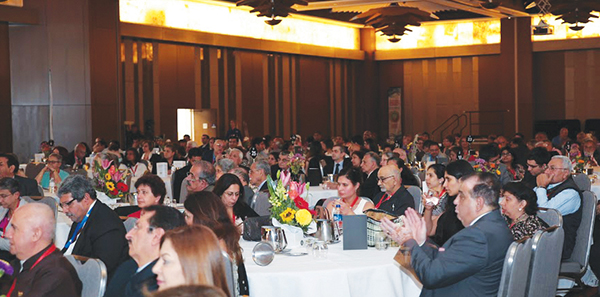
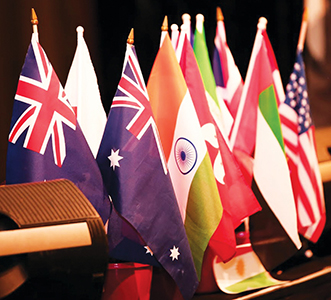
Top: Flags of nations represented at the 11WZC; above: audience in attendance on the third day Photos: 11WZCperth.com.au
Rohinton Rivetna (l) and Sam Balsara
Yazdi Tantra (l) and Xerxes Dastur
Dinshaw Tamboly (l) and Malcolm Deboo; below: slide showing aid extended by WZO Trust (l);
Zoroastrian Trust Funds of Europe partners with local organizations for the exhibition bus to remember
the 1.4 million Indian soldiers who fought in World War I
Dr Farhad Contractor (l) and Dr Keki Turel
Observing that entrepreneurship has taken a backseat, he urged the community to be less risk averse and to not follow the path of least resistance. Those who earn "a global degree that results in a plum job” are not interested in entrepreneurship, he commented. "The World Zarathushti Chamber of Commerce (WZCC) needs a more aggressive plan to create 500 new entrepreneurs in the next five years,” he advocated. Keep two percent of one’s post taxable income for charitable purpose – half for Zoroastrian causes and the other half for the general society, he recommended. Good values and education should be instilled in the youth for that will play a "key role in determining what they will become.”
Demographic decline is of greater concern to the Government of India that has introduced the Jiyo Parsi program than the community itself, he commented. Health programs should be geared to accommodate less fortunate Zoroastrians left in vulnerable positions.
"Zoroastrians have taken the words of the song Que sera sera (What will be, will be) too literally. In this fast paced world where nano seconds matter, you cannot take this stance. Teach children to compete and cope with stress. If you take the right steps today, it will increase the probability of success tomorrow.” In a lighter tone he shared the new lyrics he had penned for the song: Que sera sera/ it’s not how it used to be/… for the future you plan to see/each should take personal responsibility/to build brand equity.”
"Zoroastrians as bridge builders in the interfaith world” was the subject of Rohinton Rivetna’s talk. Past president of the Federation of Zoroastrian Associations of North America (FEZANA), Rivetna noted, "Dialog leads to understanding. Understanding creates respect for each other’s faith. Respect will bring peace to the world.”
According to him, "We mingle easily with members of other faiths because of our respect… We have learned to live as a minuscule minority and a lot of the time we even thrive. Our greeting epitomizes our respect for all: Hamazor Hama Asho Bad (Together in strength, together in righteousness).”
In the community’s favor is its non-proselytizing attitude: "We work with no self interest, We are not an ‘exclusivist’ faith, we do no work with missionary zeal. We do not claim to be the sole possessors of the ‘Truth’. We claim no superiority. We consider all faiths of equal magnitude.”
In a world where people of all faiths live as neighbors, "we do not display our identity obtrusively, but choose to assimilate and adapt to the prevalent culture and customs while maintaining our faith, traditions, and identity,” he observed. Rather than create a wedge we prefer to see peace in this troubled world and do not keep alive memories of atrocities suffered in the past.
He noted that at the navjote ceremony, the initiate recites the Fravarane or Declaration of faith that professes fraspayaokhedhram — put an end to quarrels, nidhasnaithishem — sheath the sword or lay down weapons and work for peace, khaetwadatham — self sacrifice and service, ashaonim — promote truth and righteousness.
Strife, hate and war are rooted in religious and ethnic intolerance. "Humankind’s most urgent task is to build bridges of understanding among faiths, and engender respect and harmony. Petition the United Nations to establish a religious arm of the UN,” he said, urging the gathering to sign the petition on
www.UNReligiousArm.org Networking and risk taking
"The need to connect socially is a psychological need; whilst it enhances one’s sense of identity it also results in greater happiness,” summed up Yazdi Tantra, director of On-Lyne Comtech (India) Private Limited, in his talk on "Bringing Zoroastrians Together using the Power of the Internet.” He believed that connections are required for "unity, strength and survival” for a community reputed for its positive attributes of honesty, integrity, sincerity, hard work, laughter, wisdom, charity, love for food and cars as also its negative qualities of being opinionated, argumentative, selfish and divisive, low level of religious knowledge.
Referring to the different portals he has created, he mentioned that connectivity at an individual or personal level could be attained through TheParsiDirectory.com, TheParsiFamily.com and TheParsiMatch.com. Connectivity for social and cultural resources could be sought through Zoroastrians.net and TheParsiInstitutions.com. Business and professional connectivity is possible through wzcc.org. TheParsiDirectory.com has 82,000 listings from across the world that can be searched by name/profession or location. It offers opportunities to "make new connections, revive old ones and connect with the community.” The Parsi Family.com provides a daily sms (short message service) for those in India, and a WhatsApp service for those overseas, giving news of uthamna and other community events to over 7,000 subscribers. TheParsiInstitutions.com lists agiaries and dharamshalas, associations, religious societies and baugs.
He specified that Zoroastrians.net that brings "Parsis/Iranis, Zarathushtis all under one roof,” provides opportunities to explore books and scholarships, missing Parsis, matrimonial choices, calendars, prayers, rituals, songs, business and philanthropy. The most important asset of the websites created by him are: "free use, independent of any organization, free of controversy and available for the global community.”
"The risk taking appetite in the community has drastically reduced,” observed chartered accountant and now a Bombay Parsi Punchayet trustee Xerxes Dastur in his presentation on "The Age of Entrepreneurship in the Age of the Fourth Industrial Revolution.” He advised the community to "think big, start small and act fast,” whilst assuring them that "working for yourself is satisfying.” After the initial launch, an entrepreneur needs to retain his/her ambition to succeed and to grow. According to him, 60% of all companies are single generation companies. Limited liability partnerships and one person companies with one director and one nominee are becoming increasingly popular as they require minimal compliance with regulations.
"The entrepreneurial journey has been simplified by the Government today. Under the Startup India project there are free online learning programs available. The Make in India incentives include access to potential partners and funds. As compared to the license raj, e-returns and e-filing has simplified processes for businessmen. "If the Government of India has woken up to provide incentives, it is up to us to avail of them…With elections coming up in 2019, the Bharatiya Janata Party will make more business friendly plans,” he was confident.
"As a community we don’t share enough among ourselves… Let us build bridges. We risk being too cosmopolitan for our own good. We have a network in place. Let us promote our friends and fellow comrades, empower youngsters,” he urged. India has the youngest working population as compared to China that has a greying population. Whilst conceding that launching a business is not "easy sailing, most have failed before being successful,” he made a plea, "But please try.” He referred to the youth networking session at the 11WZC that showed that three individuals on each of the five tables were doing business and they wanted to continue. They have succeeded despite odds. Coffee with WZCC (World Zarathushti Chamber of Commerce) is another endeavor that serves as an informal support group for those who are facing issues when running their business or pursuing their jobs. "The current titans will be confronted with new options. It is a constantly evolving journey,” he cautioned.
Extending alms and lifting arms
"In keeping with our policy that the dignity of beneficiaries should always remain inviolable… we evolved a strategy to rehabilitate those affected,” stated Dinshaw Tamboly, chairman of the WZO (World Zoroastrian Organisation) Trust that has been pursuing a line of action for the uplift of economically disadvantaged Zoroastrian agrarians. Those who opted to pursue farming were made to undergo training in modern farming techniques at the Tata Marginal Farm Training Institute in Navsari and then provided inputs. The understanding was that they would reimburse the Trust once their earnings improved. Those who preferred to be self employed were given interest free loans up to a ceiling of Rs 6,00,000 per applicant repayable in 40 equated monthly instalments.
Tamboly’s talk "Charity and Philanthropy” outlined how in the last 25 years they have provided self-employment opportunities to 1,090 individuals at 116 locations at a cost of Rs 18,79,07,043 (USD 2,738,177); assisted in the rehabilitation of 489 farmers, expending Rs 6,59,15,308 (USD 960,516); and converted 272 huts into brick and mortar cottages. A short film demonstrated the work undertaken by WZO Trust in village Zavda in Gujarat to ameliorate the condition of 14 Zoroastrian families that were able to progress from abject poverty to relative prosperity. One of the ladies featured in the film earlier had a daily income of Rs 20 before the Trust came to her aid, he said.
Among the other activities undertaken by their Trust are providing medical support in times of illness and hospitalization, encouraging the youth to pursue higher education, providing financial support to the elderly, infirm and handicapped, constructing economy housing in Navsari by redeveloping old, dilapidated houses gifted to the Trust, running Senior Citizens facility in Navsari, supporting full-time mobeds and running a sanatorium in Sanjan.
Acknowledging the "support extended by generous donors, both individuals as well as institutional,” Tamboly named the Zoroastrian Charity Funds of Hong Kong, Canton and Macao, FEZANA, Pervin and Jal Shroff of Hong Kong, Scylla Vatcha and Homi Bhabha from their Bai Maneckbbai P. B. Jeejeebhoy Deed of Settlement Fund and the Tata Trusts.
With 2018 being the centenary year of the end of World War I, Malcolm Deboo, president of the Zoroastrian Trust Funds of Europe, remembered the "Zoroastrian sacrifice and contribution to Great Britain and Empire in World War I.” According to him "World War I affected every part of the globe... when over five million perished...over four million were either taken as prisoners or declared missing and over 12 million were wounded.”
There were 563,369 members of the Indian Labour Corps among whom were many Zoroastrians who served the British as support staff during the War years. The many who did not return have been immortalized with their names engraved on the cenotaph at Khareghat Colony in Bombay. The 1921 census was also the first census in India since its introduction in 1881 when the Parsi count showed just a marginal increase as compared to the previous and subsequent decades.
In the call to arms, there were many Zoroastrians who volunteered. Deboo "randomly selected” a few officers whose accomplishments he summarized: Maj Dr Ratansha Kapadia, Capt Phirozshah Bharucha, Capt Heerajee Jehangir Manockjee Cursetjee, Capt Firoz Chinoy, Dr Sorab Warden, Dr Lowji Modi, Dr Jehangir Canteenwalla and Sergeant Karesasp Naoroji.
Civilian support came from many: The B. D. Petit Parsee General Hospital used to treat the war wounded. Lady Frainy and Sir Dhunjibhoy Bomanji too opened the doors of their Windsor property to treat the wounded. The Tatas sent high quality steel to Britain from Jamshedpur. "Whenever opportunities have arisen, we have served,” said Deboo.
Order and disorder
In 2018, as many as 240,000 women across the world will be diagnosed with breast cancer causing the death of 40,000, stated breast cancer specialist Dr Farhad Contractor of Los Angeles. Unlike the populations in India and China, the developed countries account for a high, 26%, incidence of breast cancer. It is the second most common cause of death among women in the US. The prevalence is high in the Zoroastrian community too with one out of five women being at relative risk as compared to one out of eight in the general US population.
While being a woman is a risk factor, so is advancing age. Every 10 years the risk of getting breast cancer doubles. The other major risk factors are family and personal history of breast cancer, high risk biopsy (when inserting an instrument for biopsy, there is risk of dislodging a tumor cell that may lead to metastases), chest wall radiation (women who received a higher dose of radiation to the lymph nodes in the neck, chest and armpits were at a 24 times higher risk than the average), and two gene mutation [many inherited cases of breast cancer are associated with two genetic mutations: BRCA1 (BReast CAncer gene one) and BRCA2 (BReast CAncer gene two)]. Some of the minor risk factors are early onset of menses, birth of first child after 30 years of age, and more than one ounce of alcohol consumption per day.
The screening guidelines he recommended were monthly self breast examination from age 20, annual clinical breast examination from 30 years and annual mammogram from 40 years. While a 2D mammogram is accepted, a 3D mammogram is preferred. In the case of mammogram reports, 90% are negative. Of those which fall in the balance 10%, a good number, 70% will be negative, 15% will be advised a biopsy and 15% will be recommended a short-term follow-up. A breast biopsy helps diagnose a suspicious mass, calcifications and enhancements. An ultrasound can differentiate solid and cystic mass. A breast MRI (magnetic resonance imaging) has a three times higher detection capacity than a mammogram. Depending on the size of the tumor, the line of treatment could be surgery, radiation, hormonal medication or a combination of these.
"The Enigmatic Brain — the Order and its Disorders,” was simplified by neurosurgeon Dr Keki Turel. The brain constitutes two percent of the body weight and is "the master conductor,” coordinating 37 trillion cells in the human body, 60 million sensory receptors and generating 60,000 thoughts per day, he noted. The 127 million retinal cells in the eye allow us to distinguish 10 million colors. One thousand olfactory receptors permit us to distinguish 50,000 smells. Human fingers can feel objects as small as 13 nanometers (one nanometer is a billionth of a meter). Taste buds are replaced every 10 days.
When awake, the human brain produces enough electricity to power a small light bulb. The left side of the brain does nothing right; and for the right side, nothing is left. Where the left side of the brain is dominant, individuals show proficiency for languages, science, mathematics. Among those where the right side is dominant, creativity, arts, imagination and holistic activities come easily. The thinking and speech functions are controlled by the frontal lobes, shapes by the parietal lobes, hearing and memory by the temporal lobe and sight by the occipital.
Cranial surgery helps in case of head injuries, skull growth defects and deformities, hydrocephalus when there is excess fluid in the brain, brain tumors, strokes, epilepsy, Parkinson’s and other involuntary movement disorders. Turel referred to the night of terrorist attacks in Bombay on November 26, 2008 when 70 patients with bullet injuries were brought to the Bombay Hospital and their team performed surgeries for 27 hours non-stop. "Time is crucial to save the brain,” emphasized the neurosurgeon who does not charge priests, teachers and widows, saying 30% of his patients are given free treatment.
More than financial returns, the most rewarding moments for a doctor, said Turel, are "the cry of a newborn baby, the waking up of a comatose patient, the heartbeat after resuscitation, recognition and appreciation from the patients, when the poorest of the poor give a box of sweets, or when a youngster says ‘I want to become a doctor like you.’”
The concluding report on the 11WZC proceedings will appear in the next issue of Parsiana.