Markar Museum
Visitors to Iran who want to understand the culture and customs of ancient Zoroastrians are directed to the Markar Museum in Yazd owned by the Tehran Zoroastrian Anjuman. The Museum of Zoroastrian History and Culture has been established in a restored orphanage and school on Marker Square built in the early 20th century by the revered Parsi philanthropist Peshotan Dosabhoy Marker of Bombay.
Created by Dr Esfandiar Ekhtiyari, the Zoroastrian representative on the Iranian Majlis, the Museum in an 84-year-old mansion has an array of exhibits and mannequins that give insights into Zoroastrian ceremonies, rituals, traditions, art, clothing and food. The grounds are beautiful and employ new techniques to water the olive trees in the garden to save water. The courtyard contains an ab anbar or traditional Persian drinking water reservoir. Another interesting feature is the gowroe where a cow draws a water bucket by moving up and down steps. Local Zoroastrian docents guide visitors around the precincts and answer their queries.
The four-year-old Musuem plays "an impressive role” in Yazd, according to Ekhtiyari who officiates as its manager. Pleased with visitors’ feedback and comments, Ekhtiyari’s email responses to Parsiana mentioned that the Museum attempts "to show all aspects of Zoroastrianism and to answer tourists’ questions about our religion.”
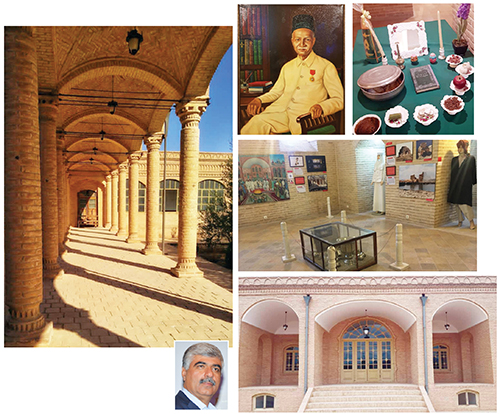
Peshotan Marker (top row, center); exhibits and exteriors of the
Markar Museum in Yazd; inset: Dr Esfandiar Ekhtiyari
"The kaleidoscope of culture and customs… is like stepping into wonderland,” commented Darayush Zainabadi, administrator of Sazeman-E-Jawanan-E-Zartoshty-E-Irani (Iranian Zoroastrian Youths Organisation of Bombay) urging Zoroastrians from India to visit it on their next trip to Iran. The cost of this Museum was reportedly borne by the philanthropic family of the late Shahjahan Godarz. Hitherto it was the clock tower at Marker Square that stood testimony to Zoroastrian munificence. Around the tower are inscriptions in Farsi by Persian poet Ferdowsi.
To Zoroastrians in Iran, Peshotan Marker is a legend. As recalled by the well-known Pakistani diplomat Jamsheed Marker in the first issue of Hamazor (published quarterly by the World Zoroastrian Organisation), his grandfather’s brother Peshotan was a bachelor of spartan habits, "an earnest, kindly old Parsi gentleman, impeccably dressed in a buttoned up dagla, coupled with a grey pheta placed with geometric precision on the dead center of a white-haired head. The image persists to this day as Pestonjee Kaka never seemed to get either older or younger.”
His association with Zoroastrian owners and waiters at the Irani restaurants in Bombay where he invariably lunched prompted him to endeavor to improve the conditions of co-religionists in Iran. Annually he would travel by second class cabin on one of the British India Steam Navigation vessels from Bombay to Basra or Bandar Abbas. Once there, he took a bus to Yazd.
According to Jamsheed, Peshotan "fulfilled his life’s magnum opus in Yazd. He started an orphanage for impoverished Zoroastrian children, and developed it into a full-fledged school which in due course grew in size and sophistication and took in children of all faiths. I was unaware of the importance and outreach of the Peshotan Marker School in Yazd until in the 1970s I came across, at two different posts, Iranian ambassadors who were my colleagues and had (studied there). As the School developed and expanded, the area came to be known as ‘Markerabad,’ and the edifice was embellished with a clock tower donated by my grandfather Ardeshir.”
Between the brothers was "a bond and understanding that was deep and profound and extended even to their similarity in physical appearance and sartorial choice… Ardeshir’s encouragement of Peshotan’s work in Yazd included a regular and substantial contribution of lakhs of rupees at a time when a lakh was a lifetime inheritance and when there were no deductions for charity,” stated Jamsheed.
When Jamsheed’s father, Kekobad Ardeshir Marker, fluent in Farsi with a distinguished position in the community, was appointed honorary consul general for Iran in Quetta, Peshotan’s "emotional, child-like delight and tearful gaze lit his eyes when he saw the Iranian flag fluttering in the garden of our residence.”
After the Islamic Revolution the School was nationalized and the property requisitioned. To the family’s surprise, the Islamic government made "a generous compensation by creating a large and beautiful park in the city and named it Peshotan Marker Park. To compound this spontaneous act of generosity, the Park was inaugurated by no less a personality than the Grand Ayatollah Khomeini, the supreme figure in Iran.”