Its name "Majestic” belied its appearance, a tin shed with a fence marking the boundary. But to the residents of Ajmer this place offered a fantastic opportunity to see silent movies in 1929, relayed from a portable projector. There was a small pit dug near the screen where sat three musicians, one with a tabla, the other with a sarangi and the third with a harmonium. They would play music appropriate to the scene being relayed. The audience had the option of sitting on daris (mats) laid on the ground for which they paid four annas per ticket or on mudas (cane stools) at the back for which they were charged eight annas.
The entrepreneur who conceived this cinema house, Majestic Talkies, was E. B. Sukhia. He had served as general manager of Madan Theatres Private Limited in Lahore before he came to Ajmer which was then the most prosperous city in North India after Delhi. The shed that was erected opposite the railway station to serve as a transit camp for the hordes of pilgrims who came to visit the Khwaja Moinuddin Chisty Dargah was given to Sukhia on rent by Wilayat Hussain. It soon came to be replaced by the Jahanuma Hall built as a temporary three walled structure.
The first talkie movie Alam Ara was screened at Majestic as an afternoon show in 1932. Gradually two daily shows in Hindi were introduced; the 6 p.m. show though was reserved for English movies where British officers and their families with ladies dressed elegantly in their gowns/dresses and hats would come in horse driven carriages. There were only two or three cars in Ajmer then. The cinema also boasted a bar where drinks would be sold during the interval which could last well over 40 minutes!
A railway hub in those days with a big missionary center, Ajmer had a fairly large population of Christians, Anglo Indians and Parsis. The present strength of Zoroastrians in Ajmer has come down to 23; the agiary is 125 years old, and the dakhma three years older. The first railway engine was made in the Ajmer Loco Shop in India and the two major railway workshops were Carriage and Wagon. Besides Mayo College, among the best schools in India, Ajmer then also boasted seven to eight good English medium schools like Sophia College, St Mary’s Convent Girls School, Mission School, St Anslem’s School, St Paul School and the oldest Government College which is now celebrating its 175th year. Located in the town then were many government offices like that of the Central Revenue Board, Central Public Works Department, Central Board of Education with a British administrator and a big Army recruiting outpost.
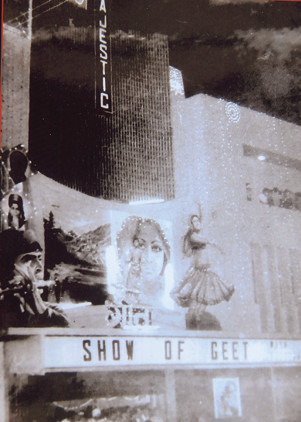
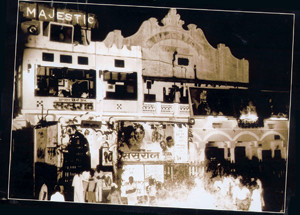
Majestic Talkies in 1929 (right) and in its renovated avatar as the New Majestic Talkies (left)
With the passage of time, good Hindi movies became a popular form of entertainment and hence the number of daily shows were increased. A small balcony was added, supported by pillars in the hall with small boxes reserved for Marwari and Muslim families who respected their privacy behind a purda (curtain). Until 1956 Majestic did excellent business but once Ajmer was made part of Rajasthan, the government put it in reverse gear and the imposition of taxes, free lists, and the interference of government officials impeded the cinema house’s working.
In 1971 the cinema was fully renovated with the government giving the enclosure on lease. A 743-seater cinema hall was created with a new frontage, spacious balcony, cushioned push back seats replacing the earlier benches and steel chairs, and sofa sets installed for use by families in the two small boxes. In 1973 after the passing away of my in-laws I had to take premature retirement from the Army as there was no family member to run the cinema now renamed New Majestic Talkies.
Things were wonderfully hunky dory for us for the next three decades until May 7, 2000 when due to an electric short circuit the cinema house went up in flames. Fortunately the disaster occurred in the wee hours of the morning so no one was injured.
Once again the hall was rebuilt with iron trusses and corrugated sheets replacing the earlier wooden ones, fire proof boards on the sides and a central air cooling system. After the cinema reopened, popular Hindi movies like Gaddar, Kabhi Khushi Kabhi Gham, Khuda Gawah and Mission Kashmir were super hits. Then came the multiplex era and the arrival of two new cinema halls on the outskirts of Ajmer that has relegated Majestic to the third position, the theater being in the heart of the city with no parking space. In terms of audience numbers the business did not suffer because tickets vary from Rs 20 in III class to Rs 40 in the balcony; the multiplex tickets start at Rs 75 and go up to Rs 250.
With my children having settled in Bombay and Poona and my wife Gulnar having passed away in 2008 I am left alone to manage the theater. My younger son Heeraz who did his postgraduation in fine arts from the San Francisco University had produced and directed a short film Birju for his master’s thesis which was nominated for the Students’ Oscar Award.
During the golden years of cinema, the Majestic Talkies was the best theater in Rajasthan. As long as I am alive I would like to keep fresh the memory of my father-in-law and his New Majestic Talkies.
A retired Army officer of the Gorkha Regiment, Maj Noshir Marfatia saw active operational service during the Chinese aggression in 1962, the Indo-Pak War in 1971 and during the intervening years was posted in Kargil, Leh, Jammu, Rann of Kutch, Barmer-Jaisalmer and Sikkim. After his premature retirement he has been managing the New Majestic Talkies started by his father-in-law E. B. Sukhia. With 108 fractures in both his legs that have been treated with 1.7 kg of steel plates, rods and screws, his name features in the Limca Book of Records, 1994 edition.