Hoshang Havaldar, patriarch of Burhanpur’s only remaining Parsi family, is a mine of information on the history, geography and culture of the place
Dilnavaz Bhagwagar
From the granthi at the gurudwara, to the maulvi at the masjid, he was given a respectful salutation, a heartfelt greeting and in places even the keys to parts of the monument, like the hamam khana (bath house) of the Mughal Bagh Palace. Hoshang Havaldar, the patriarch of the only Parsi family remaining in Burhanpur has long-standing family ties with this small town in Madhya Pradesh.
"Kéhvat chhé ké Burhanpur tan ‘K’ maaté prassidh chhè — kéra, kaapas ané kaapad (it is said that Burhanpur is famous for three Ks, bananas, cotton and cotton textiles). There were a large number of Parsis living and working here, years ago. My own family has settled here since the past 100 years,” began Havaldar. "The major industries were ginning mills, cotton yarn, oil mills, iron works and foundries. The Parsis were engaged mostly in cotton ginning and textile mills and they all prospered. We had jashans, navjotes and com-munity get-togethers,” reminisced Ha-valdar.
(Clockwise, from top): Hotel Ambar and Holiday Resort; Daisy and Hoshang Havaldar; family at Jimmy and Jamshed Havaldar’s navjote
"The B. T. Mill (Burhanpur-Tapti Textile Mill) was the fulcrum of Parsi employment and activity,” recalled Havaldar. "My father and my uncle worked there. My uncle was a doctor for the mill management and employees. Aspi Godrej was the manager, Chinoywalla was the spinning master, Eduljee the engineer and Burjor Hansotia, foreman,” said Havaldar in a rush of remembrance. "There was a Pestonjee Pumping — actually his name was Pestonjee Mody. As he was the pumping foreman, in charge of all the pumps atop the water-tanks, he came to be affectionately called Pestonjee Pumping,” explained Havaldar.
With the advent of the polyester yarn, the cotton ginning and weaving mills went into limbo in Burhanpur, as they did the world over from Manchester to Mumbai. "Younger Parsis drifted away, older Parsis passed away,” lamented Havaldar. "I took it upon myself to do jashans and necessary prayers like afargan and farokshi. Ervad Nariman Rao of Indore, "maara guru hata (was my mentor). He taught me these prayers and the efficacy of saying the prayers with devotion, never mind if you were born a behdin or a dastur,” said the man with simple conviction.
"After the cotton and textile industry collapsed most Parsi families left Burhanpur. We might have done the same but for the deep roots and love my grandfather and father had for this place and its people,” said Havaldar. "We decided to set up Hotel Ambar and Holiday Resort on one acre of land. Procuring the land was a battle in itself, with some adversaries making up a whole lot of fabricated claims to pachao (illegally grab) the land.” Overcoming all hurdles, in 1985 the Hotel opened its doors to the public. It was popular and it prospered because of a good ambience, its fine cuisine and very reasonable prices. A few years later they added a swimming pool, which became a much talked about novelty in the town till disaster struck, in the form of a horrific accident. A guest at the Hotel entered the swimming pool, never to come out alive. "It was no fault of the management,” said Havaldar, reliving the painful incident. "But even today more than 10 years after the accident the court case continues. It has drained us of our money, health and peace of mind,” he sighed. Havaldar suffers from acute tinnitus, a condition that causes a continuous ringing and swishing noise in the ear, which drives one crazy. But the man is always smiling and reaching out to help others.
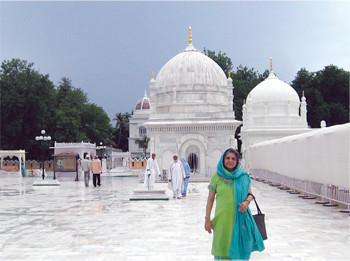
Shereen Heerjee at the Dargah-e-Hakimi, sacred for Dawoodi Bohras
The Hotel complex includes 10 air conditioned cottages and 14 centrally air-cooled rooms. Tariff ranges from Rs 400 for the rooms to Rs 1,800 (inclusive of breakfast) for the cottages. Discounts are available according to the season. The room had a fridge, TV, wardrobe, phone, clean sheets and towels and hot and cold running water. If it lacked a certain urbane elegance, it more than made up in terms of all basic necessities and personal attention.
Since Hotel Ambar serves only vegetarian food, we were invited to the Havaldar home for lunch. Here we met Daisy, Havaldar’s comely wife and their younger son Jamshed. We also went into an inner room to meet and enquire about "mamma” an elderly lady who they treated with great respect and affection. I later learnt that the lady was a retainer who had taken care of the children when they were younger. In her old age, the Havaldars look after her, as one of their own.
On a plot adjoining the Hotel, we visited the home of Havaldar’s kaka (paternal uncle) Dr Meherwanji Havaldar, known as the Godfather of Burhanpur. We could not meet this grand old man, because he was resting. However, we got to meet his bachelor son Shahrukh, the botanist and bonsai expert. On two acres of land, Shahrukh grows thousands of bonsai and other plants. "I grow them for the love of them, not for making money,” he said. A part of the land is devoted to his pets. Shahrukh has rabbits, cows, goats, poultry, parrots, geese and his most favorite pet — Simran the donkey. He caresses her and talks to her as only a passionate animal lover can.
Shahrukh maintains the beautifully landscaped greenery and gardens at the Dargah-e-Hakimi, a most sacred place of pilgrimage for the Dawoodi Bohra Muslims. It has the mazar of Maula Hakimuddin who came here in 1729 to spread the word of the prophet. It is a beautiful edifice in gleaming white-domed marble. The place is so spotlessly clean and well kept, the locals refer to it as "Chhota Amreeka (little America).”
Hoshang Havaldar (1st row, extreme left), at his navjote
Mumtaz interred
Hoshang Havaldar is a mine of information on the history, geography and culture of Burhanpur, barely 20 km from the Maharashtra border. If anything runs deeper than his knowledge, it is his passion for the place. "Burhanpur on the banks of Ma (mother) Tapti, was formerly known as Brighanpur. It was ruled by the Faruqi dynasty. In 1572 Akbar captured the town, mainly because of its strategic importance as dakshin ka darwaza (gateway to the south). For years thereafter Jehangir and then Shah Jehan ruled their kingdom from Burhanpur.
"Mumtaz Mahal, for whom the immortal ode to love, the Taj Mahal was built, lived and died in Burhanpur. She died while giving birth to their 14th child, a daughter. She was interred here and the monument to her was to be built on the banks of the river Tapti. Later, plans changed and her body was unearthed and traveled with the Mughal court to Agra, where again it lay in makeshift maqubarras, till it finally found its resting place in the Taj Mahal. Ahri varas bhatakti rahi (for two-and-a-half years her body found no place to rest),” sighed Havaldar, in remembrance of the queen and of the fact that the immortal Taj Mahal could have been on the banks of the Tapti instead of the Yamuna.
The Mughal Bagh Palace in Burhanpur, also known as Badshahi Quila, has a Diwan-e-Khas and a Diwan-e-Aam set in beautiful gardens, maintained by the ASI (Archeological Survey of India).
A striking structure here is the Zenana Hamam (royal bath for women). It was originally decorated with beautiful frescoes on the ceiling, some of which still survive. "This is an image of an early drawing, a draft you may call it, of the Taj Mahal,” said Havaldar, pointing a torch to light up a faint fresco. Havaldar is part of a group of the intelligentsia of Burhanpur, who have brought out a book in Hindi in remembrance of Mumtaz, titled Veeran Taj Mahal. They also perpetuate the memory of the queen on the banks of the Tapti river, on her death anniversary every year.
Khuni Bhandara about eight km from Burhanpur, is the next point of interest. This marvel of Mughal engineering was made in 1650, to supply water to the city without the use of pumps, from a water source 25 m underground. "The place came to be known by the gory name of Khuni Bhandara because it is believed that some rivalry led to the slaughter of merchants, whose bodies were thrown into the 25 m deep pit, to hide the crime,” explained Havaldar. A tiny electric lift manned by the Madhya Pradesh Tourism Department carries visitors underground to the damp, dark tunnels, covered with limestone deposits.
Rooms at Hotel Ambar and Holiday Resort
"In golden ink”
With a 65 percent Muslim population even today and a history of Muslim rulers, Burhanpur has a number of mosques and masjids. Jama Masjid is located in the center of the town. With symmetrical arches, sparsely decorated pillars and two 136 m minars towering over the domed structure, the Jama Masjid has an austere beauty.
While Burhanpur remains a city of architectural importance, its fame in the present day comes from being a pilgrimage center for Bohra Muslims and for the Sikhs. "The 10th Sikh Guru, Guru Gobind Singh halted at Burhanpur on his way to Nanded,” said Havaldar, as we neared the Gurudwara Sangat. "He spent over six months here, preaching to the Sangat. A hand written copy of the Guru Granth, written by Guru Gobind Singh and signed by him in golden ink is enshrined here,” Havaldar informed us in tones of awe.
In everything he does Havaldar has the solid support of his wife Daisy. She was an Indore girl before marriage and made an easy transition to Burhanpur. Their daughter Jasmine Dalal is married and lives in Poona. Older son Jimmy works in Bombay but is unmarried "because he cannot find suitable living accommodation.” Their youngest son Jamshed and his wife Kainaz lived with their parents till recently. They have now shifted to Poona where Jamshed has joined the Marriot Hotel.
The declining numbers of tourists and a new Madhya Pradesh Tourism Development Corporation Hotel have added to Havaldar’s problems but have not diminished his purpose or his passion — to live in Burhanpur, to run his Hotel and restaurant and to share the knowledge of its history with others.
The trials, tribulations and triumphs of the Havaldar family make a stirring saga of what the community once stood for and what may be slipping away before our eyes — entrepreneurship, initiative and integrity. We certainly need more ‘Havaldars’ to guard against this.
Hotel Ambar and Holiday Resort, Bus Stand, State Highway, Burhanpur 450331, (MP) India. Phone: 07325-251197/255154. Mobile: 09424024949. E-mail: hotel_ambar@ rediffmail.com