Aristocrat and industrialist Sir Hormusji Mody once presided
over Government House in Uttar Pradesh
These edited excerpts from A Journalist Reflects by S. K. Rau, former editor of The Searchlight, Patna, provide details of the tenure of Sir Hormusji (better known as Homi) Mody who was appointed governor of Uttar Pradesh (UP) after the sudden death of the incumbent Sarojini Naidu in the early years after India became independent.
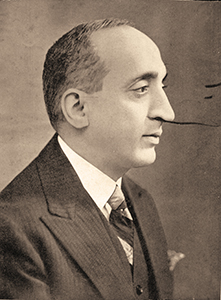
Hormusji Peroshaw Mody donned several roles and professions with aplomb and ease. Yet, public affairs and politics appear to have been his first love. A postgraduate in literature from Bombay University, he became a lawyer at the age of 30. Prior to this, his essay "The political future of India” attracted a lot of interest when it came out in book form.
He was also elected as a corporator, Bombay Municipal Corporation and remained so for the next 29 years enriching its deliberations. After a decade in the legal profession, Mody cast his eye on the textile business. Just two/three years before the great depression engulfed America and the Western world, he became chairman of the Mill Owners’ Association. (He was later to head the Employees’ Association.)
He vigorously campaigned in favor of protective tariffs for Indian textiles to ward off unfair competition from Japan and Lancashire, UK. Result: The Lees-Mody Pact, providing for higher import duties on British textiles in return for larger exports of cotton from India. The deal struck by him with the British invited the wrath of nationalist leaders who condemned it as a "sell out.” Given the nature of the Pact, UK and the Indian textile magnates also benefited, but the Japanese lost out. In 1941, he was appointed to the Viceroy’s executive council with the key portfolio of supply.
When Mody headed the textile industry, Nehru was highly critical of him. Yet, it is a measure of the tolerance of the years immediately following independence that while appointing a successor to Sarojini Naidu as governor of Uttar Pradesh (UP) following her sudden death, Nehru willingly endorsed Sardar Vallabhbhai Patel’s selection of Mody.
Mody was conscious of the constitutional role he was required to play, but he was able to introduce an element of subtle innovation and originality in his style of functioning. He was an eloquent speaker and had a vast repertoire of humor and wit at his command.
When the author sent a copy of the book Sarojini to Giri to Mody, the latter thanked him for making references to only the least harmless pieces of his humor and jokes!
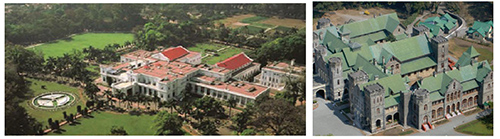
(Top): Sir Homi Mody; (above): Government House, Lucknow (left) and governor’s residence in Nainital
(L-R): Mody with Jawaharlal Nehru; Minoo Masani, C. Rajagopalachari and Mody
Mody, the aristocrat
The appointment of Mody as governor of UP came as a surprise, although it was in accordance with the pattern of Patel’s policy. No Press speculation had hinted at Mody as a probability. Nevertheless, it was widely welcomed. Mody was a liberal with progressive ideas, and in the days of the British was known to be a nationalist. He was a member of the governor-general’s executive council, but resigned along with N. R. Sircar and M. S. Aney when Mahatma Gandhi undertook a fast.
The home ministry appoints provincial governors. Patel as home minister had his own policy in regard to these appointments; it was evidently more liberal than the one followed now. He took care to select the right type of men for the job. He was not in favor of conferring governorship on superannuated partymen. For Madras, he selected the young Maharaja of Bhawanagar, a scion of the princely order and for Bombay, Sir Maharaj Singh. The practice was to ask the chief minister and obtain his consent before announcing the appointment. The cabinet did not come in the picture and so these appointments were kept secret till the last moment.
A very small gathering was present at the Lucknow station when governor-designate Mody arrived accompanied by his wife and daughter-in-law. The practice of rolling out the red carpet had been done away with. Mody was not a leader in the accepted sense of the term and his arrival did not attract huge crowds.
The Ball Room of Government House witnessed another swearing-in ceremony, but the contrast with the one held for Naidu was glaring. This time it was purely official, sober and highly dignified. Mody discarded his western dress and put on the national dress, white pants and black sherwani with a black cap. He repeated the oath of office in faltering Hindi reading out from a Roman script transliteration. By his side sat his wife Jerbai dressed in Parsi attire. After the brief ceremony, the governor’s secretary Bhatnagar displayed his amazing memory by introducing 500 guests without the aid of any notes!
Hawk-eyed Mody detected a familiar face in the crowd of officials. He walked up to him and asked, "Do you recognize me?”
He was S. N. Aga, senior superintendent of police of Lucknow city.
"Yes, Sir.”
"Any trace of my silver-plated mug?” asked Mody.
"We tried our best, Sir, to trace the culprit but didn’t succeed,” said Aga, embarrassed. He was totally unprepared to be greeted by the head of the state in this fashion.
"Never mind. Don’t worry,” said Mody laughing.
Six months earlier, Mody had come to Lucknow to attend a Labor Advisory conference and was putting up in a hotel. That night his room was burgled and the intruder walked away with his favorite silver-plated mug, a gold chain and watch. Mody told newsmen that it was his costliest weekend, the loss being Rs 1,500.
Mody’s broadcast to the people of UP immediately after assuming office — a ritual for every governor — was the briefest gubernatorial radio talk, only 400 words. It was a simple, straightforward talk by a robust realist.
Mody himself had described the life of a governor while addressing the Lucknow Rotarians. He said:
"When the position was offered to me, I must confess I was not keen on exchanging an active life, full of opportunities for work in many and varied fields, for one which I dimly conceived to be one of ease and dignity and of little else. Kind friends suggested that since I was overdue for retirement, I might as well become a governor. Whether it was that consideration, or some idea that even a constitutional governor had a useful role to play that influenced me in coming to a decision, I cannot say, but I came.
"One of the first things I discovered after I took office was that I was promulgating an alarming number of laws and ordinances. Every now and then I would read in the newspapers that his Excellency the Governor was pleased to order this, that or the other thing. So I sent for my secretary one day and told him that I had no recollection of having ordered anything. He smiled respectfully and said that under the constitution, the minister decides and the governor orders!
"I shall not tell you what I thought of the constitution when I heard that, but I soon got used to having all manner of decisions fathered on me, and felt some consolation in the reflection that at least those who did not know might think that was a very active governor at the head of affairs.
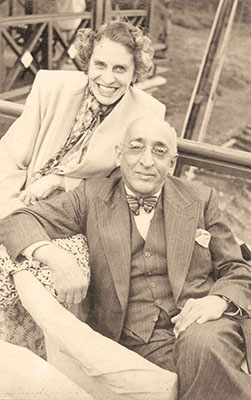
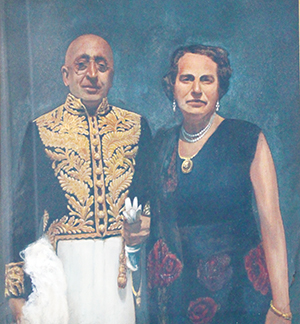
Sir Homi and Lady Jerbai Mody
"After the first few days during which I dutifully acknowledged every letter or telegram of congratulations that was sent to me as I had little else to do besides acknowledging the salute of the guards at the government house and the policemen on point duty, work started coming in. I suppose my ministers were watching me from a distance and making up their minds about how much to pass on to me. All manner of reports and other papers came pouring in and soon the files on my table assumed respectful proportions. Requests for presiding at functions followed. At every one of these I was expected to make a speech.
"It may interest you to know that I am one of those individuals – alas, a little out of fashion in our country – who have a certain facility for speaking but who hate to have to employ it, and I cannot tell you how many times in my career I have denied myself the pleasure of hearing my own voice.
"In my present position, however, I am finding it very difficult to avoid talking, and even when I stipulate in advance that I should not be called upon to speak, and the item is cut out from the program, an address of welcome is presented or my toast is proposed, which compels me to get up and say a few words.
"I should have thought that with so many leaders, ministers and public workers haranguing us every day of the week, the appetite for listening to speeches would be satisfied, but some form of curiosity, for which I cannot find a label, seems to be impelling people to insist on a speech on every conceivable occasion. This habit of mine is threatening to become a national vice, but what can a poor governor do about it?
"Another of my tortures is the number of ‘messages’ I have to send to all manner of individuals and institutions. They embrace a large variety of occasions, and it is quite usual for me to be asked to send my blessings to someone who is getting married, or reaches his 60th or 70th year, or is about to start a periodical.
"There are some odd requests, too. I have been asked to find a name for someone’s newly born daughter, and actually, on two occasions, I have received a letter urging me to recommend the writer for appointment as governor. I can tell you this was a great blow to my vanity. My services are also occasionally sought as a match-maker.”
The long quotation from Mody’s speech is cited to show that popular notions about the role of governors have not changed since the days of Curzon who recorded in his diary the numerous letters that he received requesting all kinds of help. He made particular mention of a strange letter that he received from a mother of seven children. Requesting help to maintain the children, the woman ended with: "You have to help me because you are the father of these children.” Curzon admitted that, for a moment, he was taken aback.
One can understand the ignorance of the common man, but it is strange that even learned bodies display colossal ignorance regarding the role of governors. "Most of them do not seem to bother about the constitutional position of the governor. They still think that as a man above the rough and tumble of party politics, he can take a dispassionate view of problems and grievances. They regard him as a sort of appellate authority for readers. I have seen this over and over again in the districts, where all manner of people come to me and pour out their troubles,” says Mody, who made his position clear to everyone.
Governor-General C. Rajagopalachari once compared the governor to a temple tower which keeps the gods inside safe from exposure to dust and dirt. Mody went a step further and said that a governor is like Trisanku whom Rishi Viswamitra elevated to the heavens, but the gods in their anger hurled him back. Through his supernatural powers the irate Rishi prevented him from falling to the ground and the legend says that he is still wafting aloft.
Style of functioning
Himself an aristocrat, Mody restored Government House to its old regal splendor. In every sense, he was ‘Lord sahib,’ a term by which the British governors were called.
Mody took his work seriously, but the constitution had not yet been finalized and he had for guidance only the orders issued by the governor-general on Independence Day.
Lucknow University students, after kicking up a row with the authorities, once stormed Government House, stopping Mody as he was stepping out of his car. Presenting their demands, their leader told Mody, "Lord sahib, you must issue an ordinance immediately to set things right.”
Mody coolly asked him, "Do you want me to lose my job?”
The students were taken aback, but they were made to realize the limitations of a governor and quietly went away.
Mody was in the habit of going through every letter. He would add a personal touch to his replies by making some inquiries so that the recipient could feel that it was not a formal reply to which Mody had blindly affixed his signature. To the typed letter, Mody would add a personal note towards the end in his own hand.
The number of visitors to Government House during his regime may have been small, but the hospitality was lavish in true aristocratic style.
Mody’s day began with looking at the visitors’ book. The book itself is a study in human psychology. It is strange that the British, who kept up regal splendor for the occupant of the gubernatorial gaddi (seat), did not devise a better visitors’ book. It is just an ordinary register like the ones that office peons carry while delivering letters, with columns for name, occupation and duration of stay.
Most signatories prefer to sign in English. A poet from Almora had filled an entire page, listing several publications to his credit. A Mussoorie man had dubbed himself an artist, another from Chakrata called himself a progressive writer. Judging from the Government House visitors’ book, poetry, painting and sculpture seem to have their abode in the hill regions of UP alone, with no entry from the plains!
It was a pleasure to hear Mody. His speeches would begin on a humorous note and end with a slight rebuff, particularly when addressing businessmen or local bodies. His speeches were short, never took more than 10 minutes, and always lent themselves to catchy newspaper headlines.
The Allahabad Municipal Board, while presenting him with a welcome address, complimented him to such an extent that Mody was provoked to say: "Your description of me reads almost like a perfect obituary notice, and I cannot tell you how deeply I appreciate it.”
The Board, in its lengthy address, presented a long list of grievances against the government for indifference to the city of Allahabad. After replying to all the charges, Mody said, "Having put the government in the dock, I think it is your turn to take your place there.” And he started berating the Board for its failure to implement the resolutions passed and its lapses in attending important civic needs of the city.
The fact that he belonged to no party gave Mody strength to do plain speaking. To the students of Allahabad University Mody said: "Here in India we eat, drink and sleep politics and I can understand your doing a bit of shouting and parading of slogans, but why not do some thinking as well?”
Governors need to address all sorts of organizations, but a careful study of Mody’s speeches shows that he was in the habit of making a judicious selection of the invitations. In every one of these addresses there is a gem of wisdom clothed in a humorous vein.
Addressing the Bee Keepers’ Association of Lucknow, he said: "I have struggled manfully with the demands made on me from time to time and I thought I had exhausted practically every subject under the UP sun. Now you want me to talk about bee keeping in the local municipal schools. If you could extend your activities to colleges, what new vistas that would open out! Imagine the use to which a few beehives judiciously placed can be put whenever any section of students gets into frolicsome mood and seek to order principals and professors about. I make a free gift of this strategic concept to all concerned.”
In July 1950, there was a sudden shortage of consumer goods and prices began to skyrocket. A conference of traders and shopkeepers was convened at Government House. Mody castigated them to such an extent that it had a salutary effect on the prices. No governor, even in the days of the British dared to say such things.
Although Mody scrupulously refrained from interfering with the decisions of the cabinet and maintained cordial relations with chief minister Pant, there was at least one occasion when he exercised his rights. The announcement of the names of new ministers was made before he was actually informed of it and he took exception to this. Though it was not intentional, constitutional propriety had not been observed. Pant, it appears, made ample amends.
The governor of UP is also the chief rector of Banaras University and in that capacity has some say, although without any powers. Banaras University had troubles even before Mody’s term. A certain gentleman maneuvered to become the vice chancellor through a series of manipulations. Constitutionally, it was correct, but Mody took strong exception to the way in which it was done. So he chose to return to business, thereby sacrificing governorship.
In a farewell broadcast he said: "It is not sufficiently appreciated that there is a fairly wide field in which the governor can function with advantage to the state of which he is the head and that even in the sphere of administration his duties are not confined to receiving files and reports and signing the papers which are placed before him. I have scrupulously refrained from transgressing the limits of my authority and have left it to my ministers to make what use they thought of such experience and advice as I may be in a position to give.”