History, music, architecture and beauty abound in Austria
Dilnavaz E. Bhagwagar
Melodious music, graceful dancing and Vienna the capital of Austria, are inextricably linked. Thirty years ago on our first visit there, I remember dancing the Viennese waltz in a salon in Vienna, going round in unending magical circles in my partner’s arms.
Those memories came floating back to me as we left Budapest by motor coach, driving over the Buda hills and crossing over the Hungarian border into Austria.
After a lunch of soup, slow roasted pork and potatoes, we set off for an afternoon of sightseeing on the famous Ringstrasse (Ring Road). But the highlight of that day was to be a classical music concert at night.
Power and grandeur unite on the Viennese Ringstrasse. Luxury hotels, museums, the opera house, Parliament building and the stock exchange, set amid several parks and tree lined streets, make this an unforgettable experience. The flamboyantly designed homes of rich (mostly) Jewish bankers and industrialists are also located here. The five km long and 57 m wide boulevard was inaugurated on May 1, 1865 by Emperor Franz Joseph and Empress Elizabeth. In 2015, when we were there, the Ringstrasse was celebrating its 150th anniversary year.
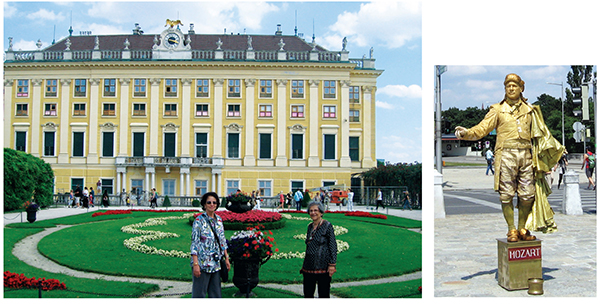
Schönbrunn Palace with Dilnavaz Bhagwagar and Ava Khullar in foreground;
(right): Mozart, not a statue but a costumed man posing as one
The Wiener Mozart Orchestra Hall
After three hours of sightseeing, getting on and off the coach, listening and looking, we barely had time after reaching our hotel to change into our formal best for the evening at the Wiener Mozart Orchester. Tickets at Euro 75 a seat were expensive, but worth the experience. Also, as they were already paid for as part of the coach tour cost, the expense was of fleeting concern.
The tail-coated, white-wigged conductor and musicians enthralled with mastery over their instruments. Dressed as they would have been in the days of Mozart, they took the audience back in time with the beautiful sounds emanating so effortlessly from their violin strings. An altogether delightful two-hour evening with a 10-minute intermission.
From what I have seen of palaces and royal residences, only Catherine the Great’s Summer Palace in St Petersburg surpasses the Schönbrunn Palace in Vienna. Built in the Baroque style, this former Summer Palace of the Hapsburgs is a combination of elegance and grandeur. If you want to be knocked over from your chair, consider this… the palace has 1,441 rooms! Imagine what would happen on a day when the staff did not come? The public is taken on guided tours (either ear-phones or personal guides). The walls and ceilings have white lacquered surfaces, with the raised ornamentation covered in gold leaf.
In the Blue Salon, Emperor Charles I signed his abdication papers, relinquishing the crown in 1918, bringing the curtain down on 640 years of Hapsburg rule in Austria. Today Schönbrunn Palace is a United Nations Educational, Scientific and Cultural Organization heritage site.
The gardens at Schönbrunn are beautiful and complement the Palace in such a way that architecture and nature weave an unbroken tapestry of beauty, color and contrast. The gardens and the palace have been used as the location of many films and TV productions.
Austrian wines are very good and are served with every meal. If one asks for a beer or whisky they will provide it, but with a very disapproving look. Light and fruity white wines like Grüner, Veltliner and Zinfandel are popular and do well in the cooler temperatures. A vineyard secret that we were unaware of was revealed to us in Vienna. A rose bush is planted in front of a vineyard because the fungus that attacks the grape vines will also attack the rose bush. This acts as a warning so that precautionary measures may be taken by spraying and protecting the grapes before they are damaged.
At most places on a tour, the last day or half-day is billed as a ‘day at leisure’ which in Parsi parlance means TTF or Tamé Tamaru Fori-lèvo (manage by yourself). A visit to St Stephens Church, walking distance from the Vienna Hilton where we were staying, was suggested. We proceeded to the beautiful edifice and were moved by the tall arched ceilings, the stained glass and the statues, the altars and the adoration, the reverence and the religiosity that envelope the people and the place.
After a leisurely walk through the town square, posing for pictures with the beautiful horse carriages and handsome drivers and eating lunch at one of the many open air pavement cafés, served by girls in Bavarian skirts, it was time to say "Goodbye, Vienna!”